
Collector's Guide: The "OG" Vulcain Cricket
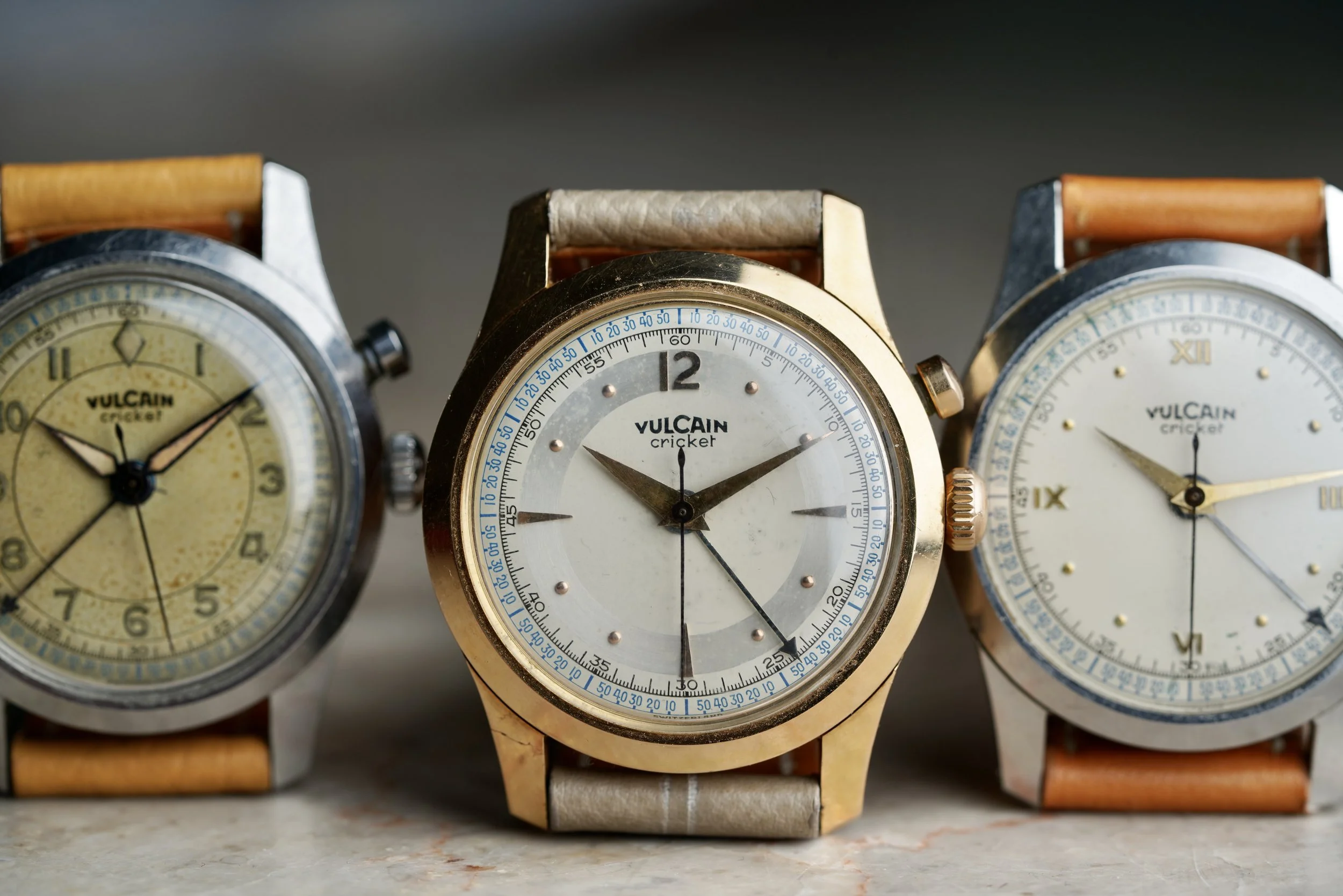
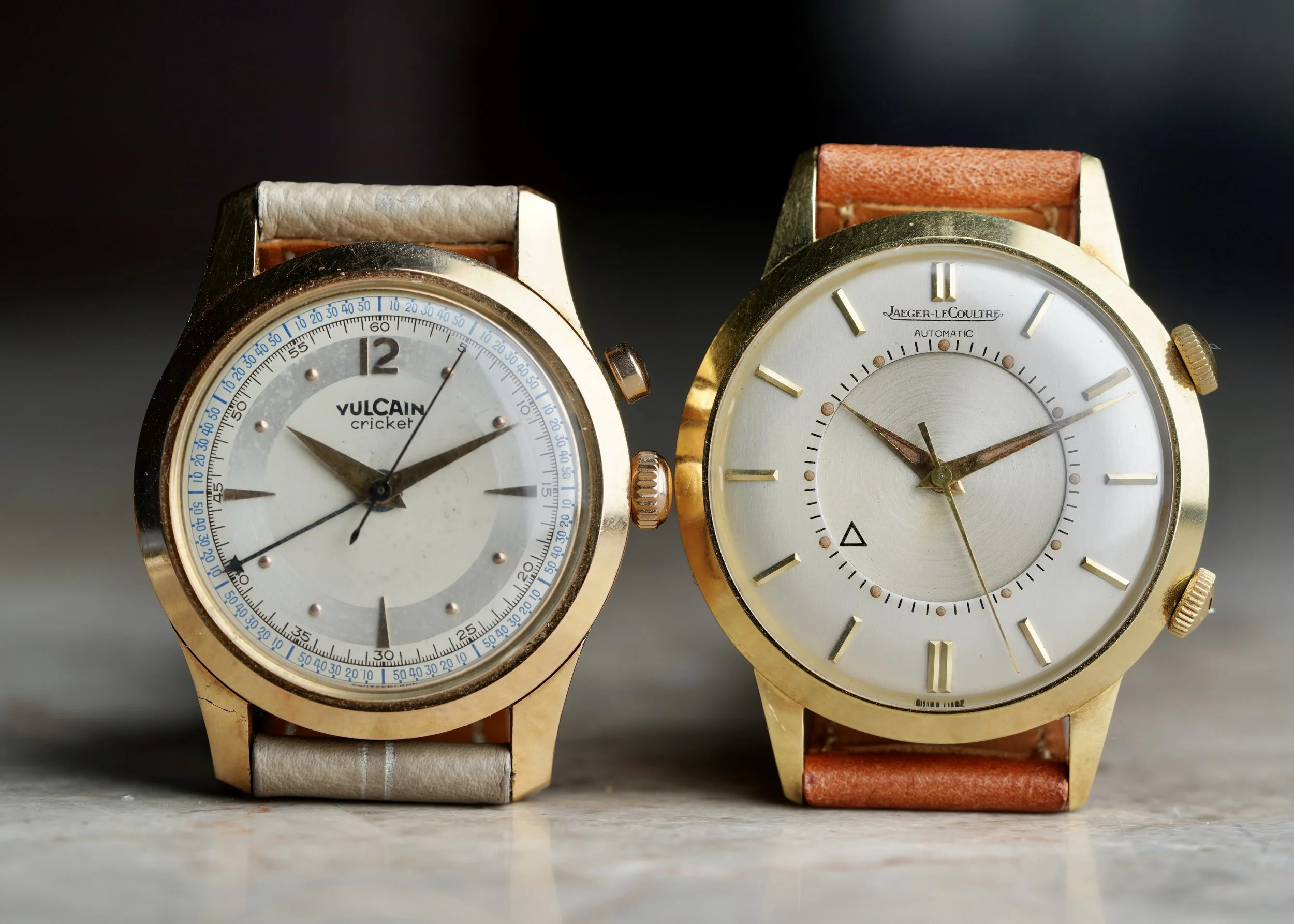
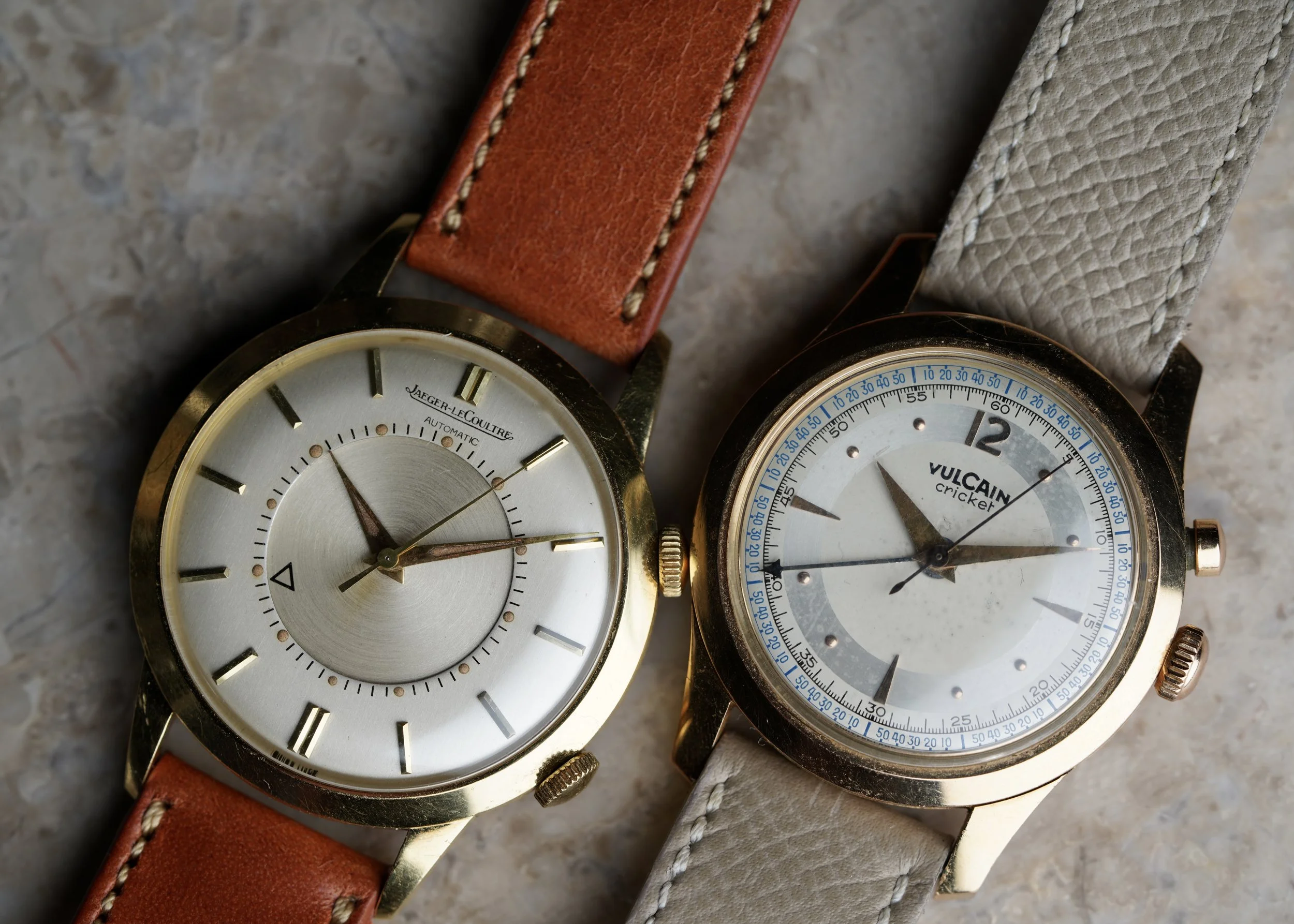
The Cricket has been one of my favorite vintage watches and a first love in vintage alarm watches. When I first met Eric, I was pleading with him to find me a Jaeger-LeCoultre Memovox reference E 855. Sadly, the only one he had for sale was a cushion-case model (YUCK). However, he circled back with me to recommend I wait for a Memovox and take advantage of a tropical-dial Cricket (the watch that would later be the feature in a Hodinkee article).
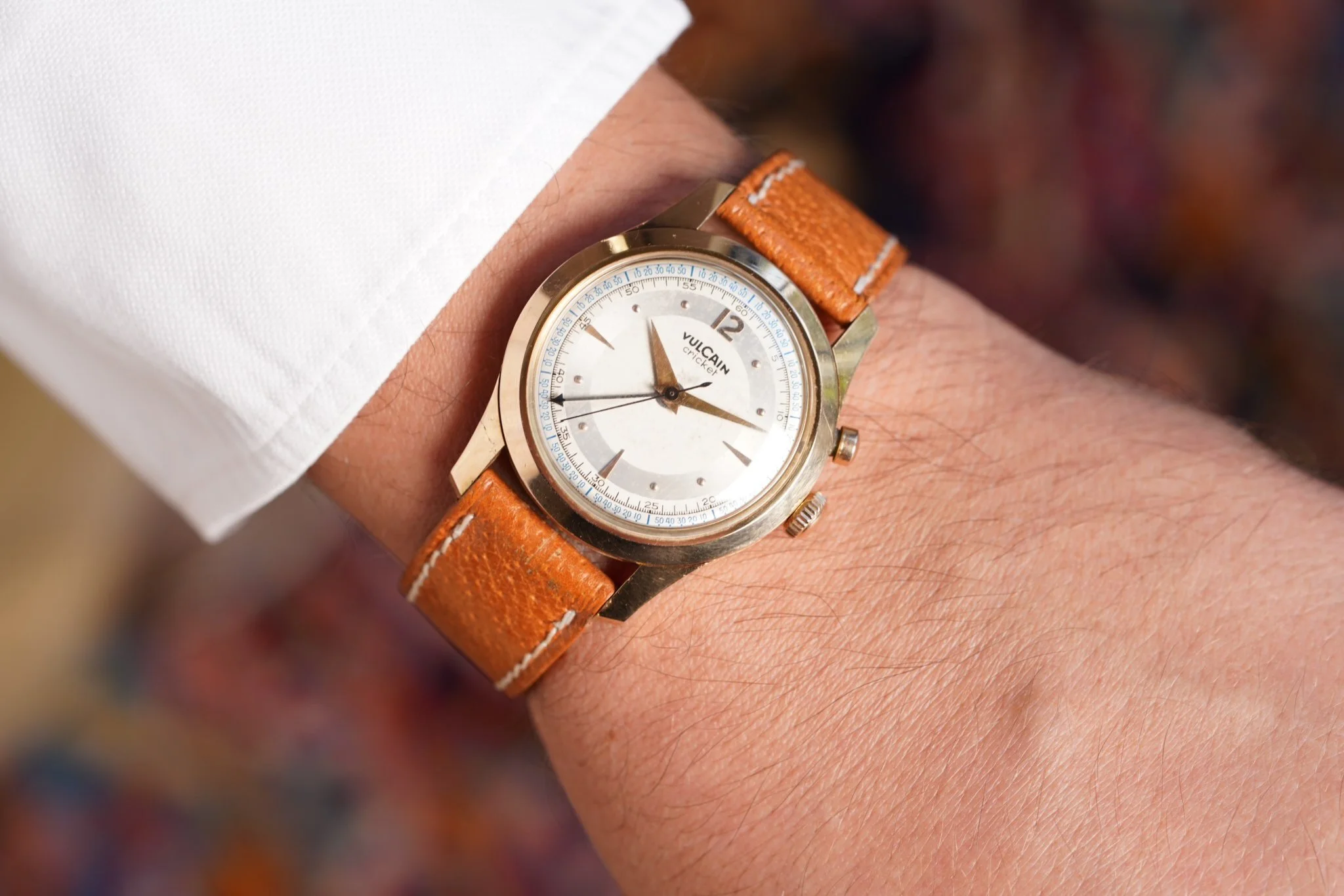
The Vulcain Cricket one of the coolest vintage watches bar none. You can say the Cricket is a great value, but regardless of the price, it is an amazing technical achievement and great vintage watch. The original Crickets (or OG) dating as early as 1947 and probably in production to the early 1950s have great case designs and wear larger than the notional 34mm diameter case size due to the thickness and robust lugs. The real highlight for me are the Stern Frères dial variants that are incredible quality. Of course, the main attribute of the watch is the incredible movement (the calibre 120) created by Robert Ditisheim and the Vulcain team over the course of nearly a decade. The Cricket was the first alarm watch for the wrist loud enough to wake up the dead, but it was more than that: it was the gateway drug that got Charlie Dunne and Eric Wind into vintage-watch ownership when they were living paycheck to paycheck. Thank goodness times have changed, but Charlie and Eric’s love for Crickets endures (until the end of time).
I have had my fair share of Vulcain Crickets over the years and for me there are three case designs that I find to be the best: 1. The Nautical Crickets, which are easily the grail Cricket models and largest alarm-dive watch from the brand. 2. The Jumbo Crickets (references 301001 and 303001) which have the largest case design from the 1950s in Vulcain and potentially one of the best case designs from any manufacturer of this era (a argument I am willing to debate over with other collectors). And of course, 3. the subject of the current article: the OG Crickets!
Honestly, there are not a wide range of high-quality watches from the 1930s-1940s. Of course, there are some from the famous brands: Patek Philippe, Audemars Piguet, Vacheron Constantin, Jaeger-LeCoultre, Breitling, Heuer, and Rolex (and Cartier if you are into small jewelry watches), but there are many “junkers” from this era, as well. The Cricket is a standout alongside models like the Gallet Flying Officer, various Longines Tre Tacche, Longines Sei Tacches and other watches with fantastic cases, movements, and outstanding dials.
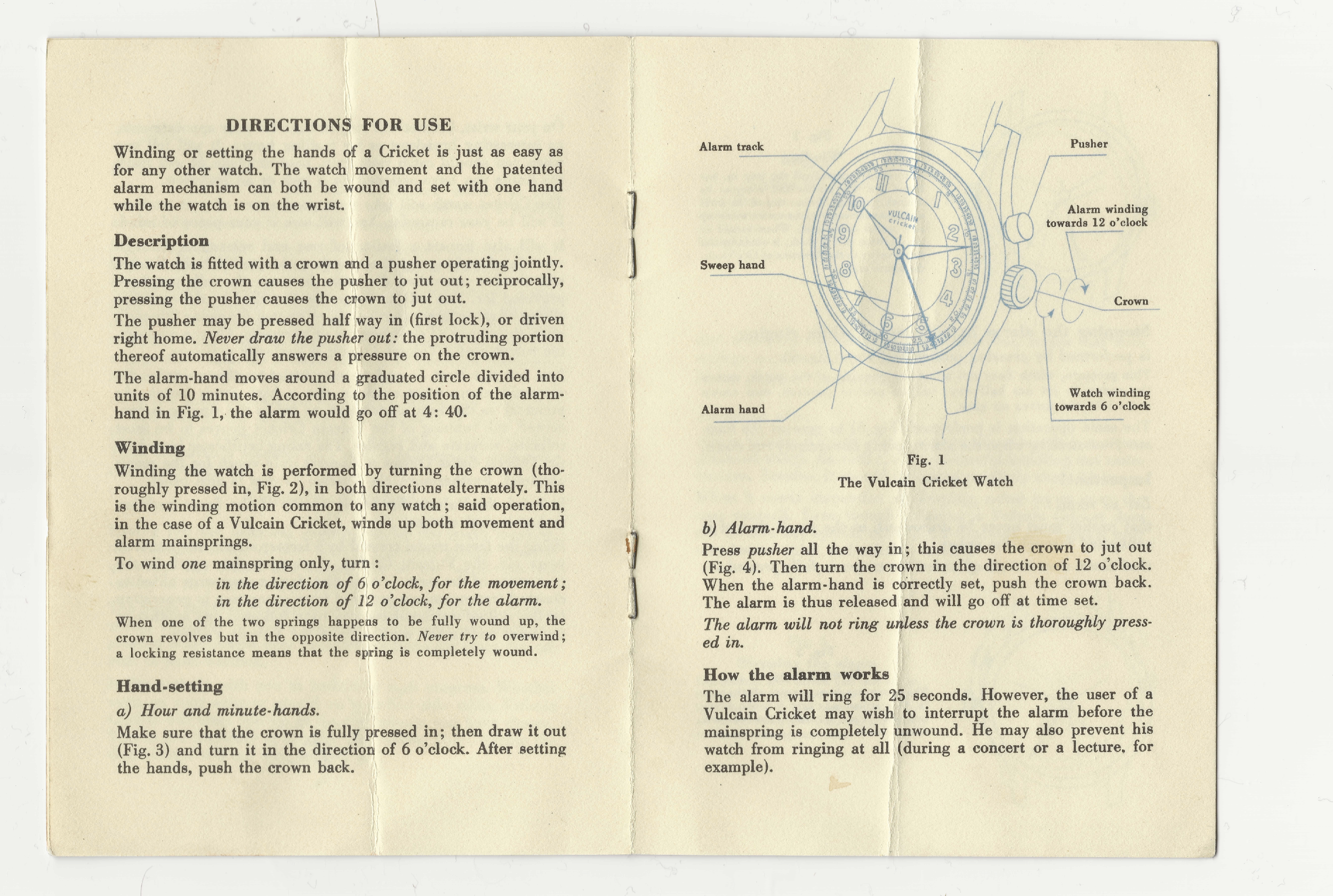
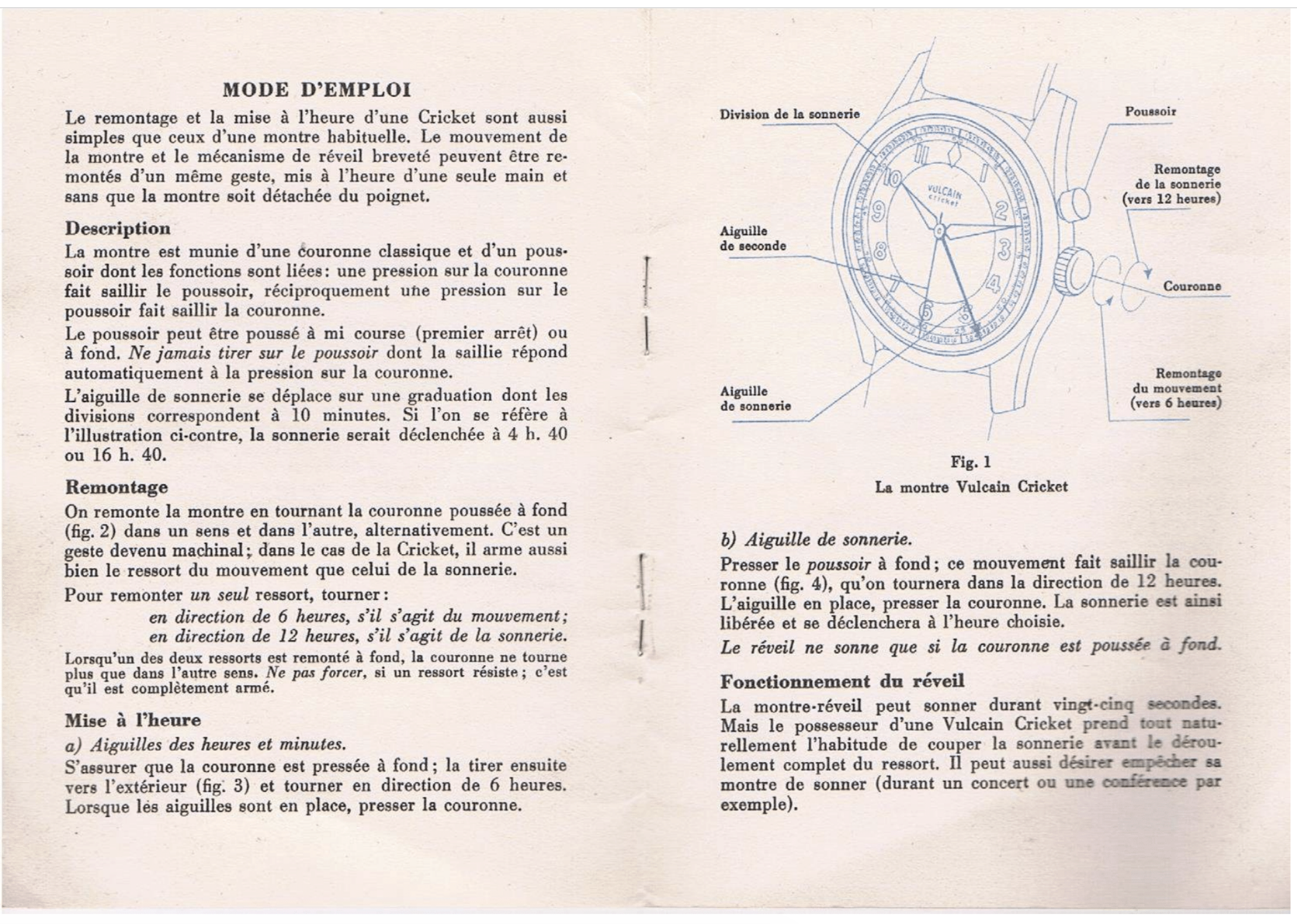
How To Use A Vulcain Cricket
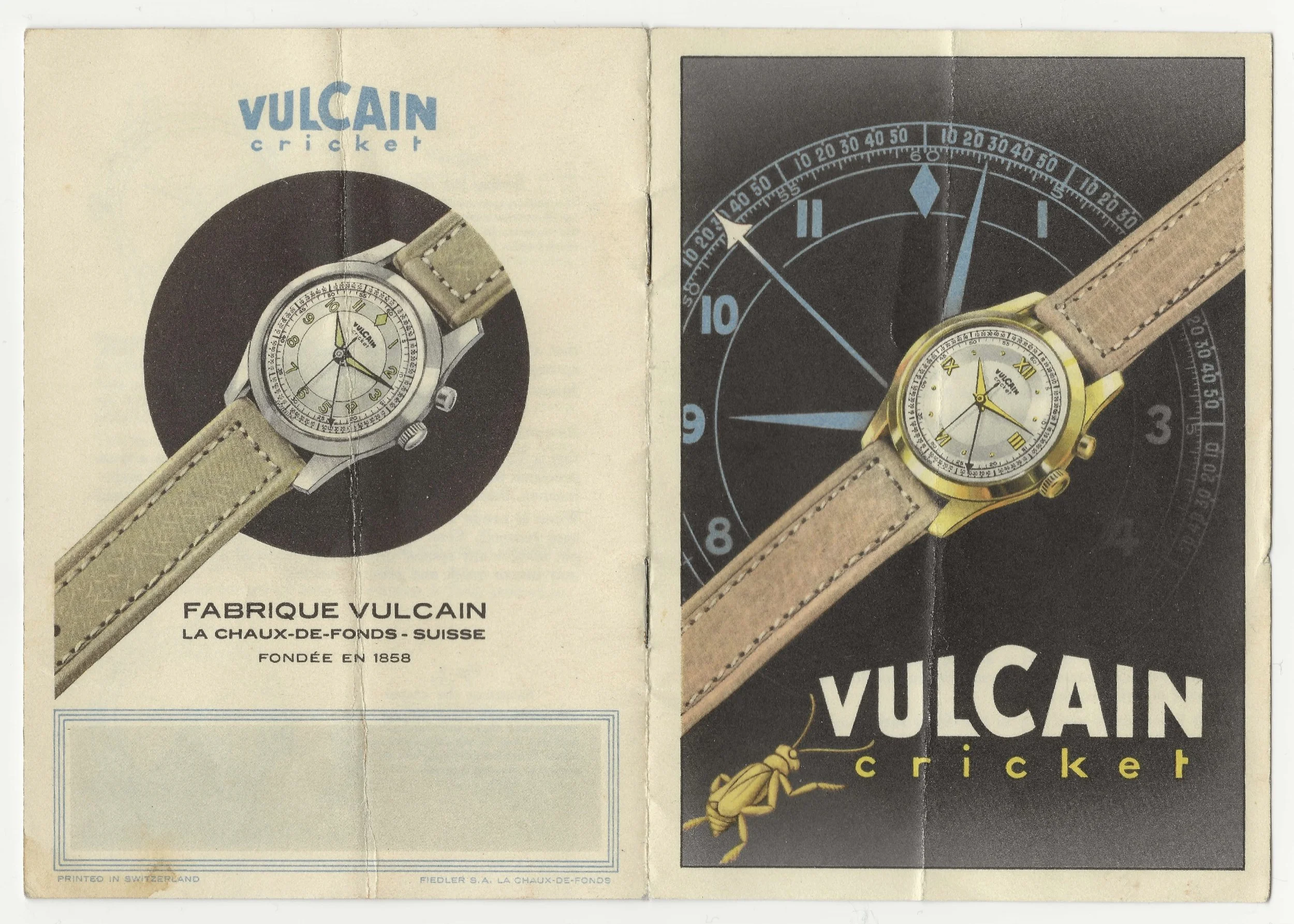
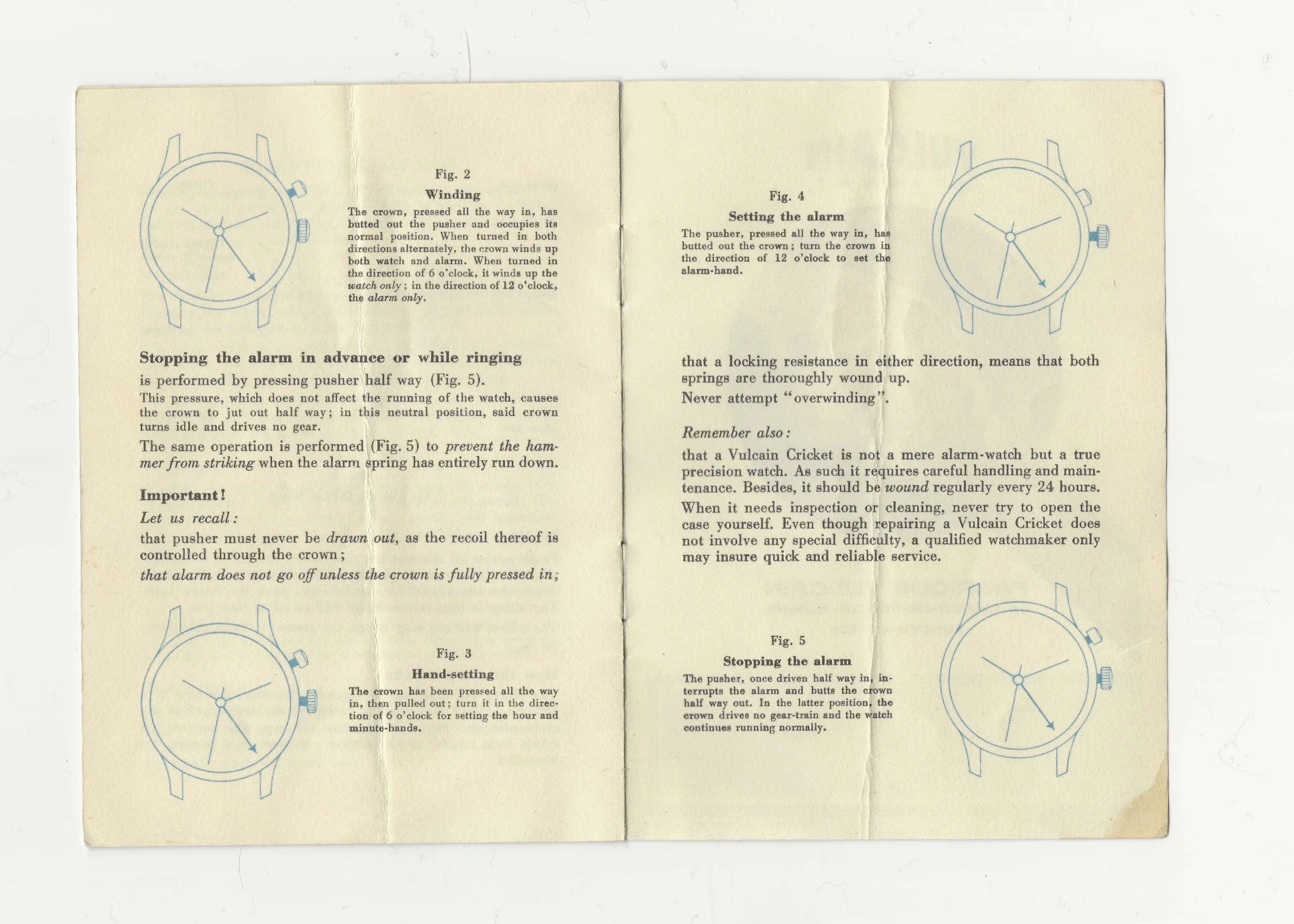
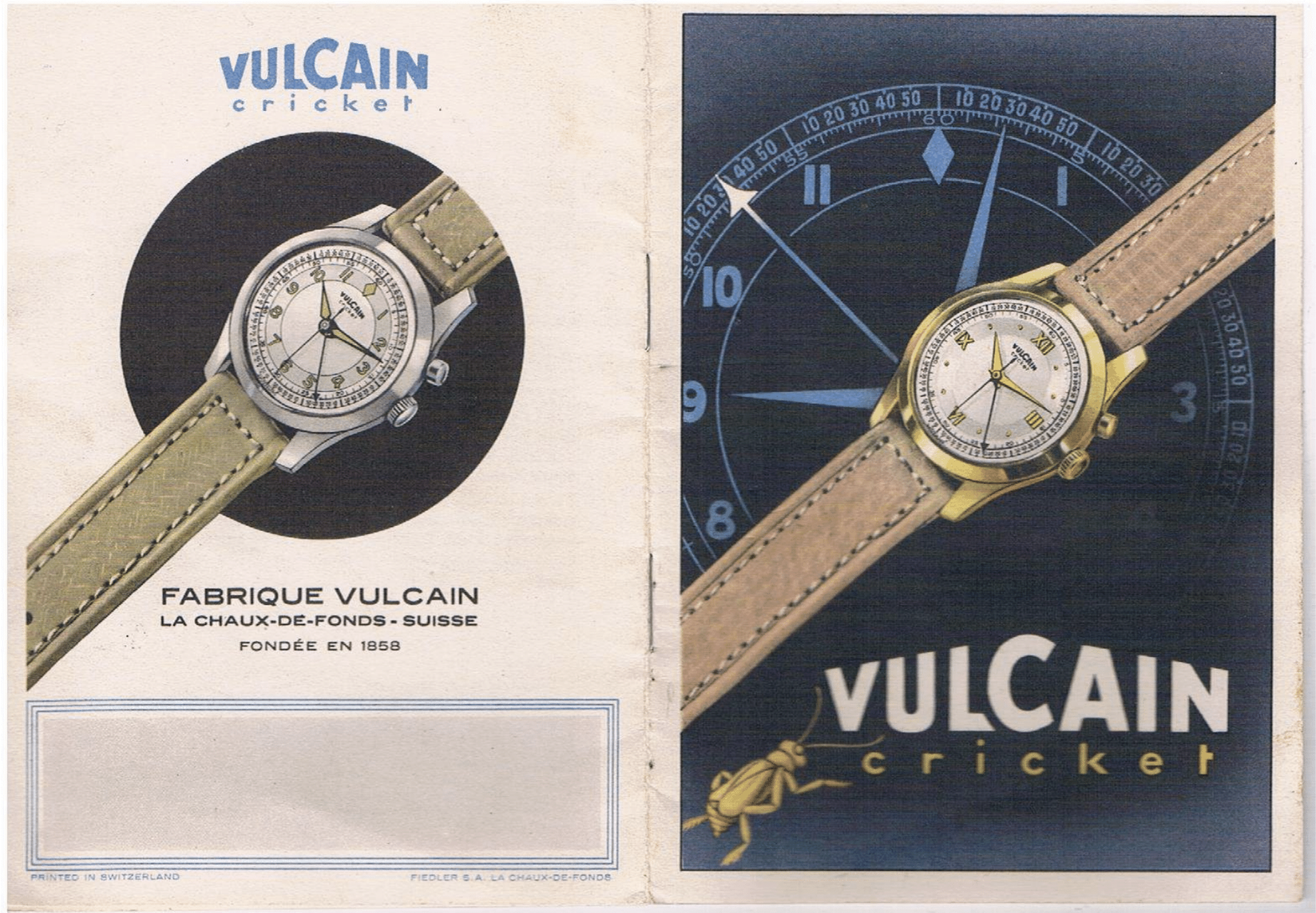
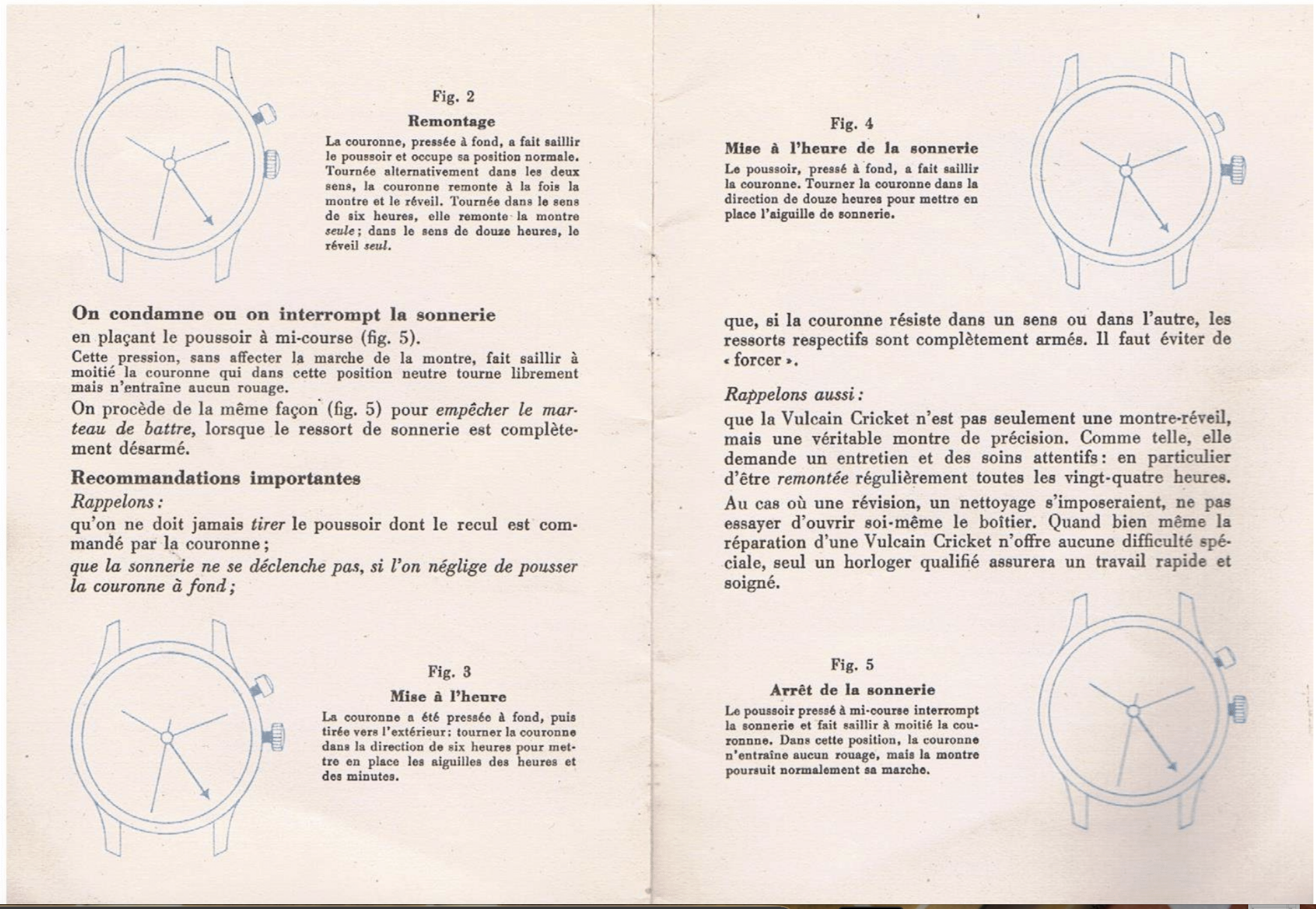
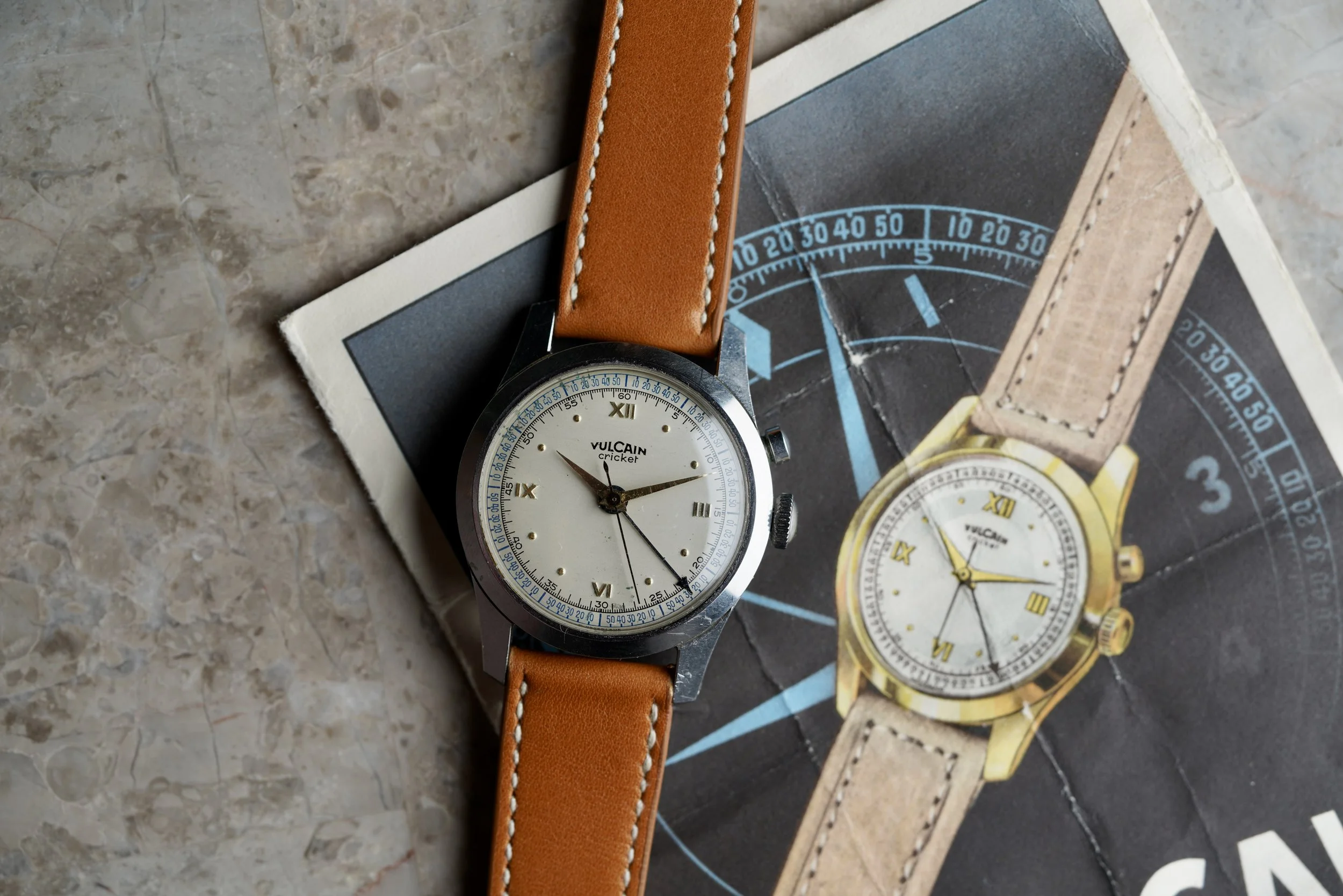
Often when someone purchases a vintage Vulcain Cricket from us, they are eagerly excited by the watch and cannot wait to set the alarm to remind them of obligations throughout their day. It is not uncommon that we soon receive a phone call or text asking for a quick tutorial on how to operate the Cricket is requested after delivery. This is a fun part of the process. Below is a 1950s Vulcain Cricket booklet highlighting the instructions for the groundbreaking alarm watch. The booklet features two versions of the earliest “OG Crickets” - the cover illustrated with a solid gold Cricket with applied-Roman numerals and sector dial, while the back page contains a stainless steel example with an “LBJ” dial. If you have been sent this article and still need to hop on a FaceTime, please dial me up now!
Winding the crown counter-clockwise powers the Vulcain Cricket’s movement.
Winding the crown clockwise powers the alarm.
You can only move the time on the watch forward.
By pulling the crown out two positions, you can then wind the crown clockwise advancing the time.
To set the alarm hand to a reminder time, first push the crown in completely. Then press the pusher in all the way (generally you will feel two clicks). At this point, you can wind the crown clockwise which will cause the alarm hand to rotate counter clockwise (you can only move the alarm hand one direction also). You are then able to set a reminder up to 12 hours away.
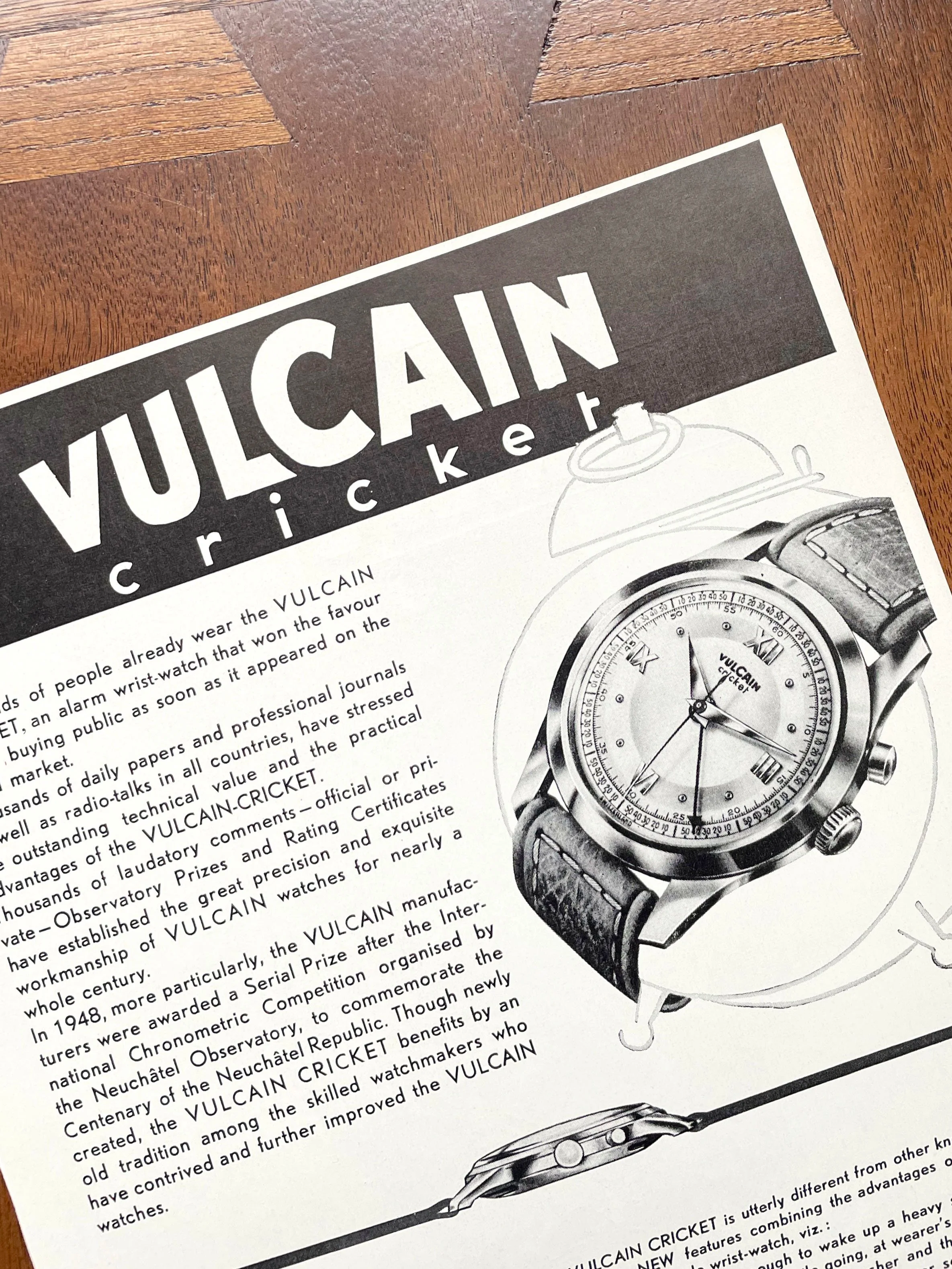
1948 Image credit: grail-watch.com
Advertisements & Marketing
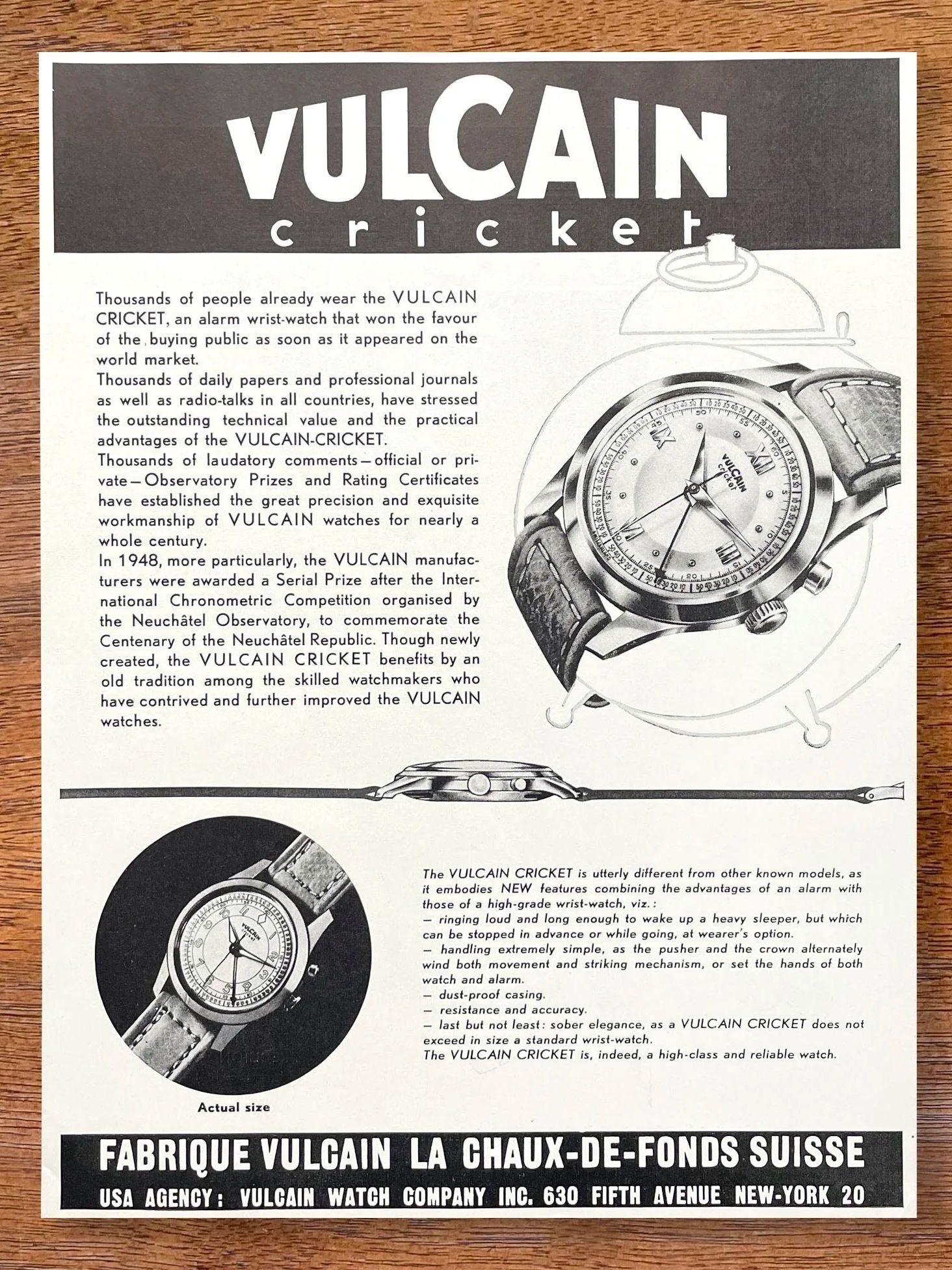
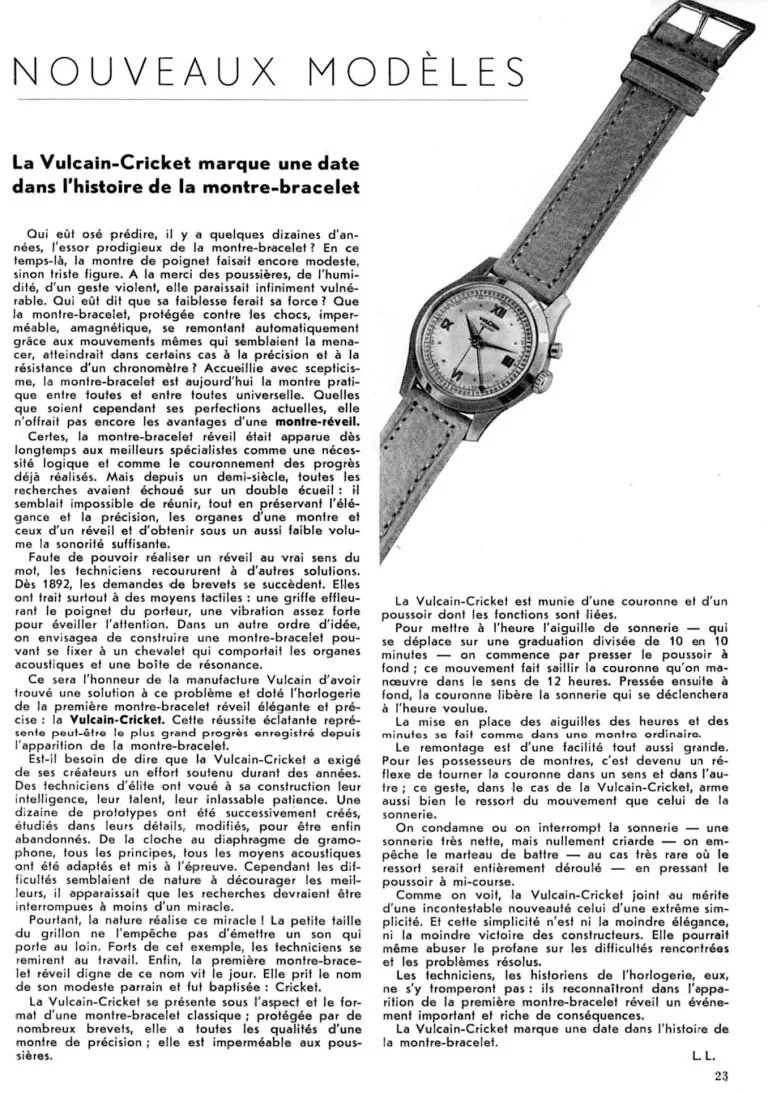
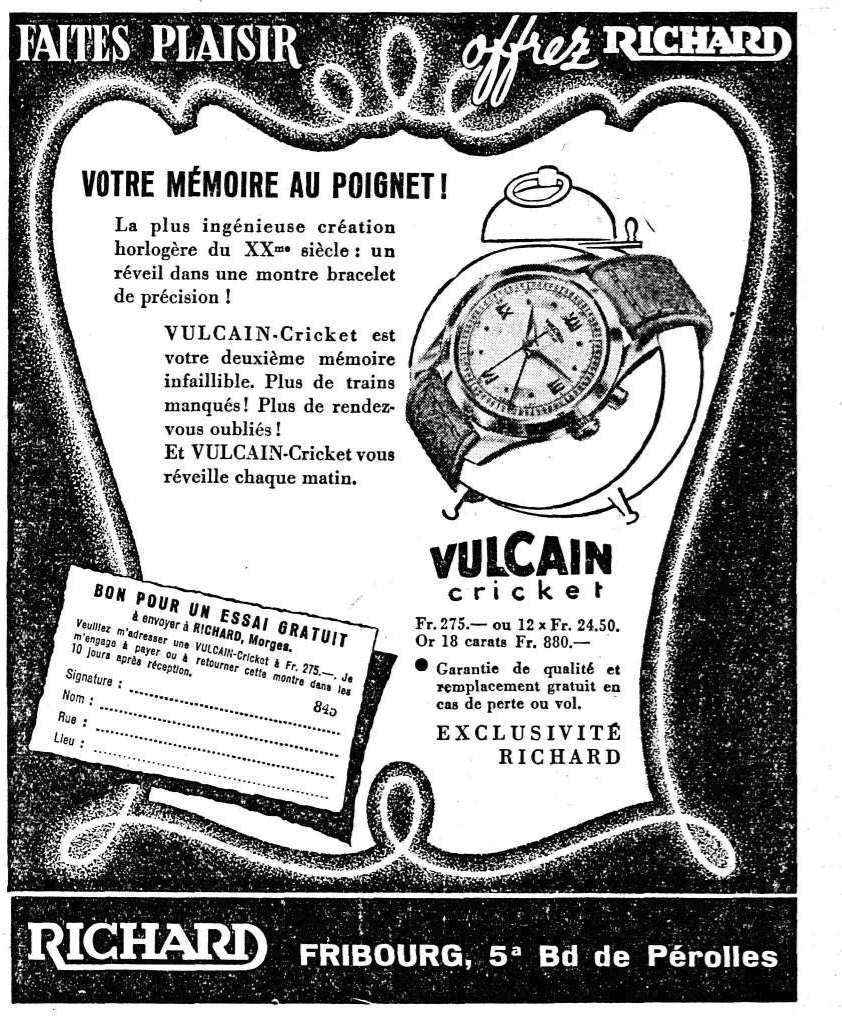
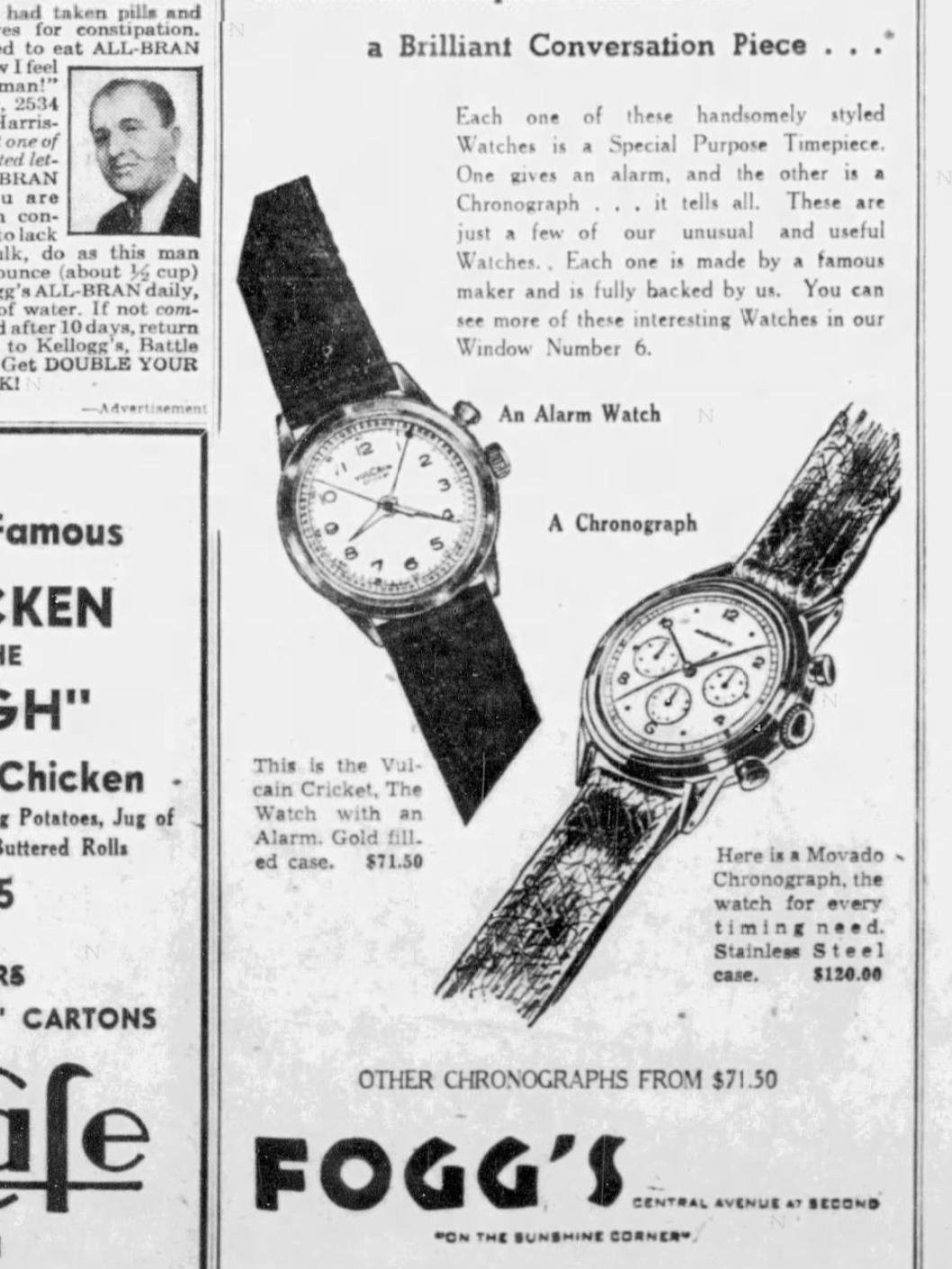
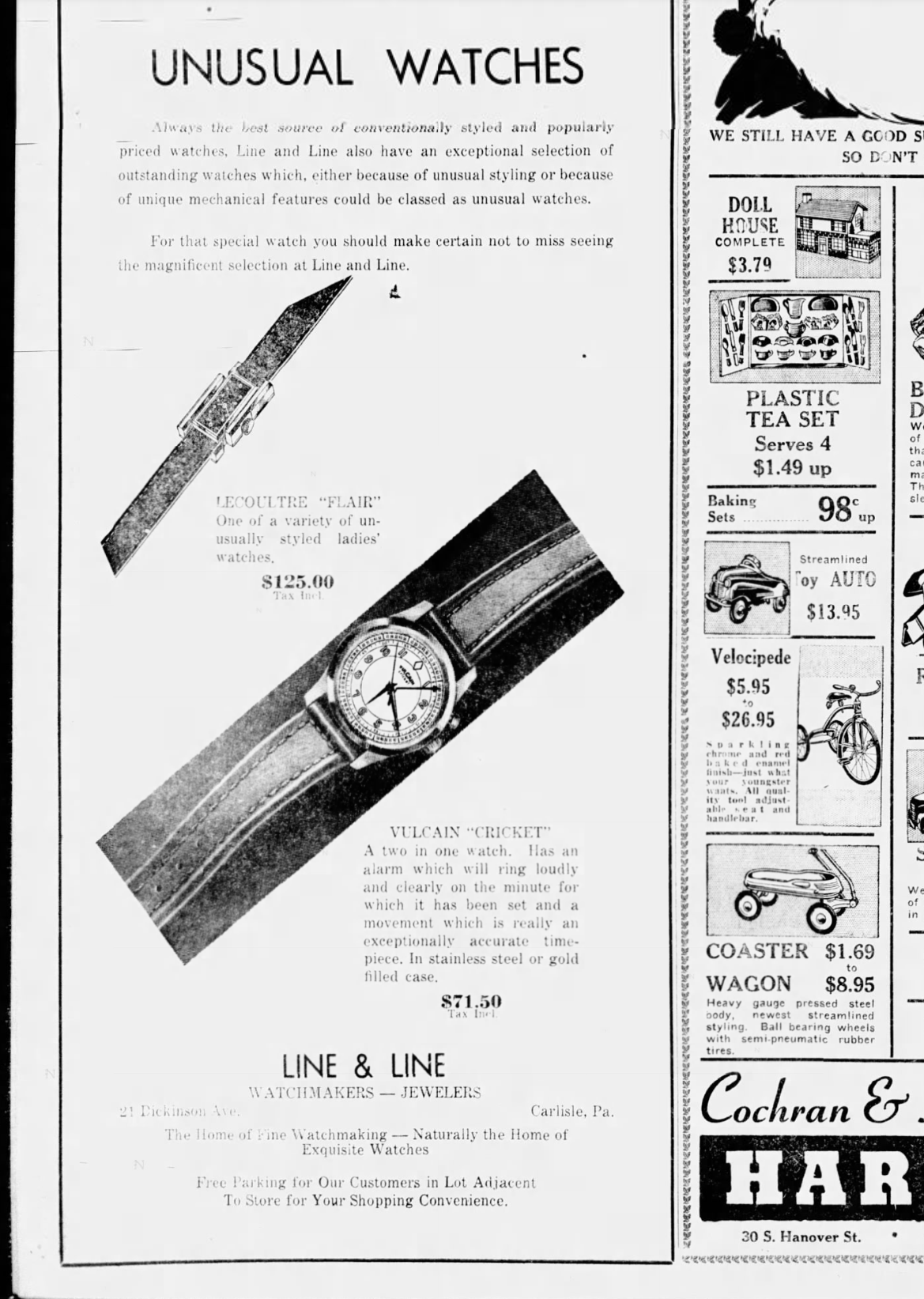
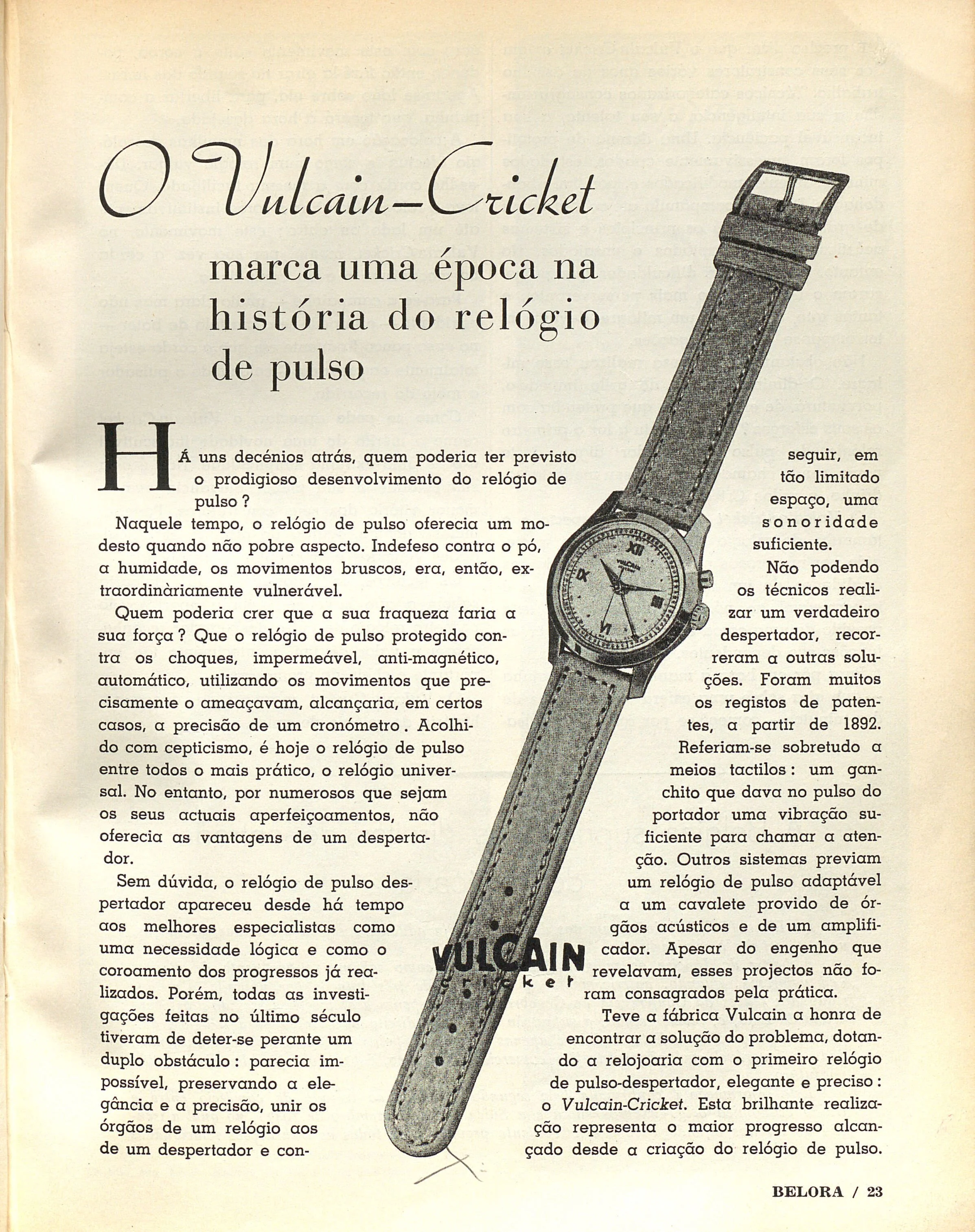
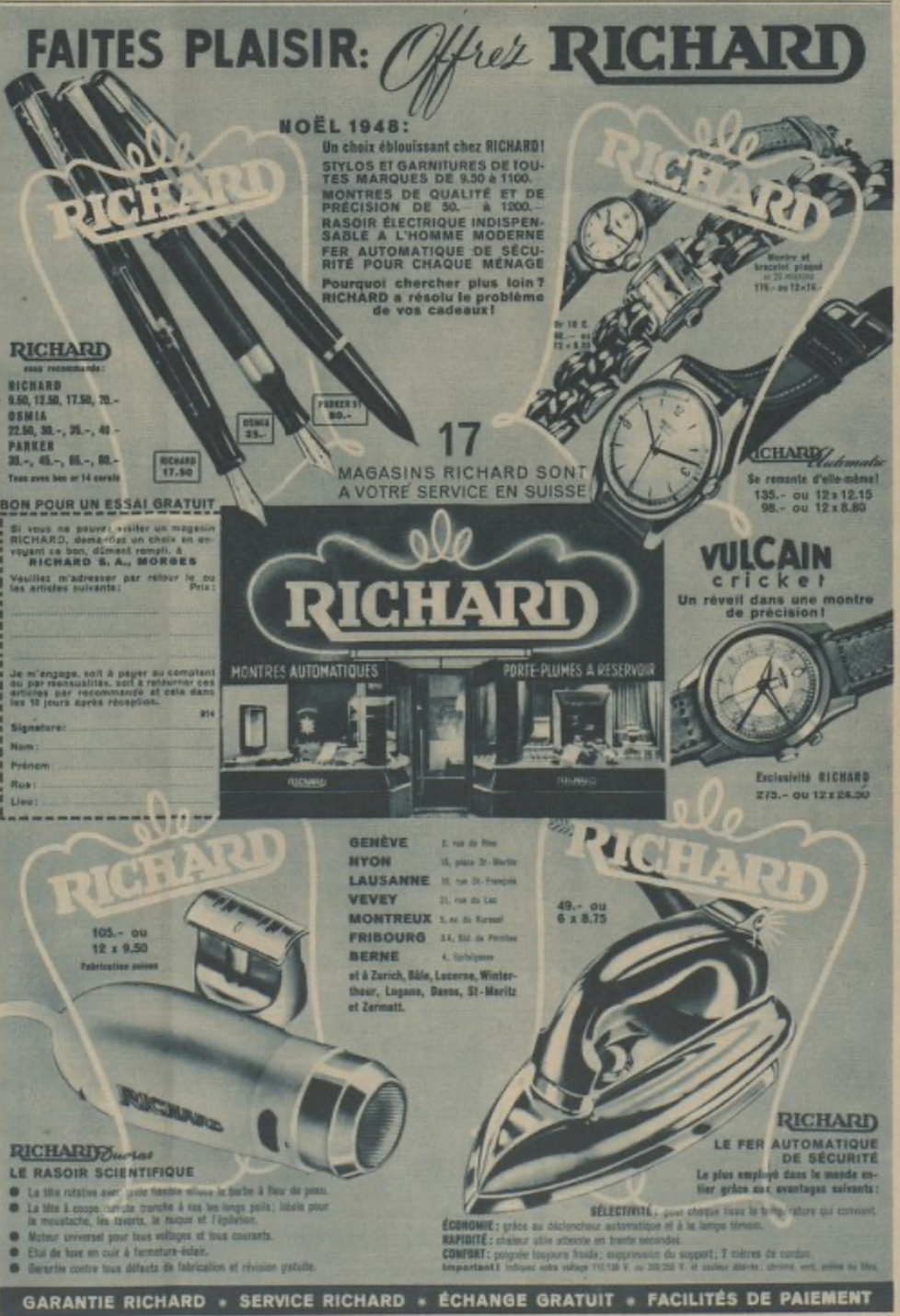
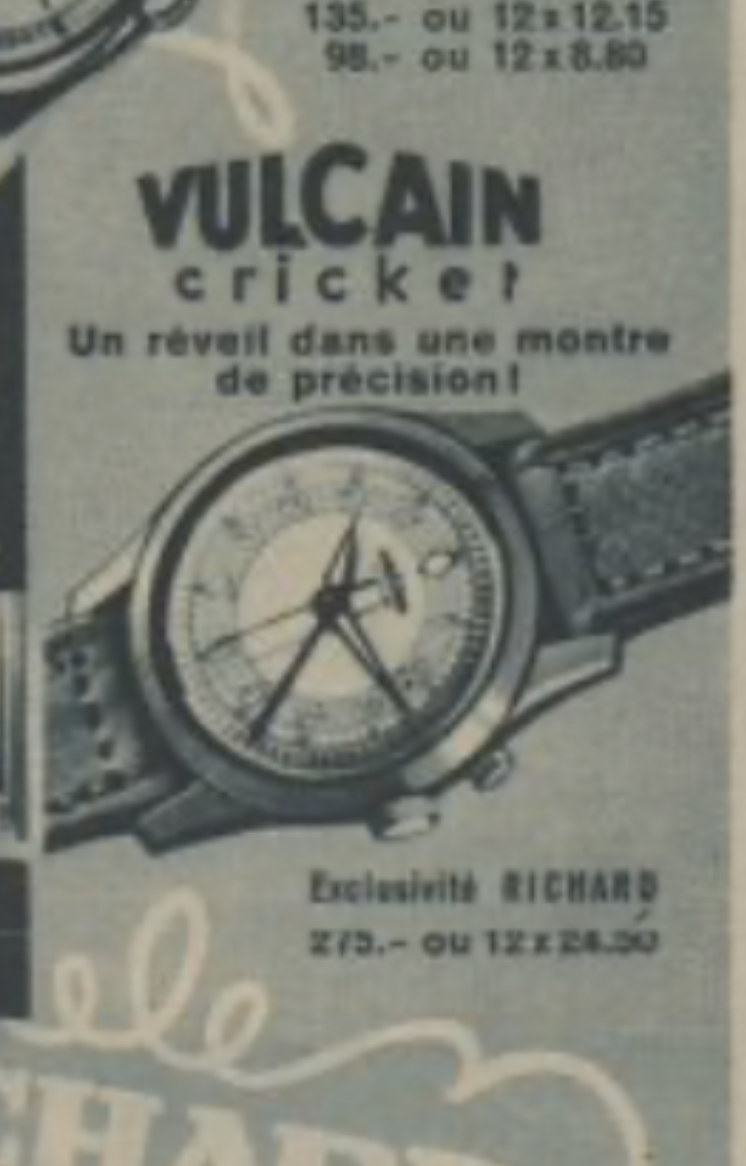
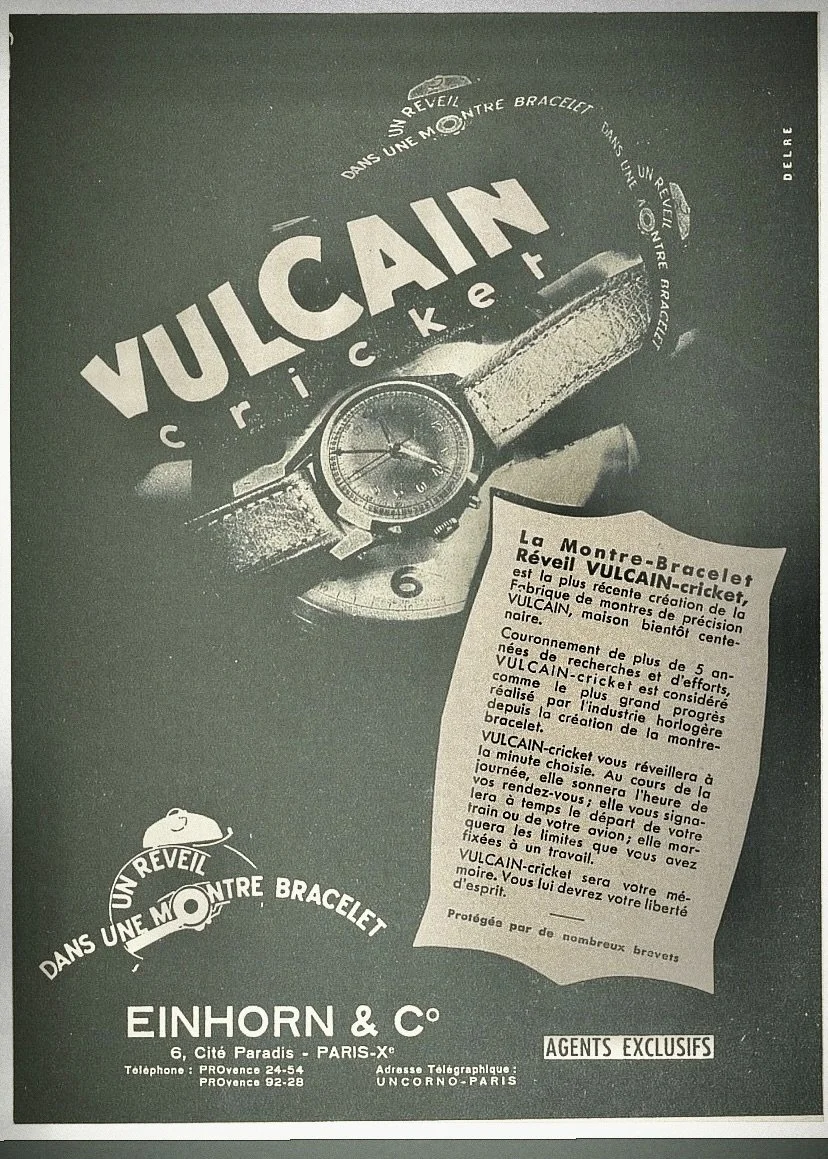
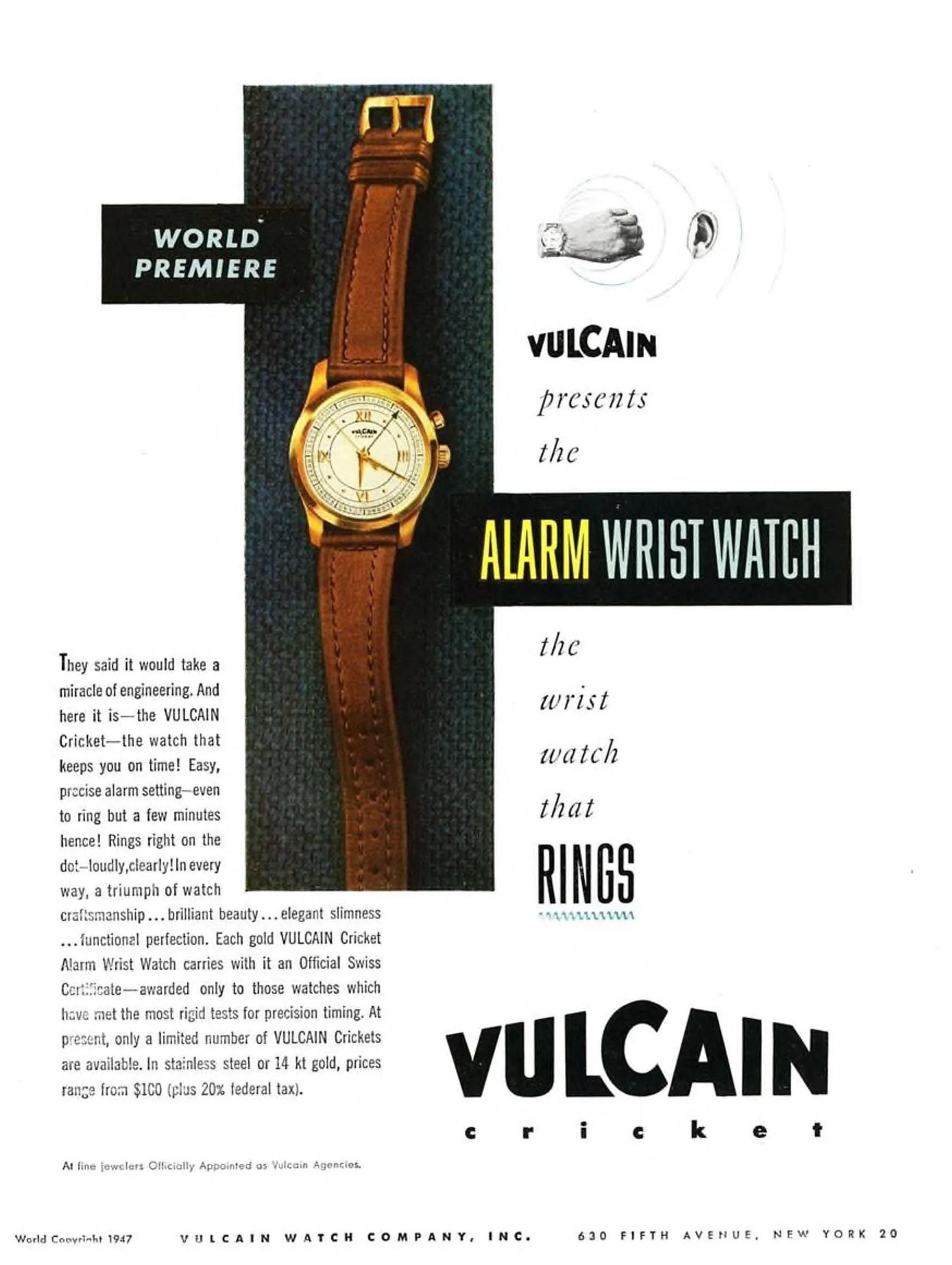
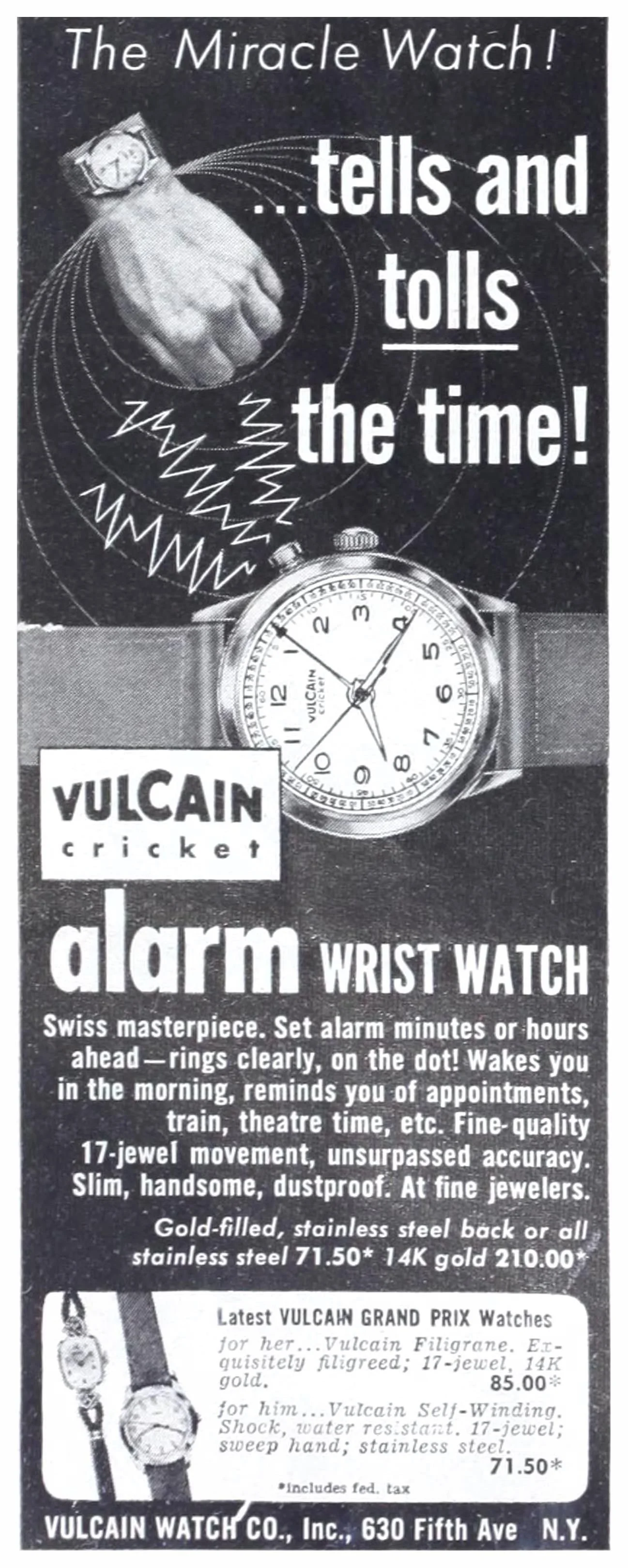
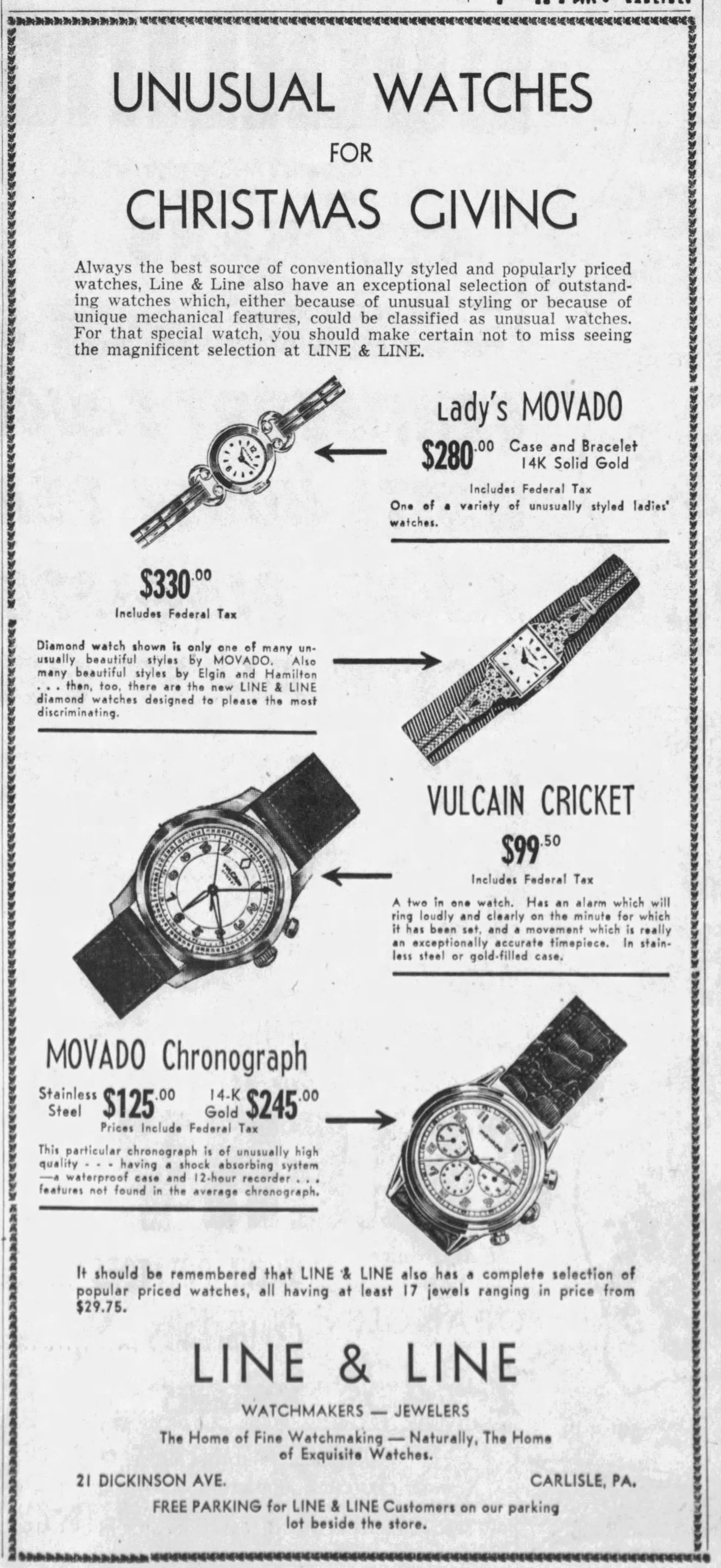
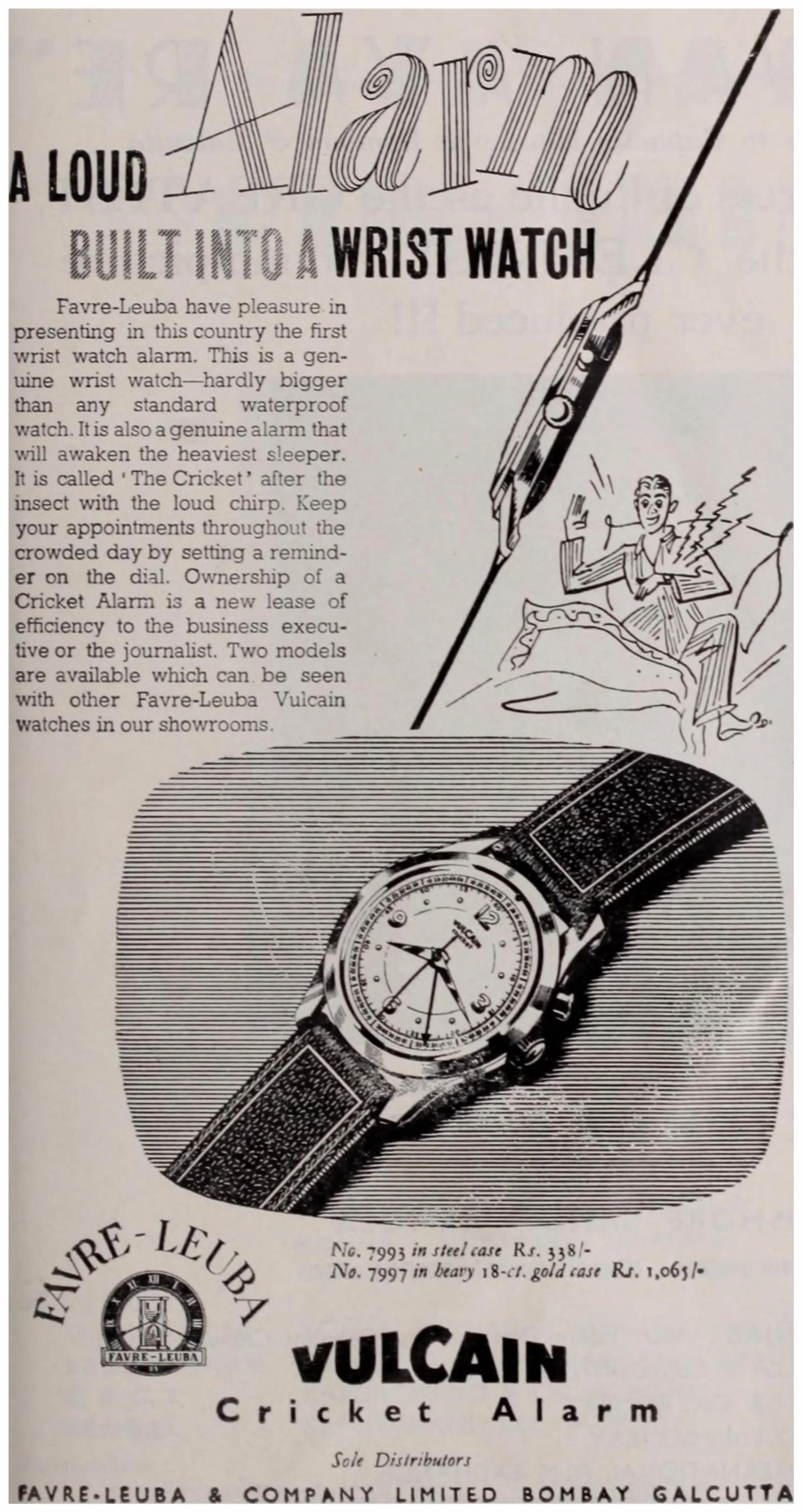
The Vulcain Cricket is a legendary watch known for being the first commercially-produced effective alarm wristwatch. The model was an incredible success upon its release in the United States enjoying unrivaled press highlighted in Esquire, The New Yorker, and LIFE magazine. The Cricket was introduced in December 1947 at the Waldorf Astoria in New York City and would soon go on to be worn on the wrist of politicians, businessmen, salesmen, and pilots (and Charlie Dunne, Eric Wind, and many legendary Wind Vintage clients decades later). When looking back at the advertisements from the late 1940s-early 1950s, the advertisements were phenomenal with bold layouts highlighting the exclusive and innovative alarm complication. One such example of the great press was a three page article in L'impartial in the summer of 1948 - a length rarely covered for a wristwatch of the era.
L'impartial, 16 June 1948
“The interesting volume on watchmaking by Dr. Henri Buhler—published as part of the "Centenary" series—features a reproduction of the "Cricket," an alarm wristwatch from the Vulcain manufacture. Its arrival on the American market a few months ago caused quite a sensation. The aforementioned author—a man who does not mince words—stated that "this watch will mark an era." This is the opinion of a watchmaking expert, and it will undoubtedly be shared by the general public. Indeed, the "Cricket" watch solves a problem that had long been posed but never resolved: how to add a mechanism that truly functions as an alarm to the wristwatch—the most practical of all timepieces. For half a century, many inventors had tackled this challenge, and numerous patents had been filed as early as 1892. Yet, none of the solutions—whether a pin grazing the wrist, a plate pressing against it, or a bridge assembly housing the acoustic components—proved satisfactory. As Louis Loze notes in his excellent account of this invention from La Chaux-de-Fonds: "It seemed impossible to combine the mechanisms of a wristwatch and an alarm—while preserving elegance and precision—and to achieve sufficient sound volume within such a compact space......a wristwatch—a supremely practical device—that truly functioned as an alarm clock. For half a century, many researchers had tackled this problem, and numerous patents had been filed as early as 1892. Yet neither a claw brushing against the wrist, nor a plate pressing into it, nor a mechanism involving a bridge fitted with the sound-producing components proved satisfactory. As Louis Loze noted in his excellent account of this invention from La Chaux-de-Fonds, "it seemed impossible to combine the components of a wristwatch with those of an alarm clock—while preserving elegance and precision—and to achieve sufficient sound volume within such a compact space..."
Yet, the Vulcain factory succeeded in pulling off this technical feat. Though initially skeptical, we have held one—or rather, several—of these "Cricket" watches in our hands. They are elegant, precision timepieces no thicker than a standard chronograph. Yet, not only do these wristwatches chime, but they also vibrate intensely! The sound they emit—shrill yet pleasant in tone—lasts for about 25 seconds. It is loud enough to wake even the soundest sleeper! As piercing and insistent as the chirping of a cricket, the sound is so overwhelming that the manufacturers once received a curious request from the U.S.: "Couldn't you put a mute on the alarm? ... Then your 'Cricket' would be perfect!" Faced with such a reaction, one can certainly say that the inventors of the alarm wristwatch truly achieved their goal!
* * * This resounding...and resounding success was, however, achieved neither in a day, nor in a month, nor in a year. On the contrary, during the five years that the arduous research lasted, and until the creation of the final prototype, very often the team of elite technicians who worked hard on the problem almost became discouraged. Many times, after passing from the bell to the diaphragm, and all existing acoustic methods, Mr. Robert Ditisheim and his team wondered if they, too, were about to throw in the towel. Yet, one day—just as they were losing hope and seemed on the verge of giving up—they received a visit at the factory from Professor Langevin, the renowned French scientist and physicist who had taken refuge in Neuchâtel after being hounded by the Nazis. Looking at the blueprints spread out before him and the team’s downcast faces, Langevin exclaimed: "But nature has achieved this very miracle! The cricket’s small size does not prevent it from producing a sound that carries far. Even though watches have neither serrated legs nor wing cases, you will succeed one day..." Heartened by this encouragement, the technicians went back to work. And while the countless sound and mechanical problems were not solved at that precise moment, the name for the alarm wristwatch was found: thanks to its godfathers—figures both famous and modest—it was christened the "Cricket".
The layperson can hardly grasp the intricacies of a creation that watchmaking technicians and historians alike recognize as one of the most sensational innovations of the last fifty years. Yet, in short, one can appreciate that combining the mechanisms of a standard watch, an alarm, and a striking function within the confines of a 12-ligne timepiece is a truly remarkable feat. After all, it is not every day that one sees an alarm—a precision timepiece—worn on the wrist... Especially since, in previous designs, contact with the wrist would muffle the sound, whereas the "Cricket" actually amplifies it! It is hardly surprising, then, to learn that the manufacturing process is complex and time-consuming: the movement blank alone takes twice as long to produce as a standard one; the mainplate requires over a hundred operations; and the steel membrane—acting as an acoustic resonator—demands another twenty-nine.
Naturally, the "Cricket's" unique character will be most apparent to the technician in its resonance chamber—a double-cased structure featuring sound holes much like those of a violin. Indeed, this is where much of the invention's ingenuity lies. Yet, while the acoustic design required in-depth study and the resolution of numerous challenges—issues that do not even arise with an ordinary alarm watch—and while the sound may vary by an octave (allowing the user to choose their preferred tone!), the true marvel is that the Vulcain Cricket "combines the merit of undeniable novelty with extreme ease of use." Only a single pusher is added to the crown to control the alarm and set the alarm hand, while time-setting functions just as it does on a standard watch. This simplicity is by no means the least of the manufacturers' achievements; their invention is protected by numerous patents.
First presented in America – because this is the biggest watchmaking market at the moment – the “Cricket” caused, as we have said, a sensation. 3000 newspapers in the United States spoke about it, some only to report the invention, others to comment on it. The titles are symptomatic. We read: “A new watch that will revolutionize existence”, “Chirp! Chirp! It's time to work! », « Alarm clocks — The chirping of the cricket reminds you of the time! », “A cricket tells us when...”, “The greatest progress made in watchmaking since the appearance of the wristwatch”. Americans, as we know, have always been passionate about what we call “the five-legged sheep”! However, articles devoted to "cricket", both by major newspapers include such as the *New York Times* or the *New York Herald Tribune*—as well as dailies from other major American cities—demonstrate that journalists across the Atlantic immediately recognized the importance this invention is bound to assume in modern life. Indeed, several of them highlight that the precise and practical alarm-clock wristwatch is destined to play a significant role—if not revolutionize—family and social life. Depending on how it is set, the "Cricket" serves as both a warning signal and a reminder. A reminder that the time has come—literally!—to head to a particular appointment... Honestly, one will no longer be able to say, "I lost track of the time!" when it is buzzing right in one's ear. Even on the train, there will no longer be any need to ask the conductor to wake you up if you doze off; the "Cricket" will take care of that! An anecdote aptly illustrates the popularity of this invention. It comes from an American who wore one of the very first "Cricket" models:
"Eight days after acquiring it," he said, "I had to stop wearing my 'Cricket,' even though it had given me complete satisfaction. Every time I set it to ring as a reminder for an appointment, everyone around me would rush over to ask for an explanation. And everyone would marvel at it—which, inevitably, ended up making me late! No doubt, dozens upon dozens of new uses will be found for it. The fact is that in the fast-paced, precision-driven world we live in, the alarm wristwatch is destined to provide invaluable service. But what highlights the significance of this discovery for our city and our country is that American newspapers did not hesitate to run headlines such as: 'A Swiss invention...', 'The Swiss have invented...', and—of particular significance at this moment—'Switzerland fights to avert a crisis.'"
- Paul BOURQUIN.
“When the Vulcan Cricket made its first appearance, it was greeted with a feeling of curiosity somewhat tinged with skepticism. For a long time, the construction of an alarm wrist watch had both tempted and discouraged many a skilled horologist. The problem - almost insoluble for the human mind - was, first, how to combine a thin watch-movement, along with the organs of an alarm, in the small space of a wrist-watch. Then, to obtain from a tiny mechanism, the very sound produced by a large size alarm. As a matter of fact, all previous researches had failed owing to this double difficulty.
After five years of ceaseless efforts and continuous researches carried out in the laboratory, the engineers of the Vulcain Factory have overcome obstacles apparently unconquerable. Their endeavours resulted in a marvel of ingenuity and accuracy combined, the Vulcain Cricket.
Having left the technical department for the world markets, the Vulcain Cricket is now held in universal repute. Nobody questions any longer the uniqueness of the watch nor the variety of its practical applications.
The Swiss and foreign patents which protect the Vulcain Cricket watch, establish in fact a sensational advance, probably the greatest achievement ever recorded in horology since the advent of wristwatches.
It lies entirely with you to benefit by such progress. Whether worn on your wrist or placed on your bed-side table, Vulcain Cricket will wake you up at the very minute you have chosen.
This is the first duty of Cricket, the easiest. Then, during the day, Cricket will not stop serving you.”
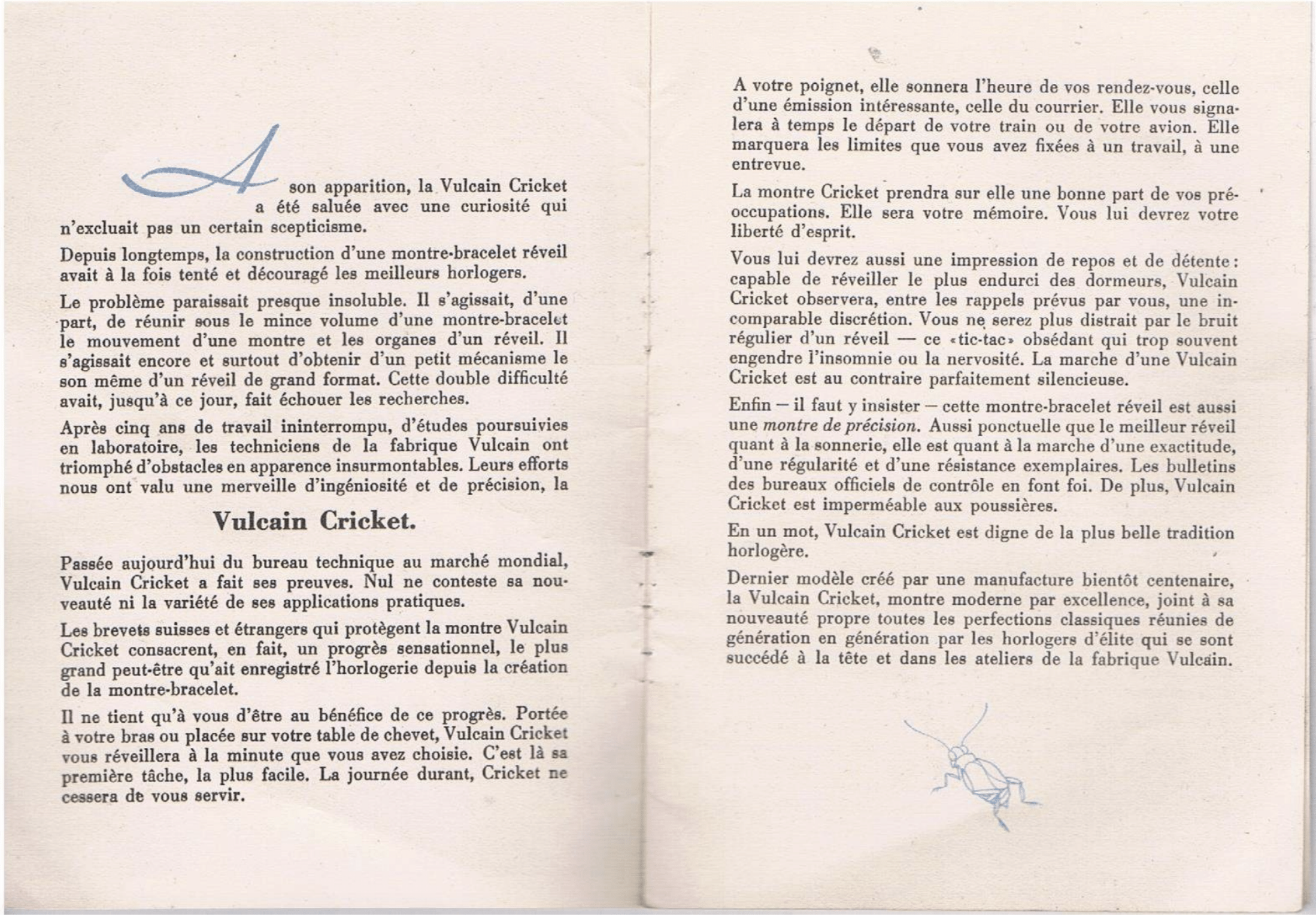
“On your wrist, Cricket will ring in time for your appointments, an interesting broadcast or for mailing hours. It will tell you when you should catch your train, boat or plane. It will mark the limits you have assigned for a task or an interview.
The Cricket watch will take up a good share of your worries. It will be your reminder. You will owe it your peace of mind It will also impart a feeling of rest and relaxation. Though capable of waking up the soundest sleeper, Vulcain Cricket will observe unrivalled discretion between the calls you have provided for. You will no longer be disturbed by the ceaseless clatter of an ordinary alarm-clock - by that obsessing "tie-tac". Often the source of sleeplessness or nervosity. On the contrary, the running of a Vulcan Cricket is perfectly noiseless.
Last but not least and we may insist on this point - the aforesaid alarm wrist-watch is also a high grade watch. As punctual as the best alarm-clock as far as the ringing is concerned, the running of the Vulcain Cricket proves to be most reliable, accurate and regular. The rating certificates issued by the Official Swiss Offices of Control duly vouch for the result obtained. Furthermore, the Vulcain Cricket is dust-proof.
In brief, the Vulcain Cricket is worthy of the finest tradition in horological science.
Being the latest model created by a factory almost one hundred years old, the Vulcain Cricket - an up-to-date watch in the true sense of the term - embodies daring modernity allied to classical improvements gathered from generation to generation by the skilled watchmakers who have followed one another at the head and in the workshops of the Vulcain Factory.”
Patents
Vulcain was founded in 1858 by Maurice Ditisheim. It was Maurice’s grandson, Robert Ditishiem who went on to create the manufacturers’ legacy model. Robert Ditishiem received his diploma as a watchmaking technician at the School of Watchmaking in La Chaux-de-Fonds and over the course of the 1940s worked vigorously to create the perfect alarm wristwatch. Below are the five patents and their corresponding drawings.
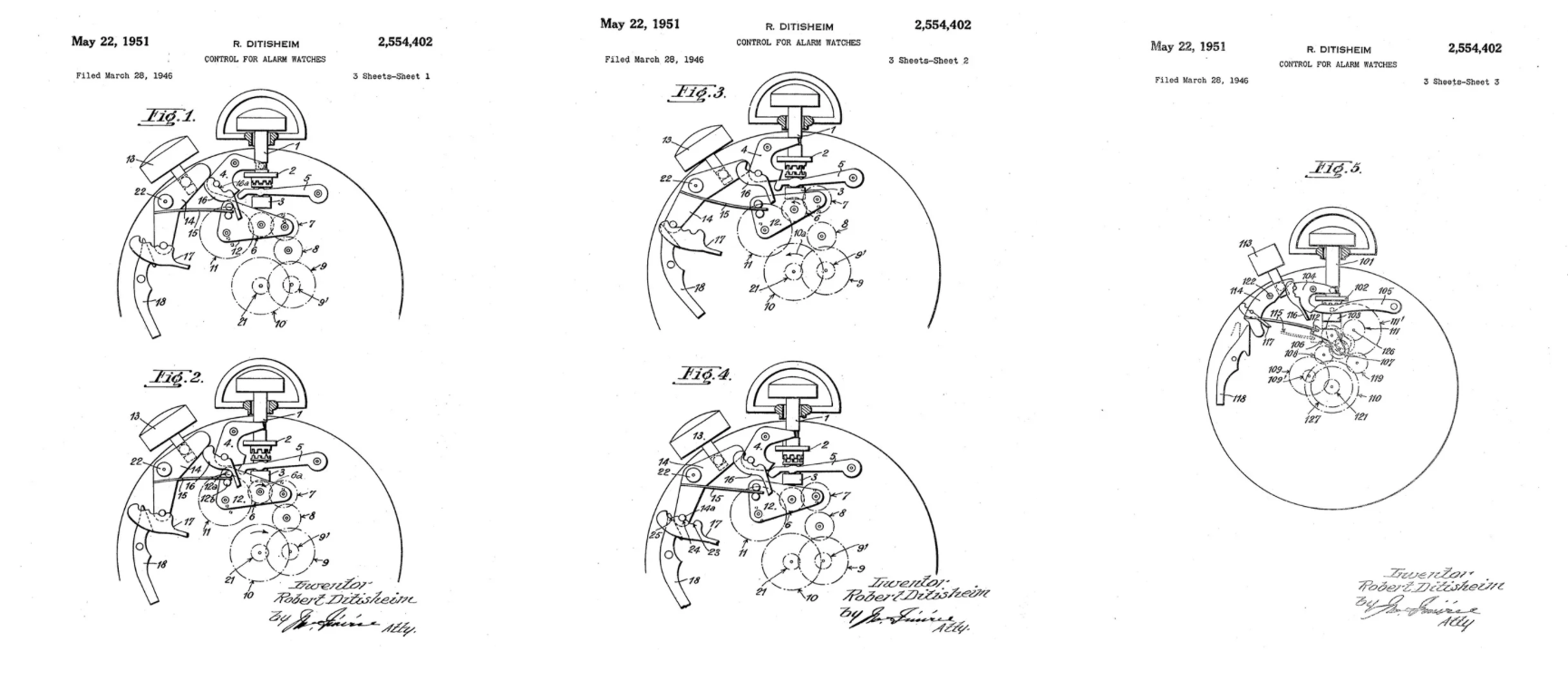
US Patent 2,554,402 (1951)
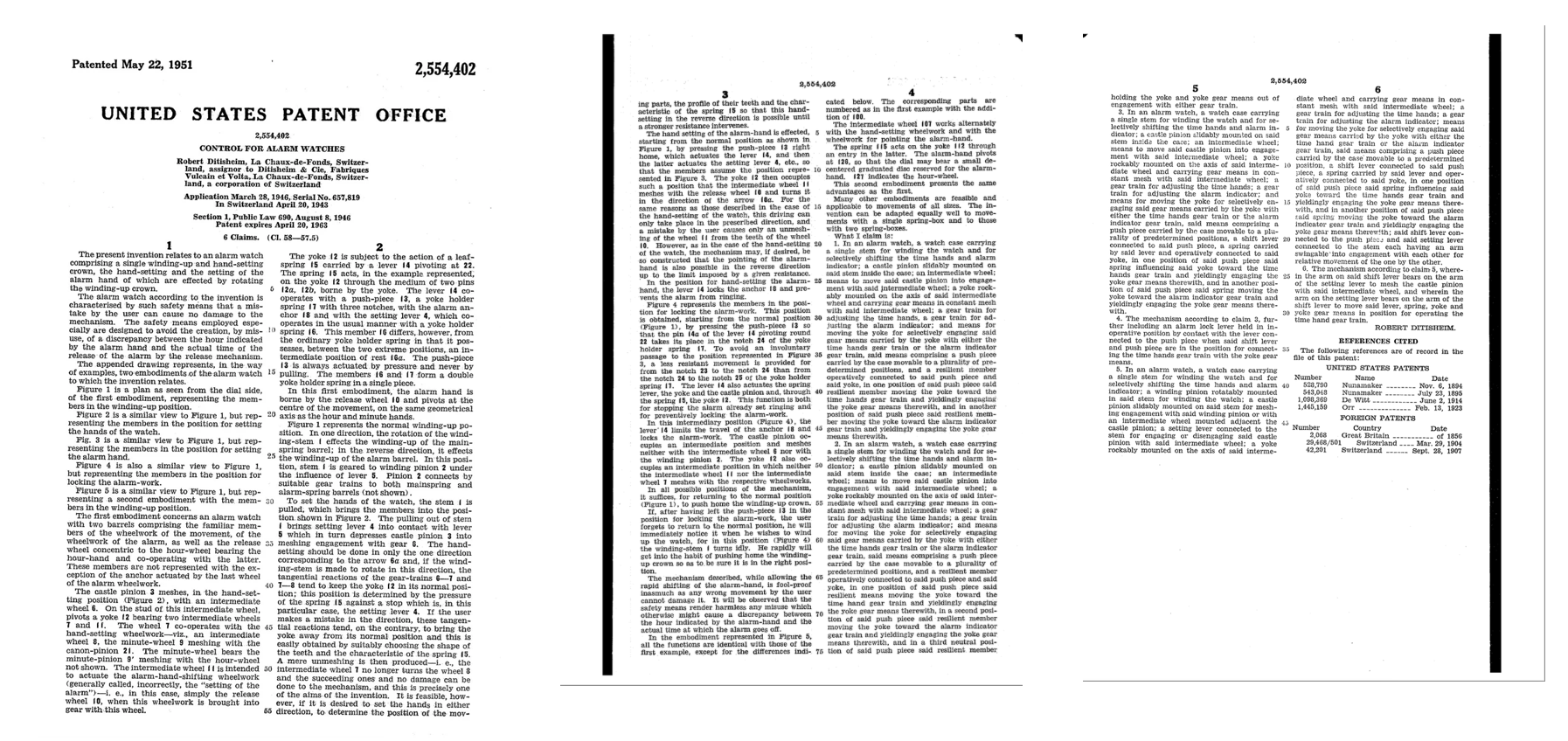
The first patent “relates to an alarm watch comprising a single winding-up and hand-setting crown, the hand-setting and the setting of the alarm hand of which are effected by rotating the winding-up crown. The alarm watch according to the invention is characterised by such safety means that a mistake by the user can cause no damage to the mechanism. The safety means employed especially are designed to avoid the creation, by misuse, of a discrepancy between the hour indicated by the alarm hand.and the actual time of the releas.e of the alarm by- the release mechanism.” The drawings represent a pocket watch that appears to be the prototype timepiece Ditisheim began with. It was applied for a patent on April 20, 1943 and it would eventually be patented on May 22, 1951.
US Patent 2,568,795 (1951)
The second patent “relates to an improved alarm locking device of particular utility in an alarm wrist watch. In ordinary alarms, the locking of the alarm mechanism is usually achieved by introducing a pin, or a point, into the trajectory of a member having a reciprocating motion. In most cases this member is constituted by either the anchor or the hammer of the alarm mechanism. The movable member can then be stopped by the pin either on one or the other side of the latter, the pin interrupting the path of travel of the member and excluding it from access to a part of its trajectory. The excluded part of the trajectory is situated on one or the other side of the pin according to the position of the movable member at the instant when the pin is set in its locking position. This known type of locking device has the disadvantage of permitting the movable member (anchor or hammer) to continue to oscillate through that part of its trajectory which will bring the haffimer into contact with the sounding mechanism as the result of moving or jolting the time piece. This condition occurs when,(a) the alarm mechanism is run down, and (b) the locking member or pin has happened to engage the movable member in one of two possible parts or segments of its trajectory. When this occurs there is no way definitely to shift the movable member to the other side of the locking pin while the latter is in locked. position.
A principal object of the present invention is the provision of a locking member controlling the alarm mechanism, which, when in locked position, excludes the movable member (anchor or hammer) from a selected or definite part of its trajectory. According to the invention as provided for an alarm watch having a hammer acting on a s ' ounding member, the part of the trajectory selected for elimination may either correspond to the part of the trajectory of the said hammer in which the latter acts upon the sounding member in order to prevent the impact of the hammer upon the sounding member, or may correspond to another part of the trajectory of the said hammer which ensures that the remaining travel of hammer will not be sufficient for action of the hammer on the sounding member to cause an 5o, audible vibration. The watch can then be shaken without this resulting in the production of sound, even when the spring.of the alarm mechanism is run down. In a preferred embodiment of the invention, 2 the alarm mechanism comprises an anchor escapement driving a hammer which is integral with the said anchor. The locking member is constituted by a locking lever the extremity of which: is situated, when in locking position, in the trajectory of either the hammer or the anchor, in order to form a stop which holds the said member in one direction but allows it to pass in the other direction. This result is obtained by giving the lever a shape designed to cause the extremity of the said lever to be elastically repelled by the movable member out of its trajectory when the said member moves in this latter direction, inclined cam-surfaces being provided on the movable member and on the locking member in order to facilitate the passage of the movable member.
The drawing shows, by way of example, two embodiments of the locking mechanism of a watch object of the invention, comprising a hammer driven by an anchor escapement and also, for comparison, a known form of such a mechanism.” It was applied for on July 17, 1948 and eventually patented on September 25, 1951.
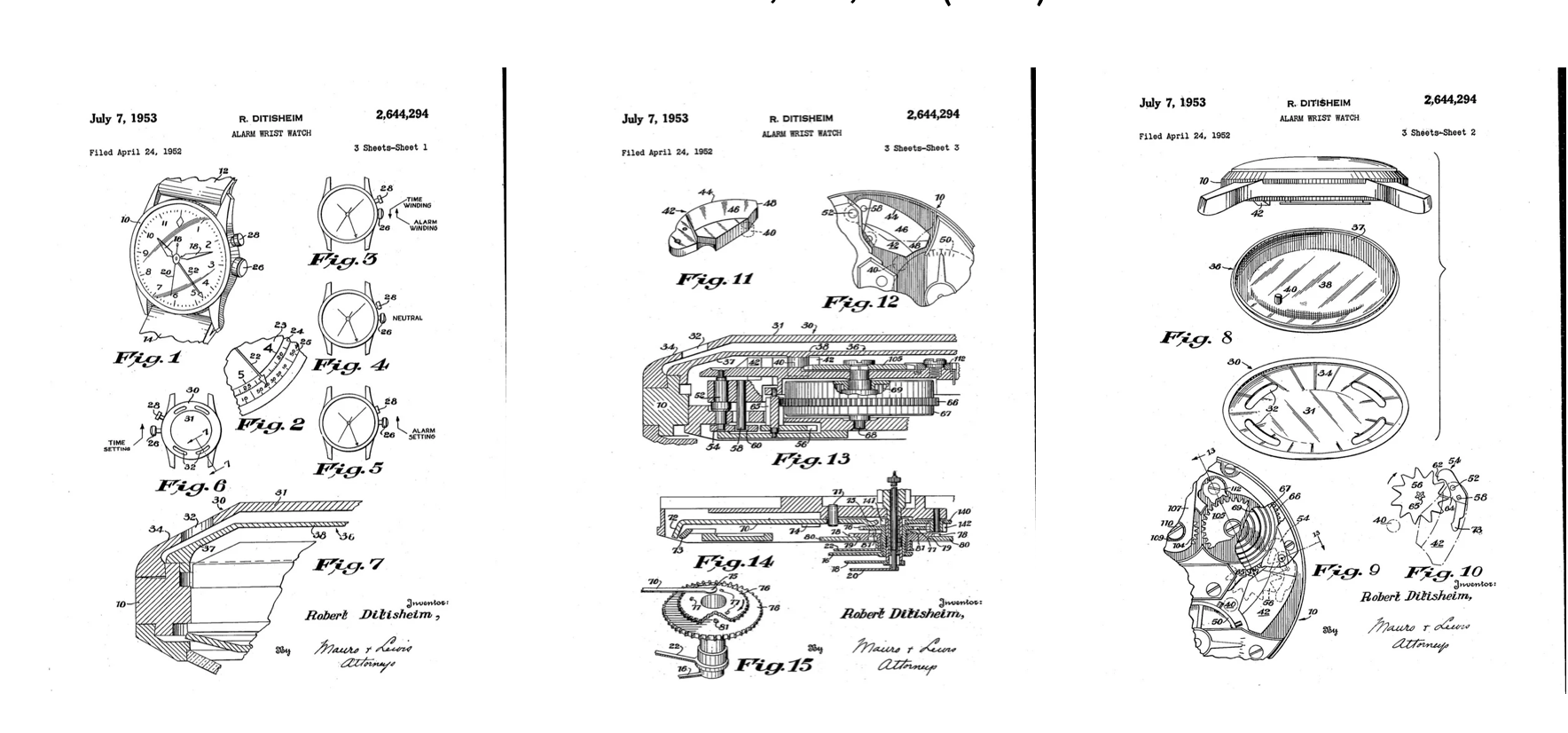
US Patent 2,644,294 (1954)
The third patent is for the perforated case back and inner membrane which is “audible to the human ear. The diaphragm is furthermore designed to occupy the least space possible in the direction of thickness of the watch, to provide a dust proof inner-cover for the mechanism, and at the same time to provide the inner wall of a resonant chamber in conjunction with the outer back cover. [The} back cover [is} designed in conjunction with the diaphragm beneath, a resonant chamber of the maximum diameter possible [to enhance] the alarm sound which means cannot be muffled by the wrist of the wearer. By reason of the selected design, these objects are attained while avoiding a distorted or bulky appearance at the back of the watch, and without adding objectionably to its thickness.
The size and shape of the chamber are attuned to the vibrational rate of the diaphragm to provide maximum amplification of the sound vibrations. A separate alarm spring and special connecting and driving means with the hammer to insure rapid oscillation of the latter, together with- means for releasing and turning off the alarm.”
It was applied for on April 24, 1952 and patented on December 2, 1954.
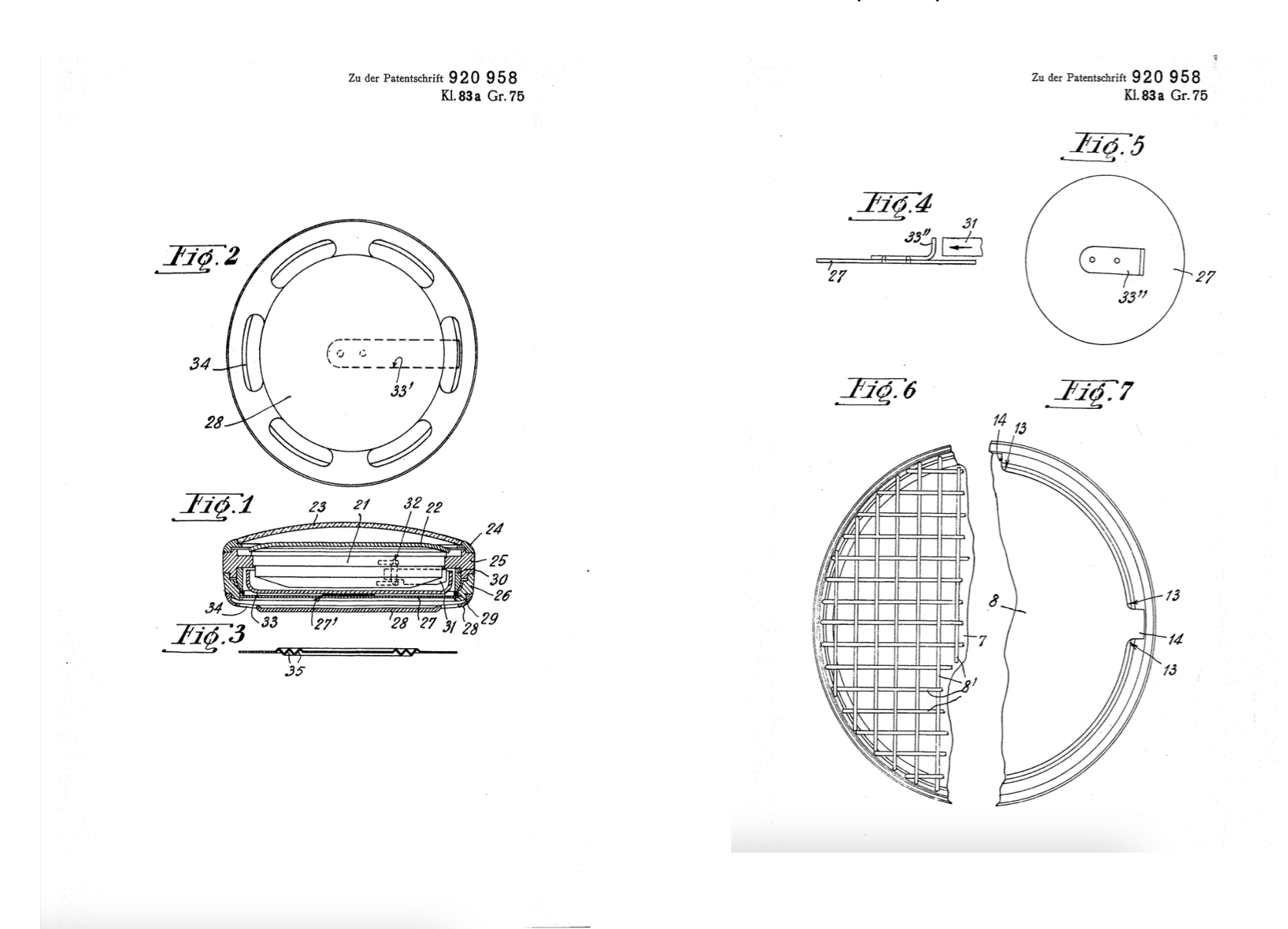
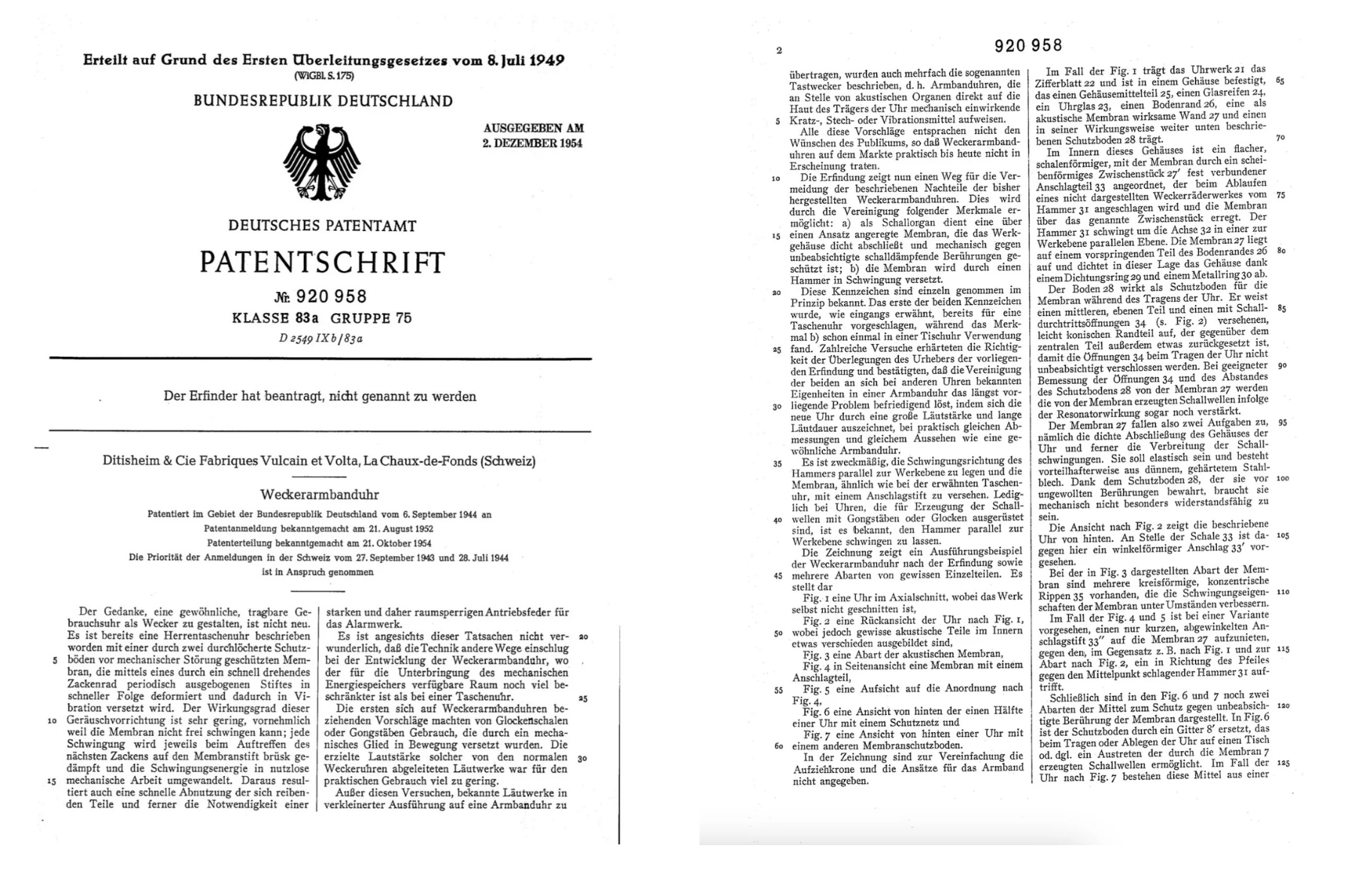
German Patent 920,958 (1954)
“The idea of designing an ordinary, wearable utility watch as an alarm clock is not new. A men's pocket watch has already been described with a membrane protected from mechanical damage by two perforated protective bases, which is deformed in quick succession by means of a pin periodically bent out by a rapidly rotating toothed wheel and is thereby set in vibration. The efficiency of this noise device is very low, mainly because the membrane cannot vibrate freely; each vibration is brusquely dampened when the next spike hits the membrane pin and the vibration energy is converted into useless mechanical work. This also results in rapid wear of the rubbing parts and also in the need for a strong and therefore bulky mainspring for the alarm mechanism.
In view of these facts, it is not surprising that technology took different paths in the development of the alarm wristwatch, where the space available for accommodating the mechanical energy store is even more limited than in a pocket watch.
The first alarm wristwatch proposals made use of bell shells or gong sticks set in motion by a mechanical link. The achieved volume of such chimes derived from the normal alarm clock noise was far too low for practical use. In addition to these attempts to transfer known chimes to a wristwatch in a smaller version, the so-called touch alarm clocks were also described several times, i. H. Wristwatches which, instead of acoustic organs, have mechanical means of scratching, piercing or vibrating directly on the skin of the wearer of the watch. All of these proposals did not meet the wishes of the public, so alarm wristwatches have practically not appeared on the market to this day.
The invention now shows a way of avoiding the described disadvantages of the alarm wristwatches previously produced. This is made possible by the combination of the following features: a) a membrane excited by an attachment serves as the sound organ, which tightly seals the movement case and is mechanically protected against accidental sound-dampening contact; b) the membrane is made to vibrate by a hammer.
Taken individually, these characteristics are known in principle. As mentioned at the beginning, the first of the two features has already been proposed for a pocket watch, while feature b) has already been used in a table clock. Numerous tests confirmed the correctness of the considerations of the author of the present invention and confirmed that the combination of the two characteristics known from other watches in a wristwatch satisfactorily solves the problem that has existed for a long time, in that the new watch is characterized by a large volume and long ringing time , with practically the same dimensions and appearance as an ordinary wristwatch.
It is advisable to position the direction of vibration of the hammer parallel to the plane of the movement and to provide the membrane with a stop pin, similar to the pocket watch mentioned. Only in clocks that are equipped with gong rods or bells to generate the sound waves is it known to swing the hammer parallel to the plane of the movement.”
The fourth patent was applied for on September 6, 1944 and patented on December 2, 1954.
German Patent 932,420 (1955)
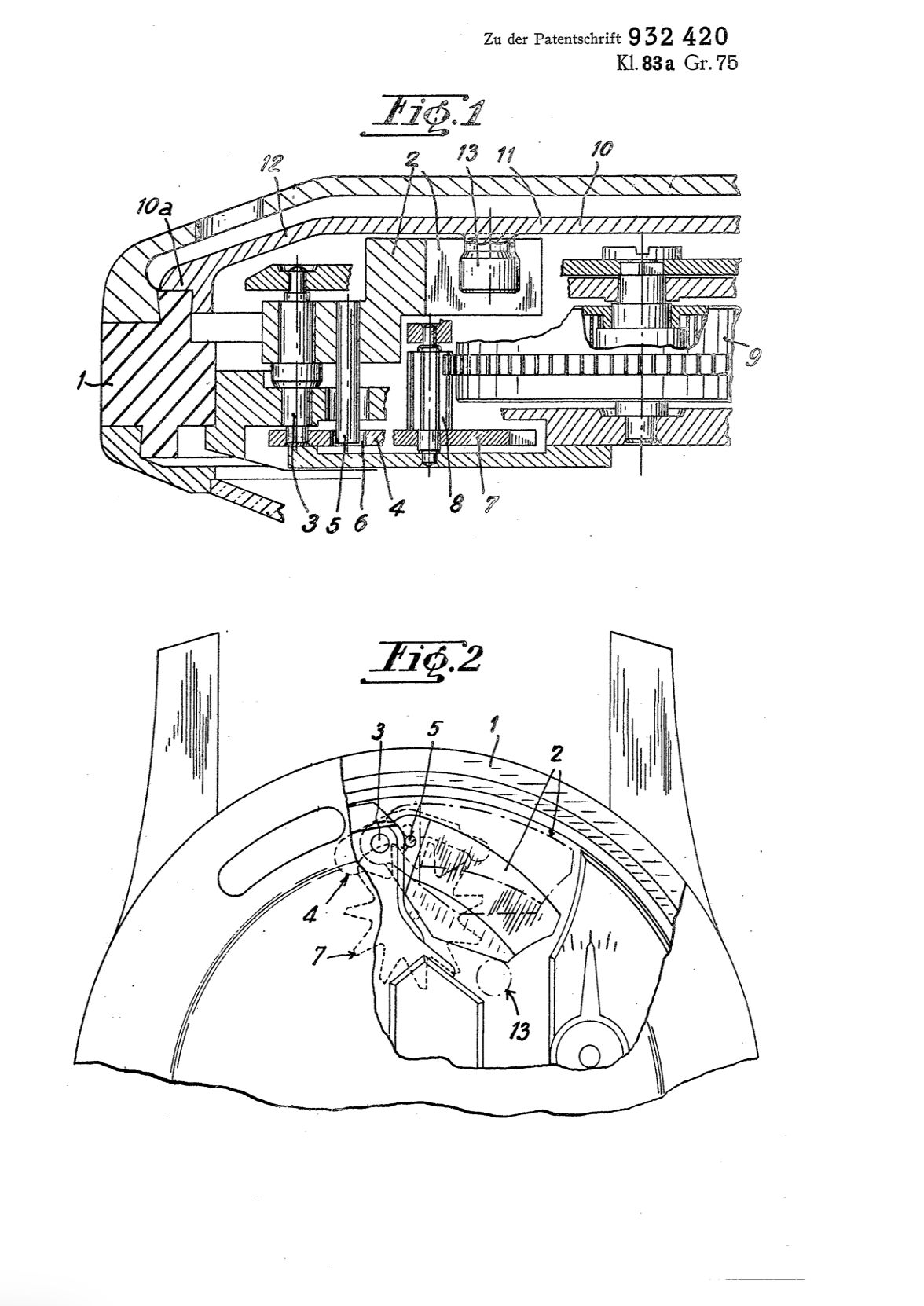
“Anchor-bevel drive for the alarm hammer in alarm wristwatches The subject matter of the invention is an anchor-bevel drive for the alarm hammer in alarm wristwatches. In these drives, the armature interacting with the pitch wheel and the hammer striking the sounding organ have hitherto always formed a rigid unit. It has now been found that the hammer, which is in rigid operative connection with the armature, when striking the vibratory organ, i. H. the diaphragm or the like, does not produce a full, lingering bell tone, but rather tones that are very short and muffled. This is because the hammer is prevented from freely swinging back immediately after striking the tone organ. This is not possible because the hammer is rigidly connected to the armature and is therefore briefly stopped in its two extreme positions. The result of this is that the hammer rests on the tone organ for a short time and thus prevents it from vibrating freely. For these reasons, it is not possible to produce an insistent and full chime with the known anchor pitch wheel drive for an alarm hammer. A further disadvantage of the cited anchor pitch wheel drive is that the rigid hammer with its relatively large weight can have unfavorable repercussions on the sensitive anchor or on the pitch wheel cooperating with this when braking suddenly, because parts of this anchor may open quite abruptly the teeth of the ascending wheel can hit, which can even lead to damage. These disadvantages are avoided in the armature pitch wheel drive according to the invention, that the armature is not rigid, but is connected to the hammer by a pin or the like, which in turn is attached to the hammer and on the other hand engages in an opening of the armature which is dimensioned in such a way that the hammer can swing freely within certain limits. It is particularly expedient to arrange the armature and the hammer so as to be rotatable about the same axis and to provide the hammer with a pin with which it engages with play in an opening in the armature. This design of the drive means that the hammer receives an impulse accelerating the hammer through the armature for each strike of the sounding organ (membrane etc.), but that the hammer is released from the armature before it hits the sounding organ , so that it is struck only briefly. The consequence of this is that the kinetic energy is largely converted into sound energy. The arrangement has an extraordinarily high level of efficiency and allows an easily audible tone to be produced with a relatively small drive spring. The advantages of the invention for alarm wristwatches are therefore obvious.”
The final patent was applied for on February 16, 1950 and patented on September 1, 1955.
The Case
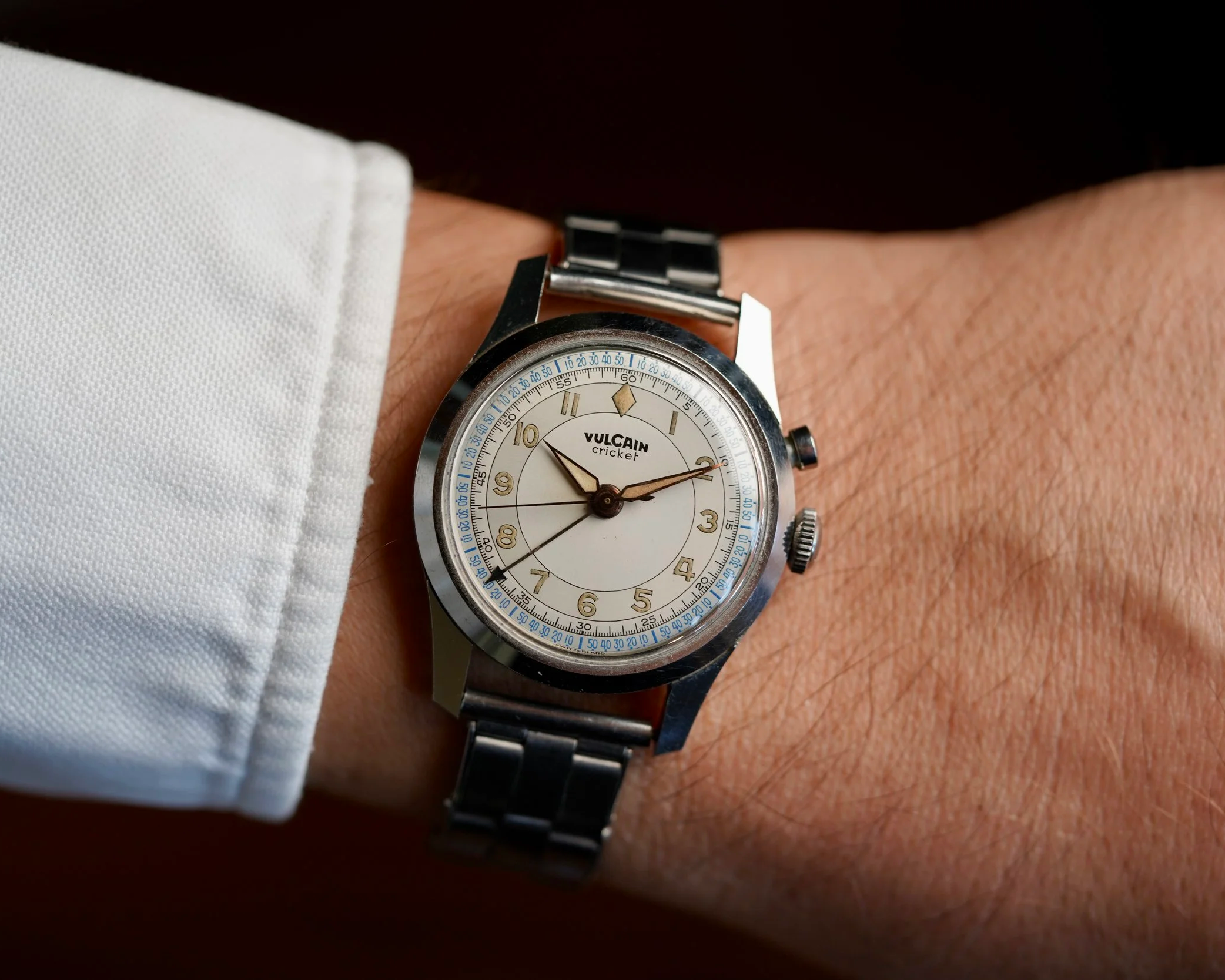
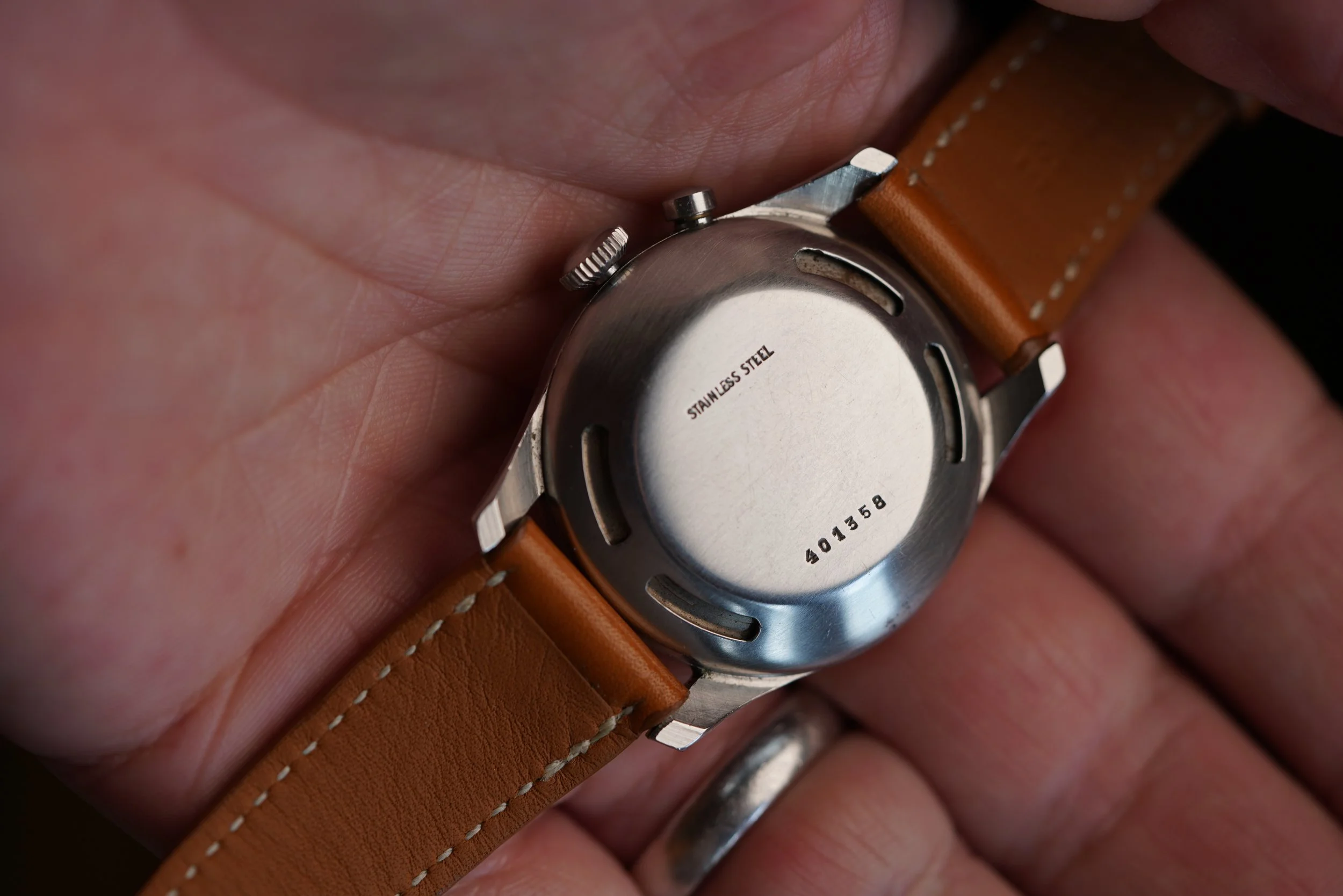
The original Vulcain Crickets are 34mm in diameter and 43mm lug-to-lug. These are three-part cases - yet the bezel appears integrated from the straight-on view. The perforated caseback is a snap-on piece that is domed and allows the alarm to be amplified through the back. These are particularly unstable if polished. On the caseback, the watches feature serial numbers - the references would come in the a few examples of the 2nd generation and consistently within the 3rd generation of Crickets.
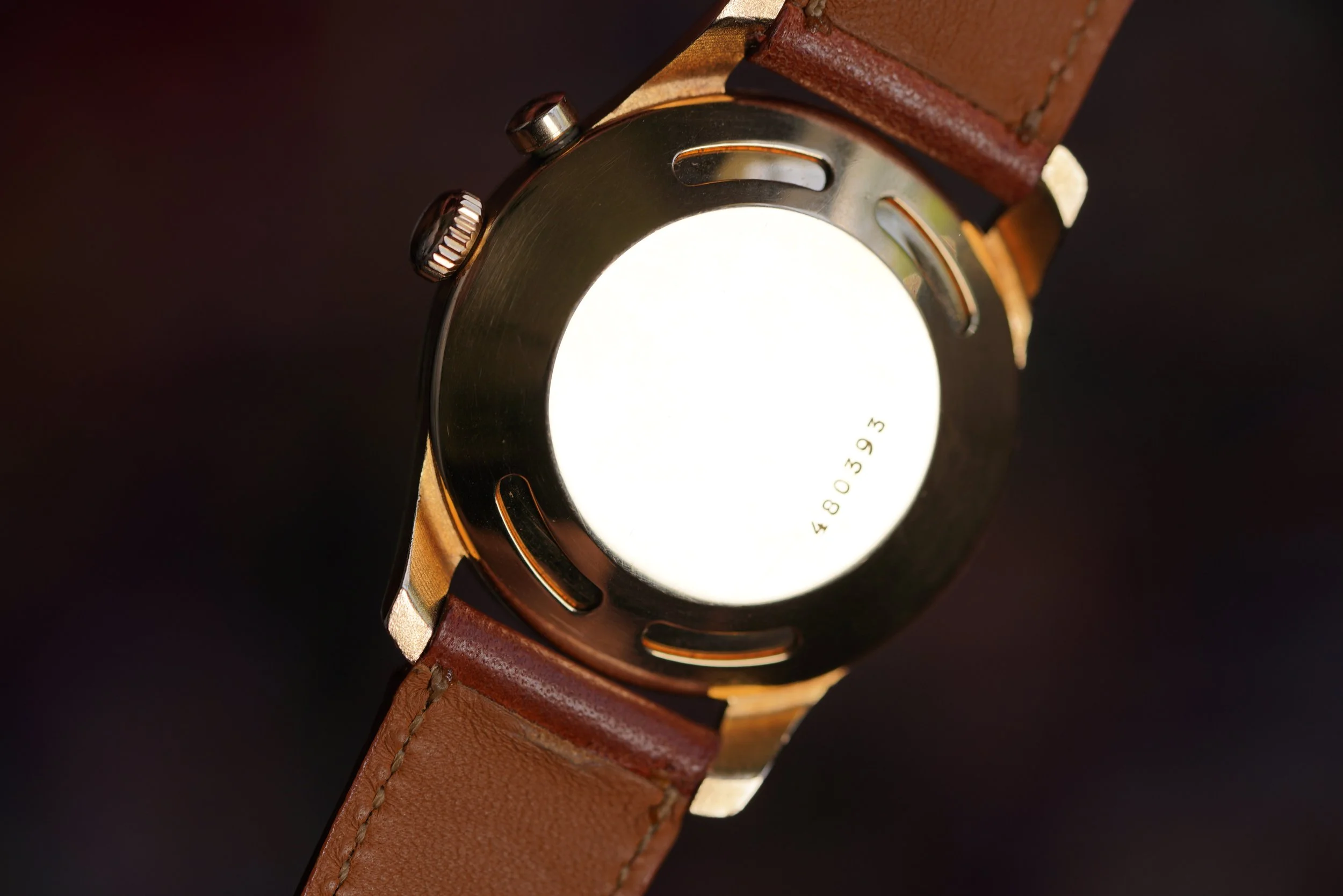
These cases are made in two metals: Stainless steel and gold. The gold cases are 14K yellow gold and 18K yellow gold or rose gold. The OG Cricket was primarily produced in stainless steel, and the gold examples are quite rare. Finding any great OG example with a nice dial is very hard as the cases were never water resistant and many were melted for gold value due to the Vulcain name not being prestigious outside of windvintage.com. The gold models feature a gold membrane instead of copper-looking membrane found on steel examples. The membrane on steel examples sometimes discolors or gets patina and can get a bit of attention for collectors on first impression, but is part of the charm. Application of the membrane can sometimes take a bit of technique, as the post and hammer need to be aligned to get the right tone for the alarm. If it is misaligned, the alarmsound can be flat or dull.
The interior of the case back will feature a Poinçon de Maître No. 1 (hammer head hallmark) with the number 126. This indicates the maker of these cases was Jean Humbert & Co. S.A - a case maker also based in La Chaux-de-Fonds. This is interesting context for those who are aware that Vulcain was based in La Chaux-de-Fonds, so the relationship between the manufacturer and case maker was likely formed due to their geographical proximity. These OG cases appear to have been made specifically for Vulcain and no other manufacturer. The only competing faction at the time was Jaeger-LeCoultre. Interestingly, the casemaker for JLC is still a bit of a mystery and I am praying to one day find out who the casemaker 3 is.
Dial Variants
The LBJ Dial
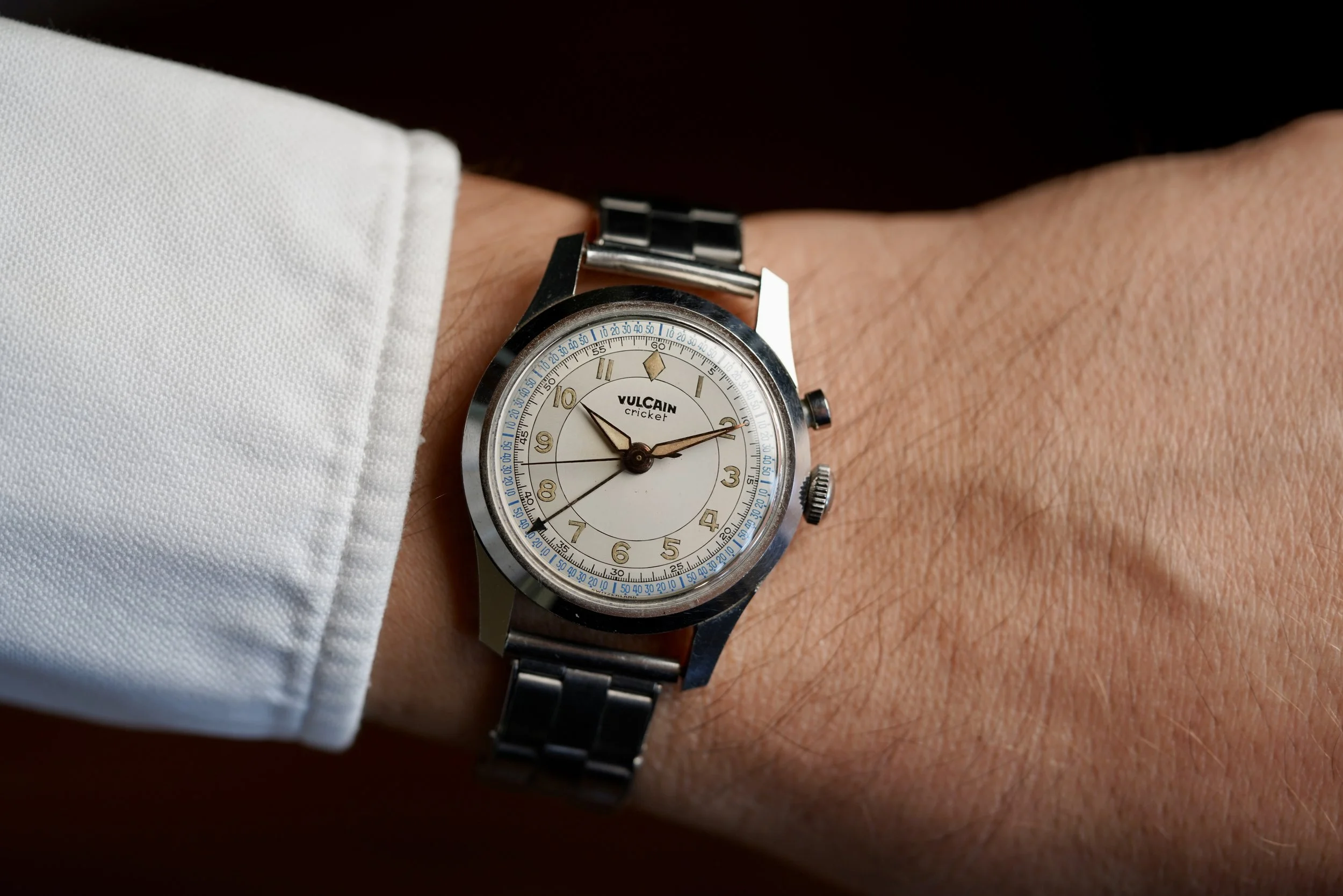
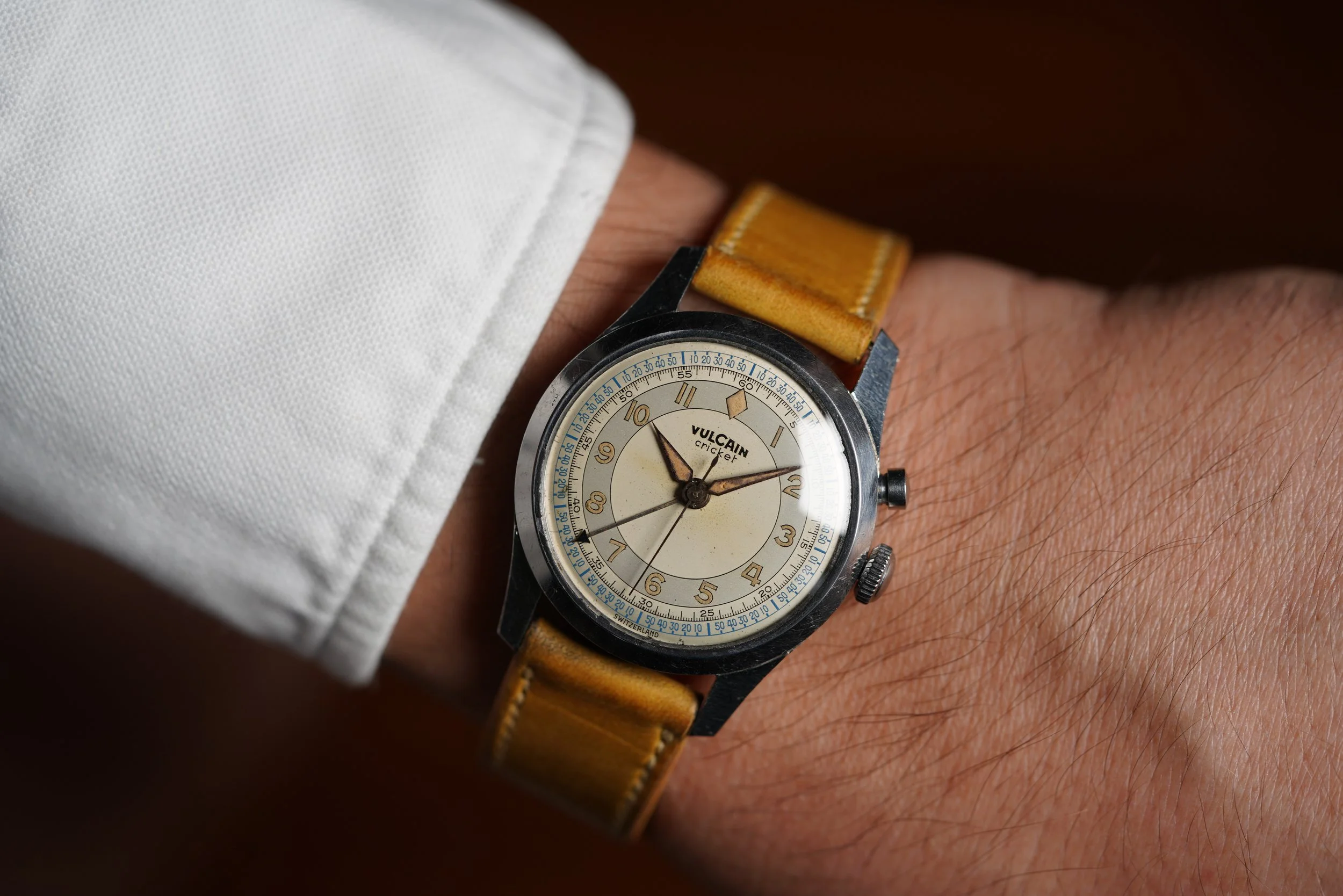
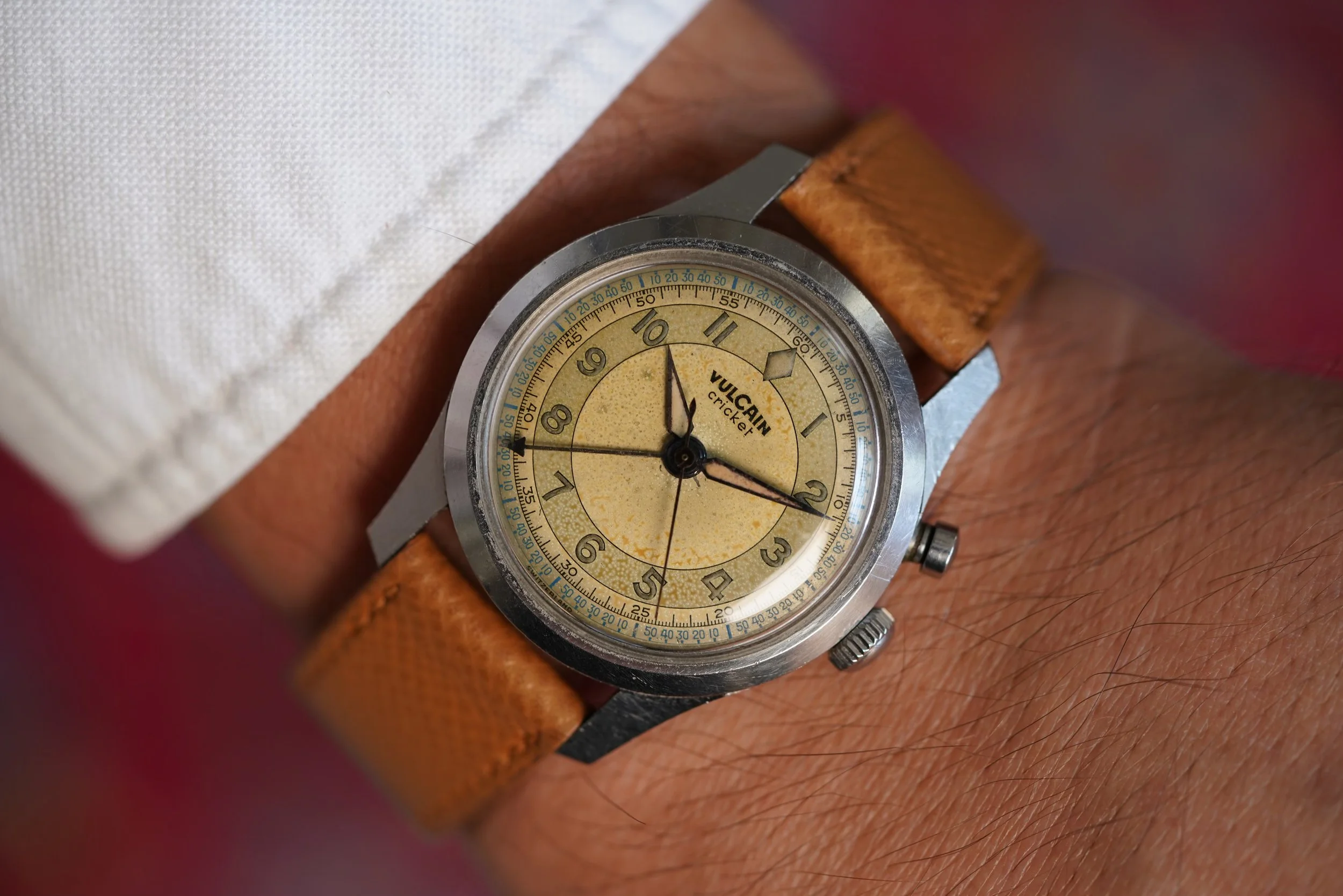
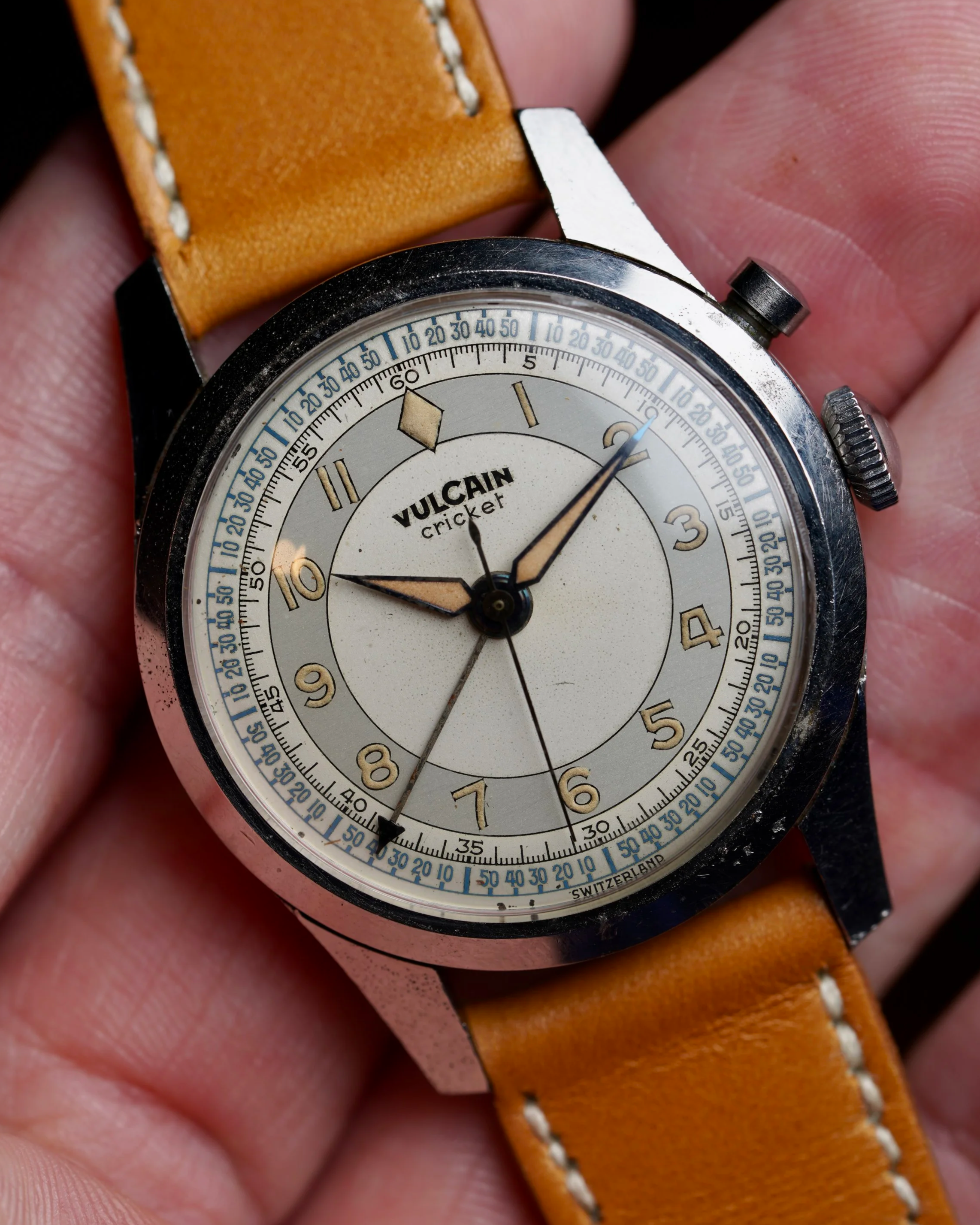
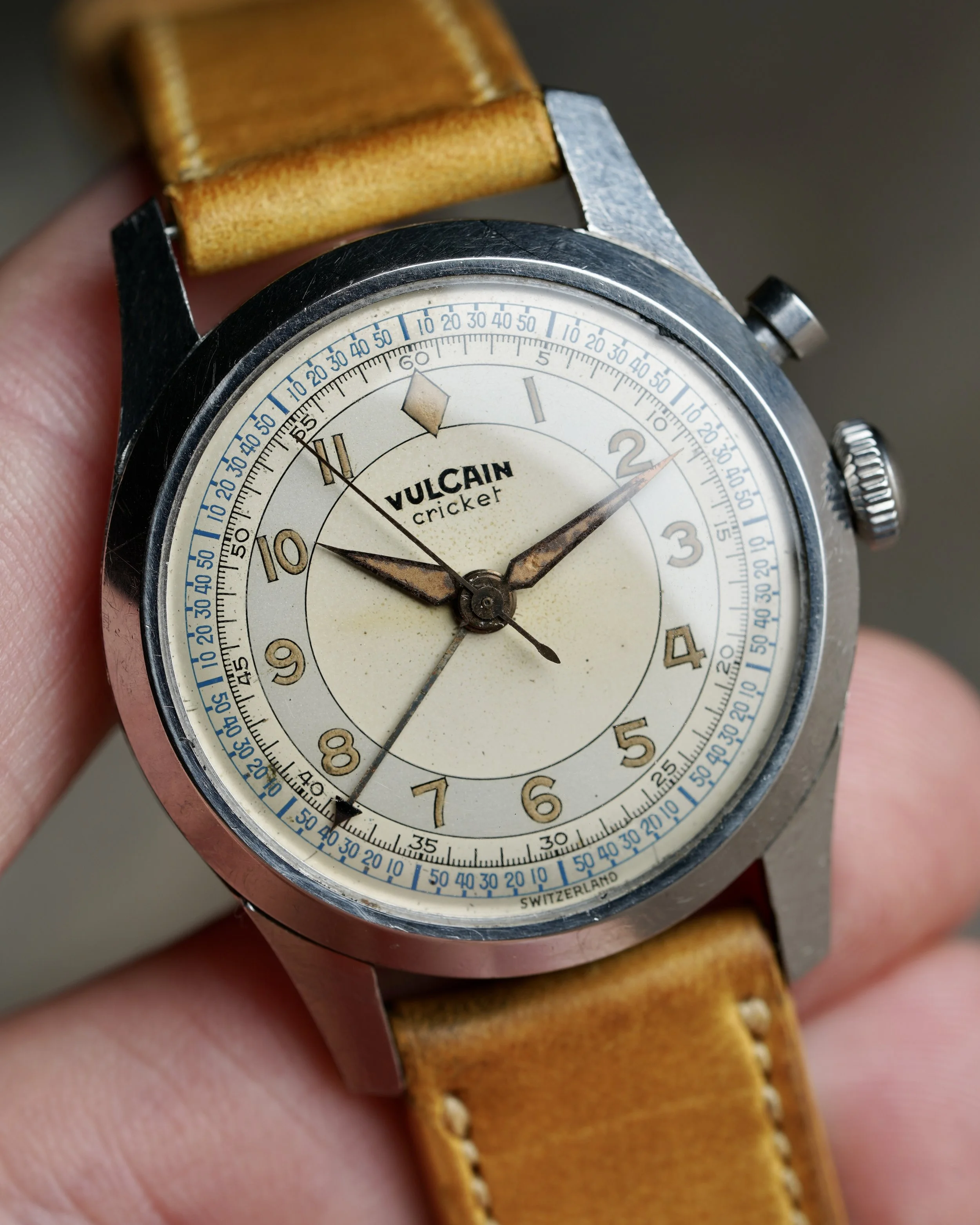
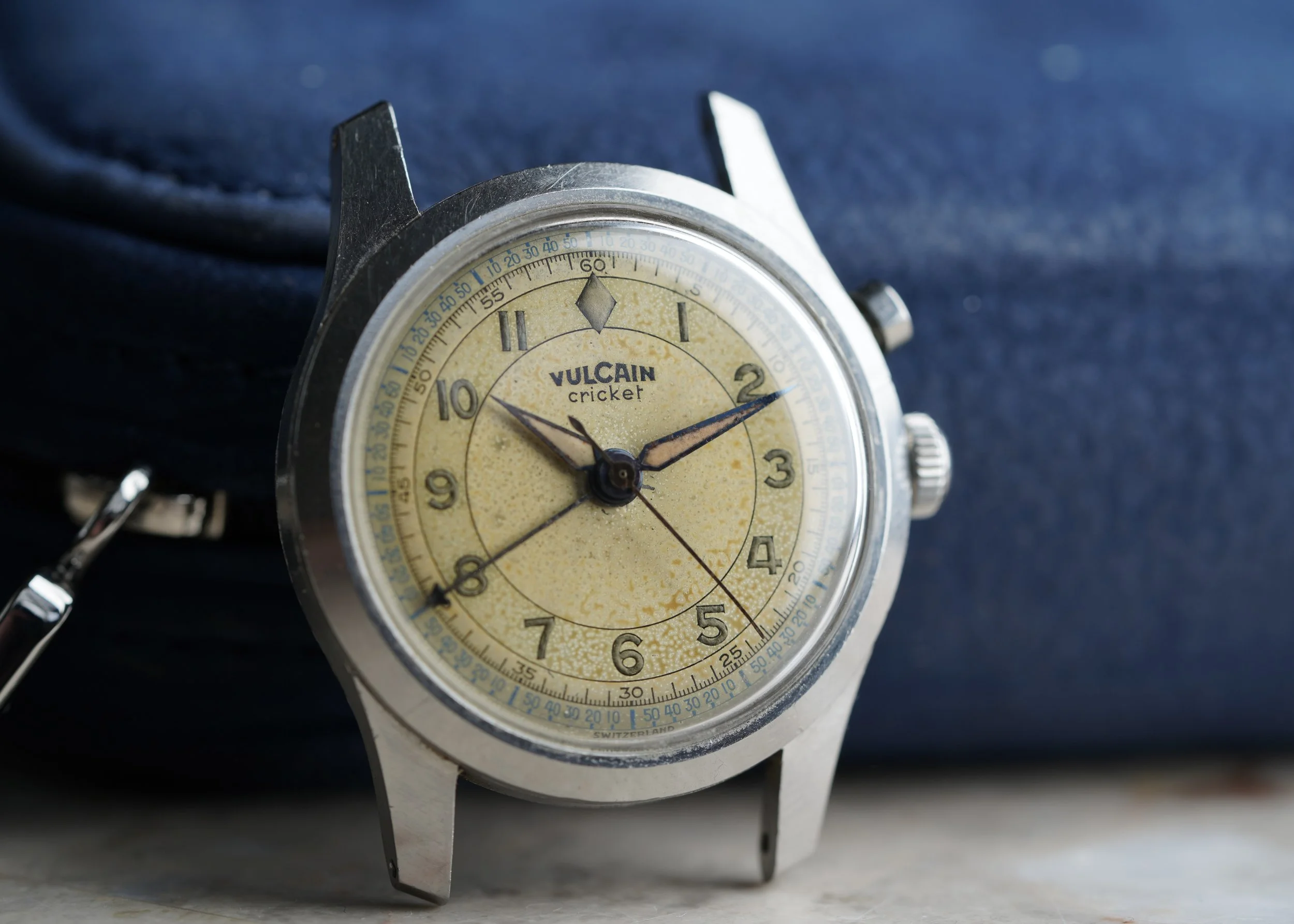
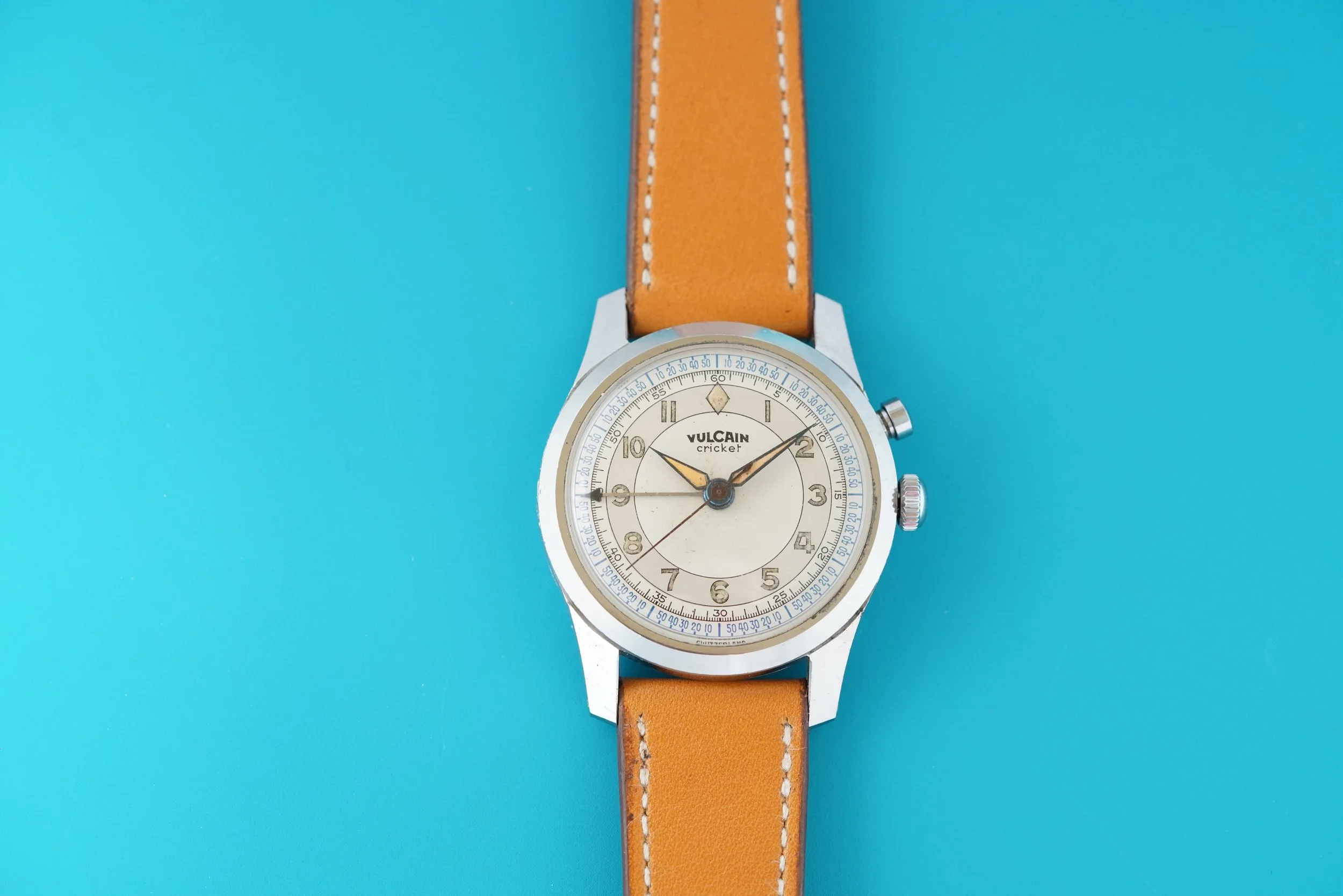
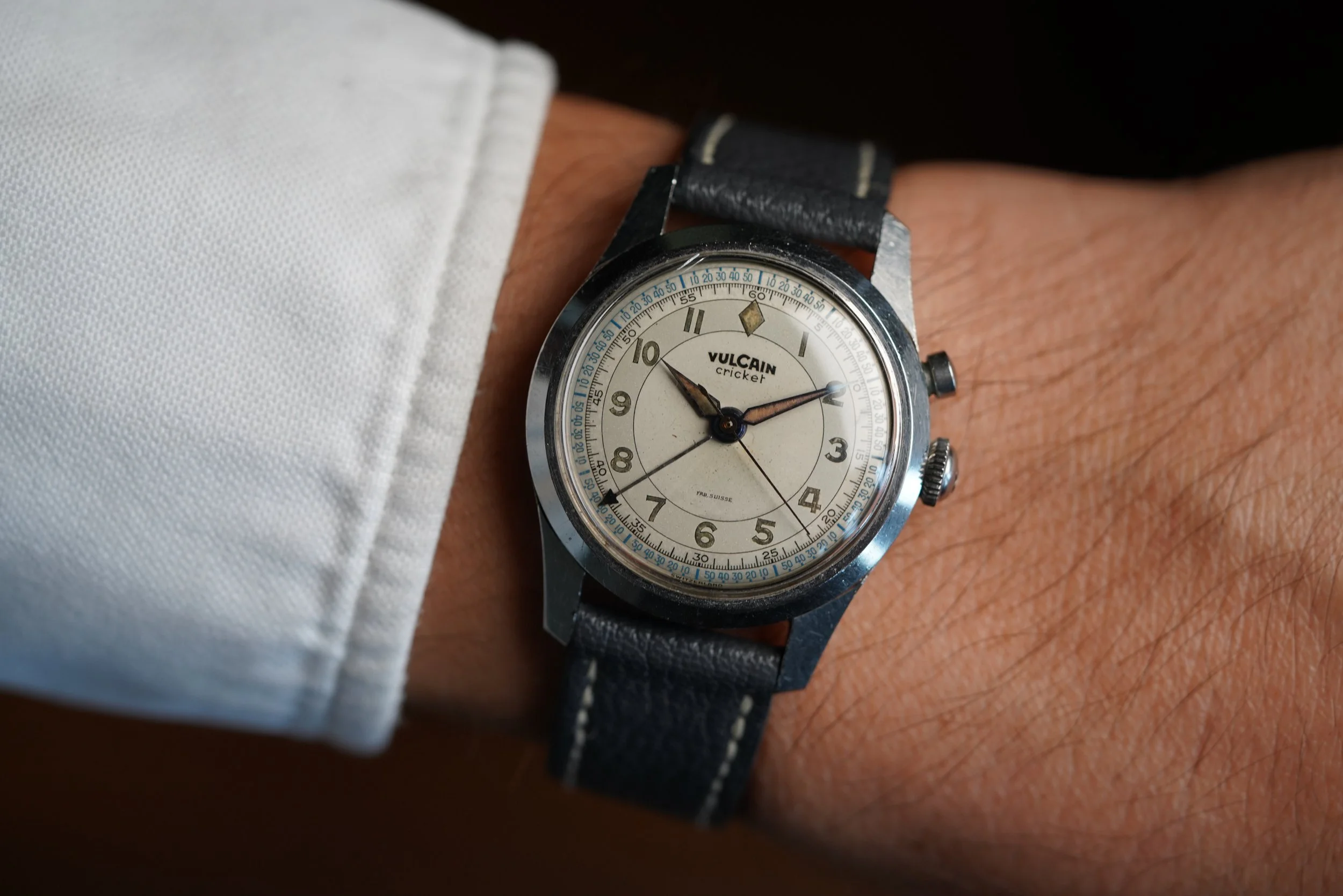
The LBJ dial variant is a nickname associated with the earliest Vulcain Cricket dials due to the variant being worn by the Texan United States Senator Lyndon Baines Johnson (before he became President). Johnson was a huge fan of Crickets and purchased dozens which would be gifted to colleagues over the years. It is believed the only person to give more Crickets as gifts is Eric Wind. Senator Johnson would later adopt Rolex (a Day-Date reference 1803) as his daily while President, but he still loved alarm watches, particularly as gifts! The LBJ dials are probably the most desired variant, and the most common within the OG Cricket, although the feature radium luminous material. You can read about LBJ’s watches in the Guide to Presidential Watches by Eric Wind.
“Fab. Suisse” Dials
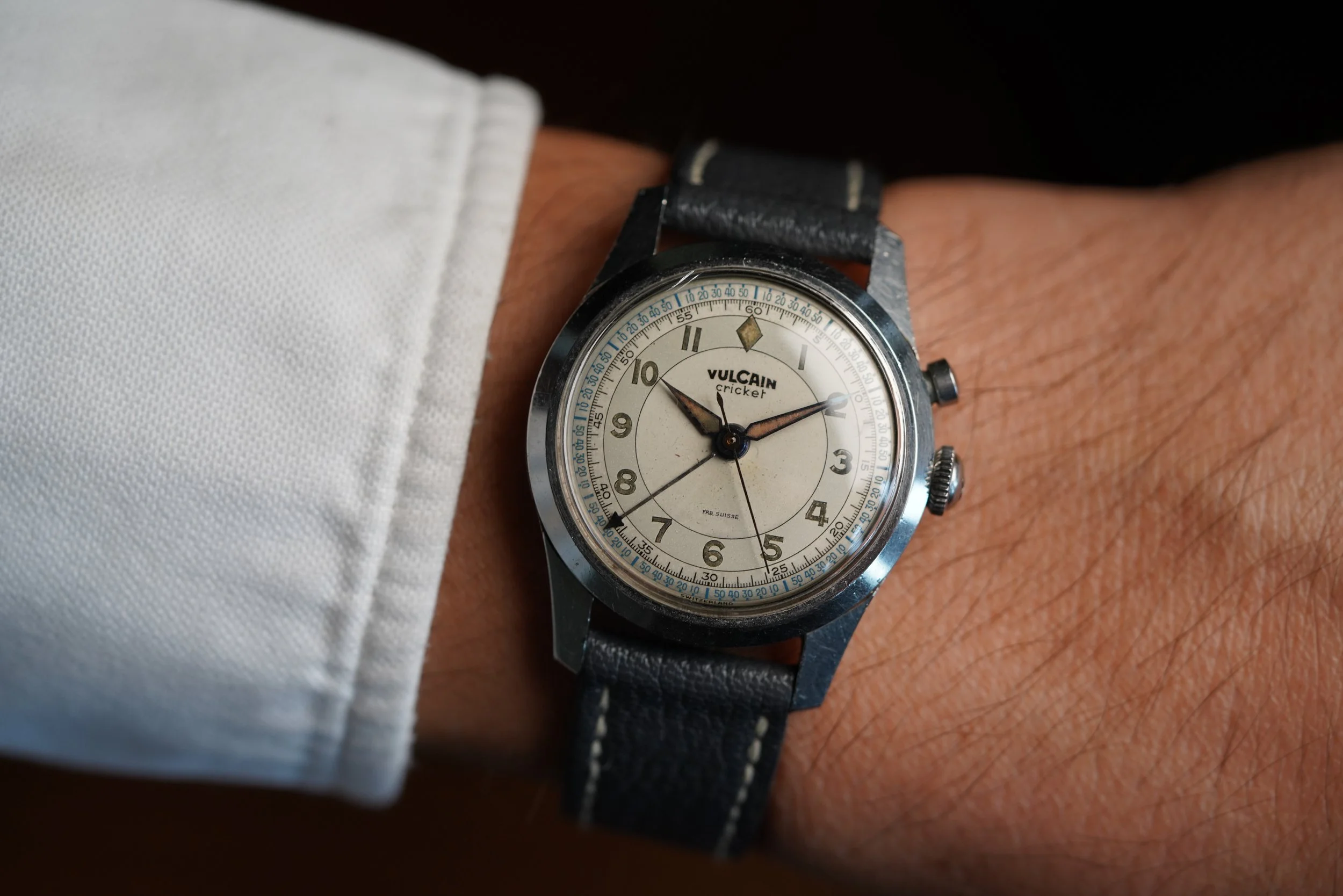
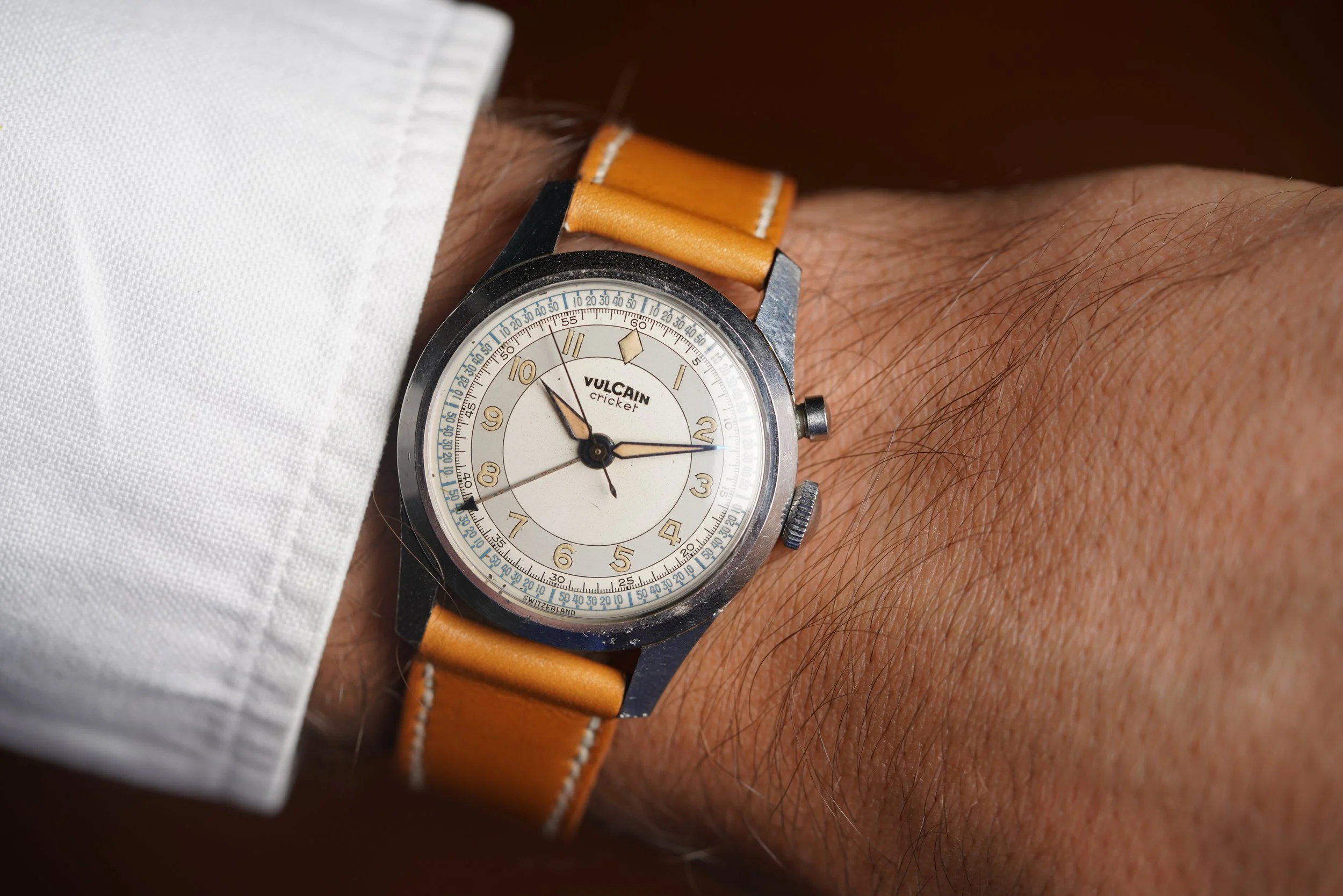
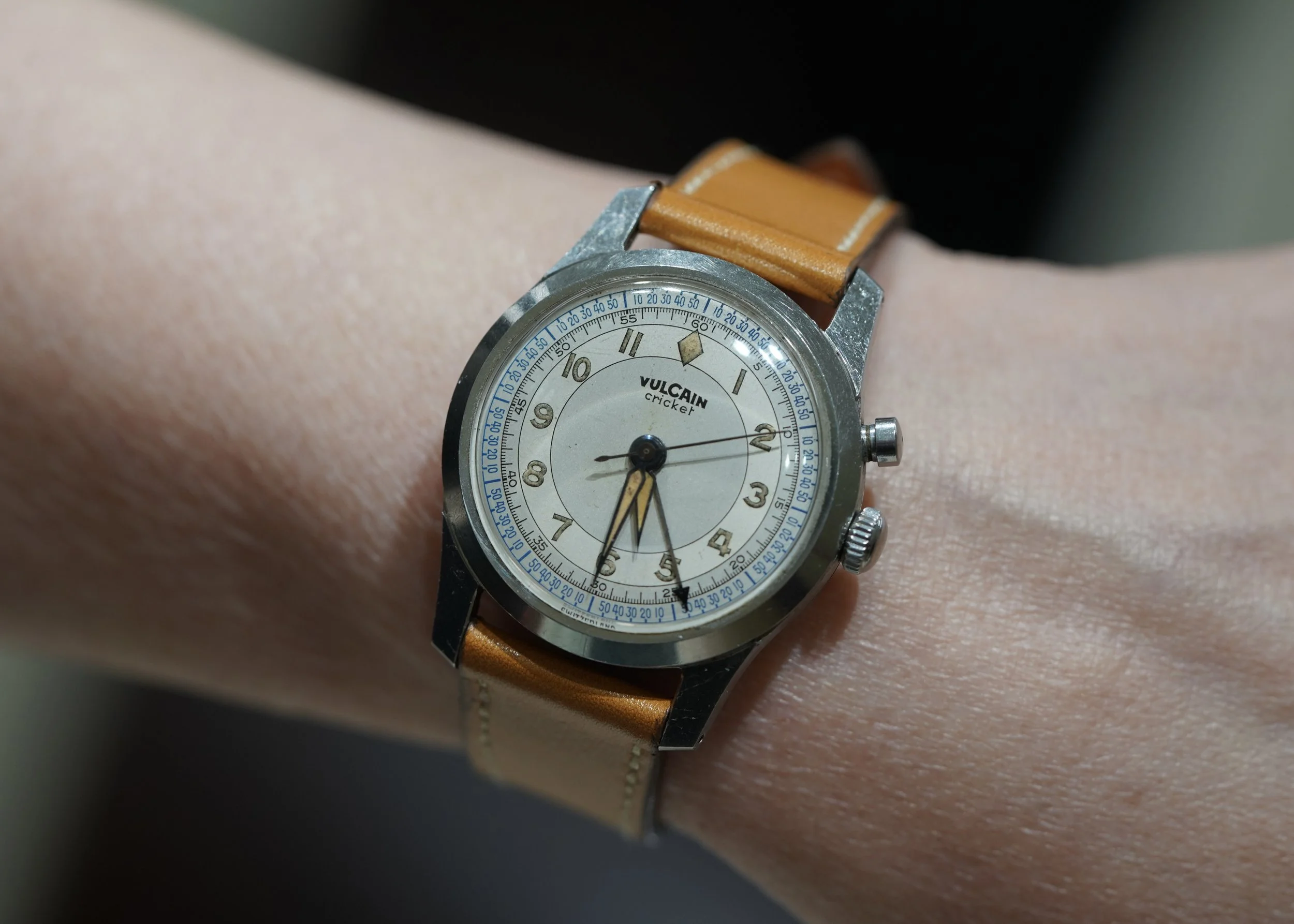
There are also a handful of known examples out there with “Fab. Suisse” signed dials. Most are early luminous two-tone dials with full Arabic numeral layouts. There are also non-luminous models with applied numerals that are seldom seen. The “Fab. Suisse” signed dials are very rare, and I’m man enough to admit I was a bit jealous of collectors who scored these years back while having around 10 Vulcain Crickets in my collection at the time. “Fab. Suisse” on the dial meant that the watch was meant for export from Switzerland to the French market. On these early OG watches with Fab. Suisse on the dial, there was typically a secondary three-digit number below the serial number that Eric theorizes was for the batch and easier tracking of the export order.
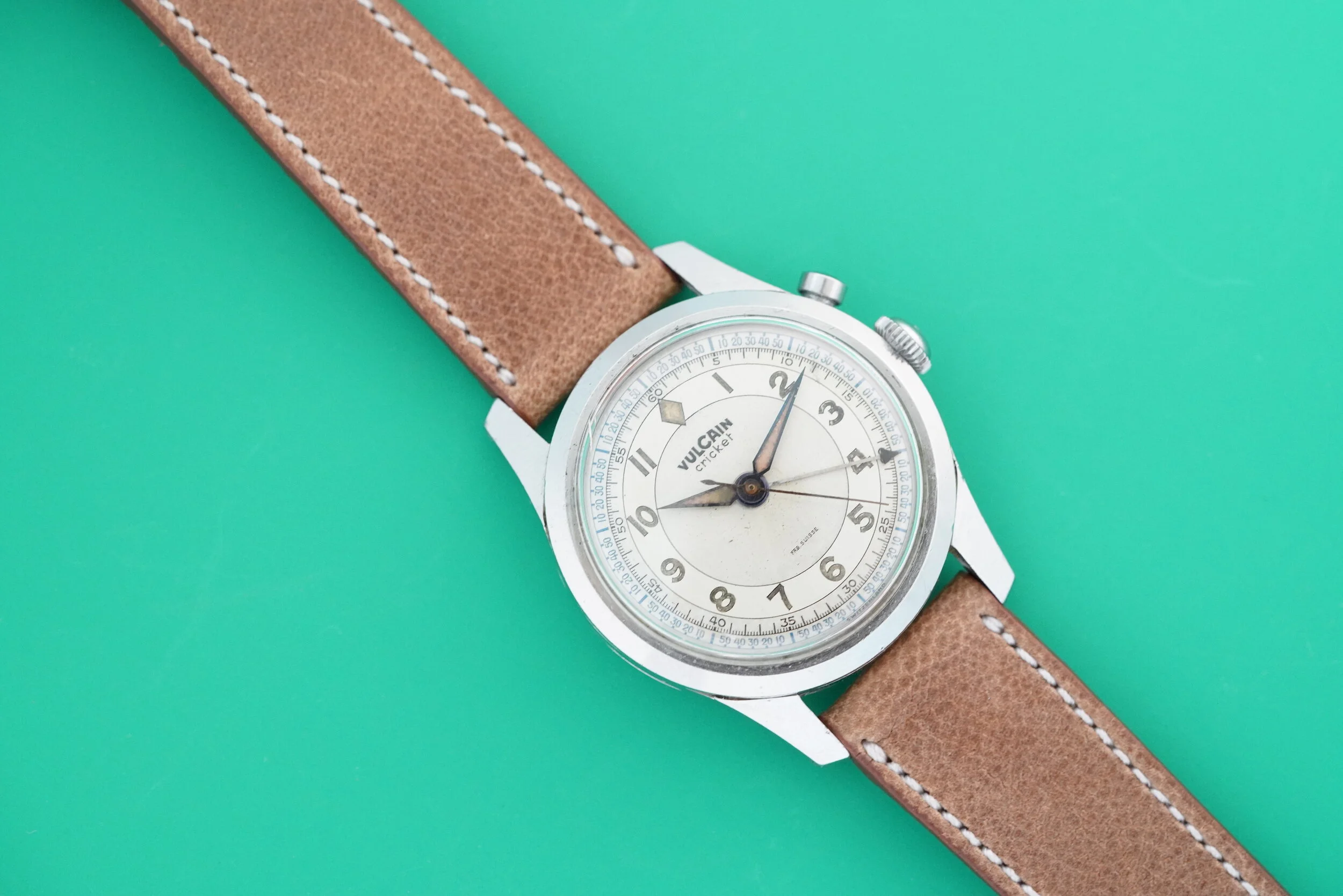
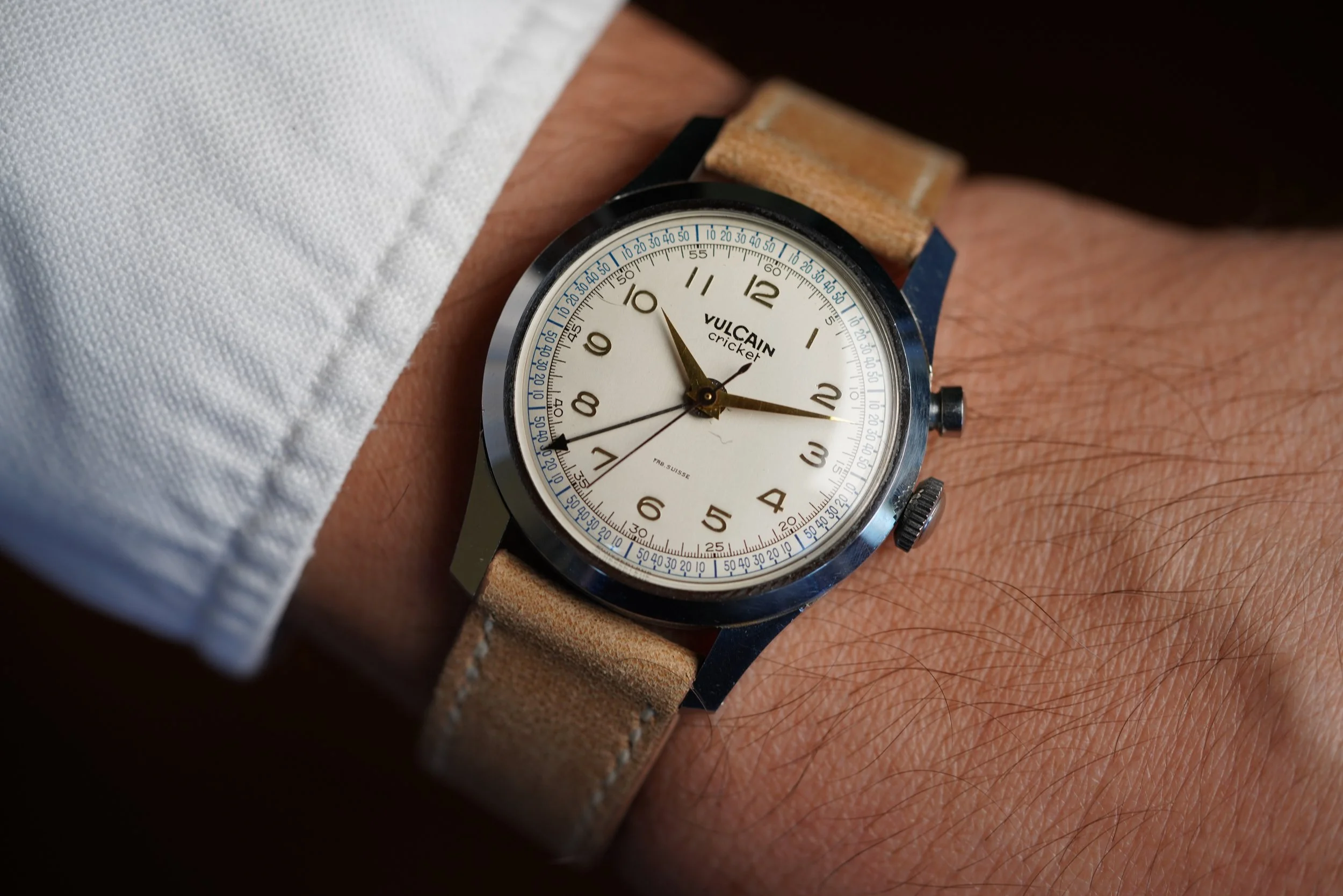
Full Arabic Numerals (Non-Luminous)
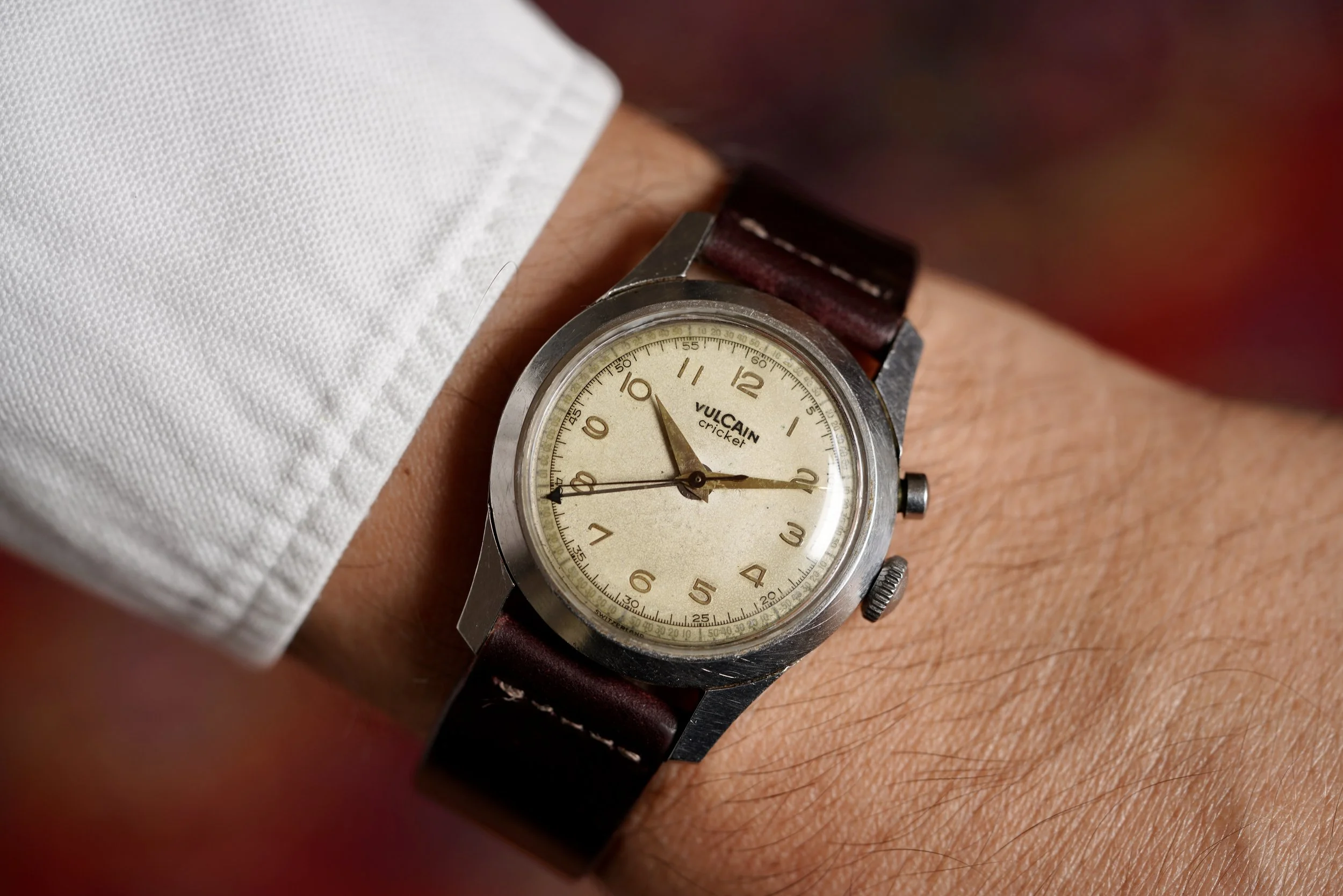
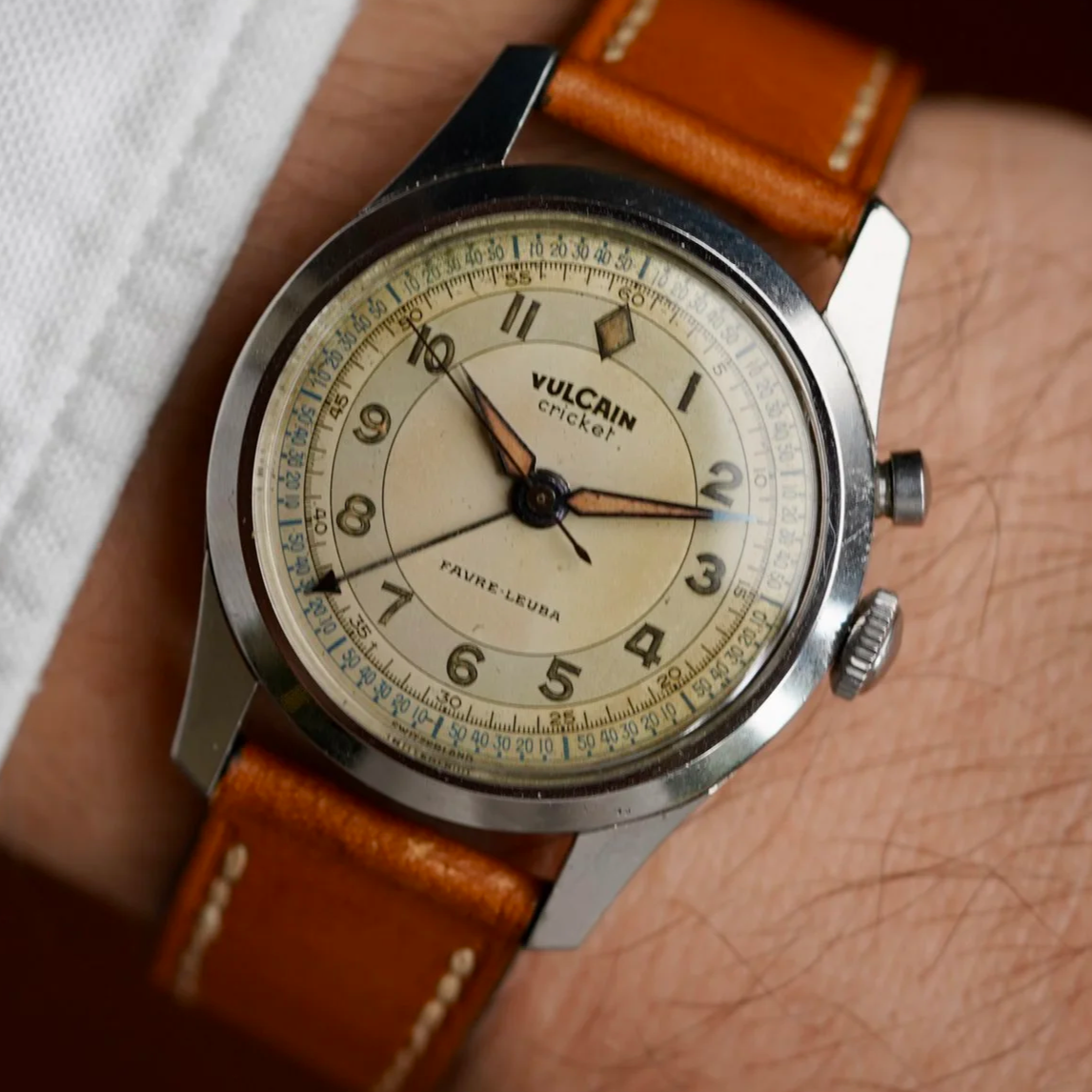
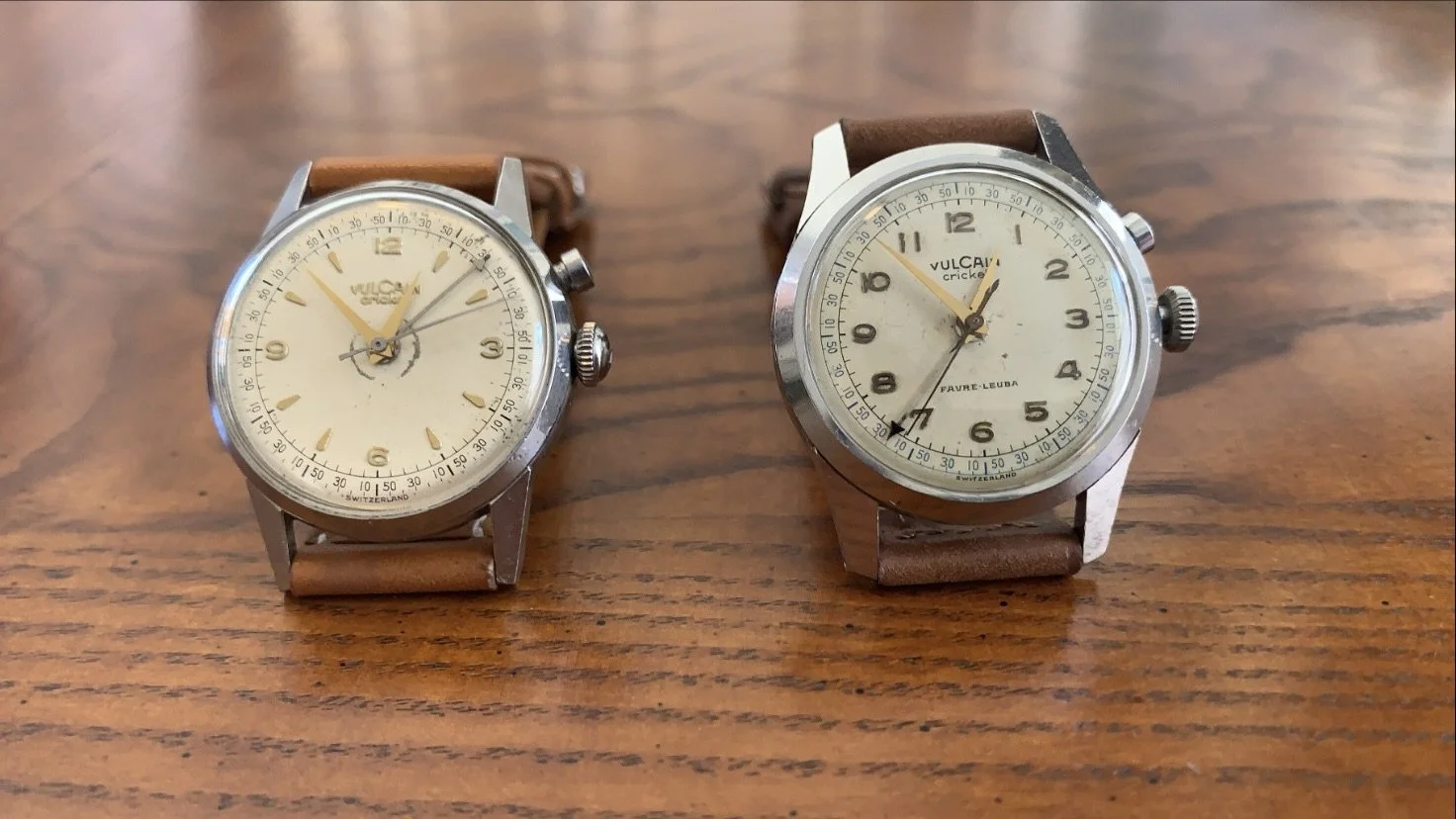
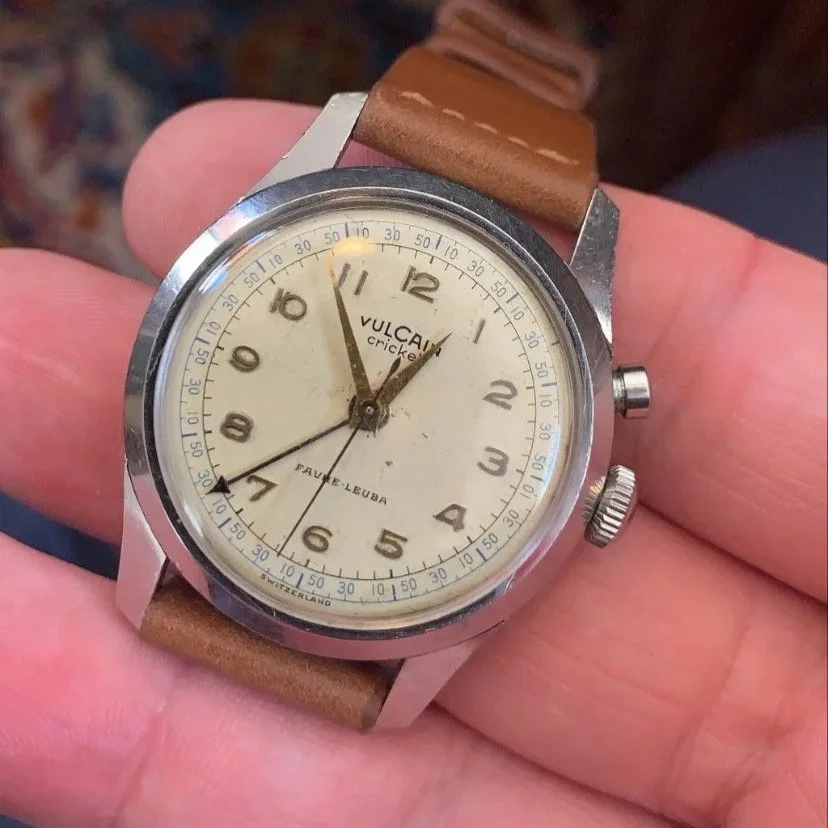
The Fab. Suisse dials (as well as Favre-Leuba dials) can be seen with non-luminous, full-Arabic numerals dials. These are one of the less common formats. The handsets are a bit wider than non-luminous dials with Arabic and Roman numerals at 3, 6, 9, and 12 o’clock. It seems as though the outer demarcations are blue, but it is possible that some were black. Compared to the LBJ dials, the “VULCAIN” font is slightly less bold.
Favre-Leuba
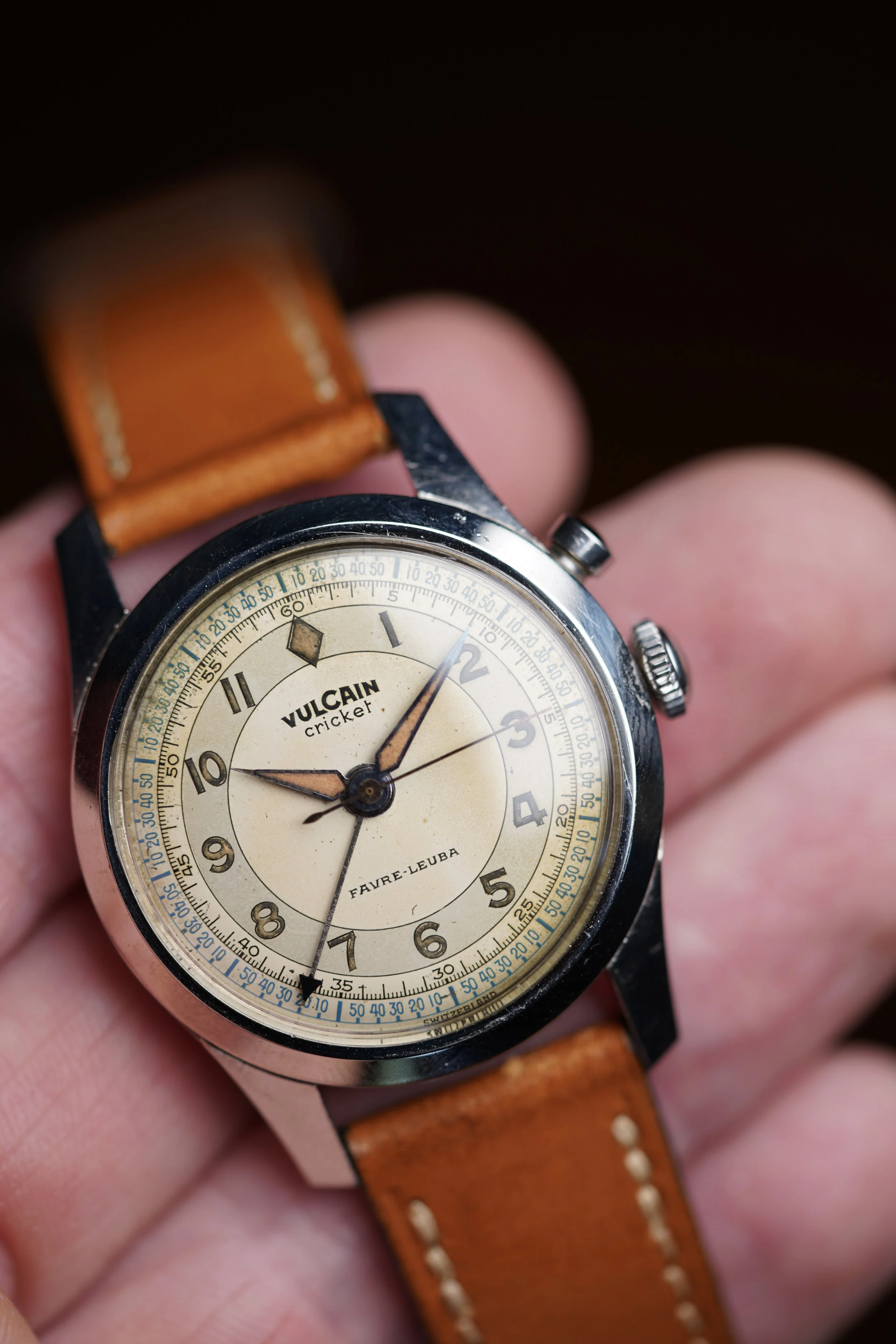
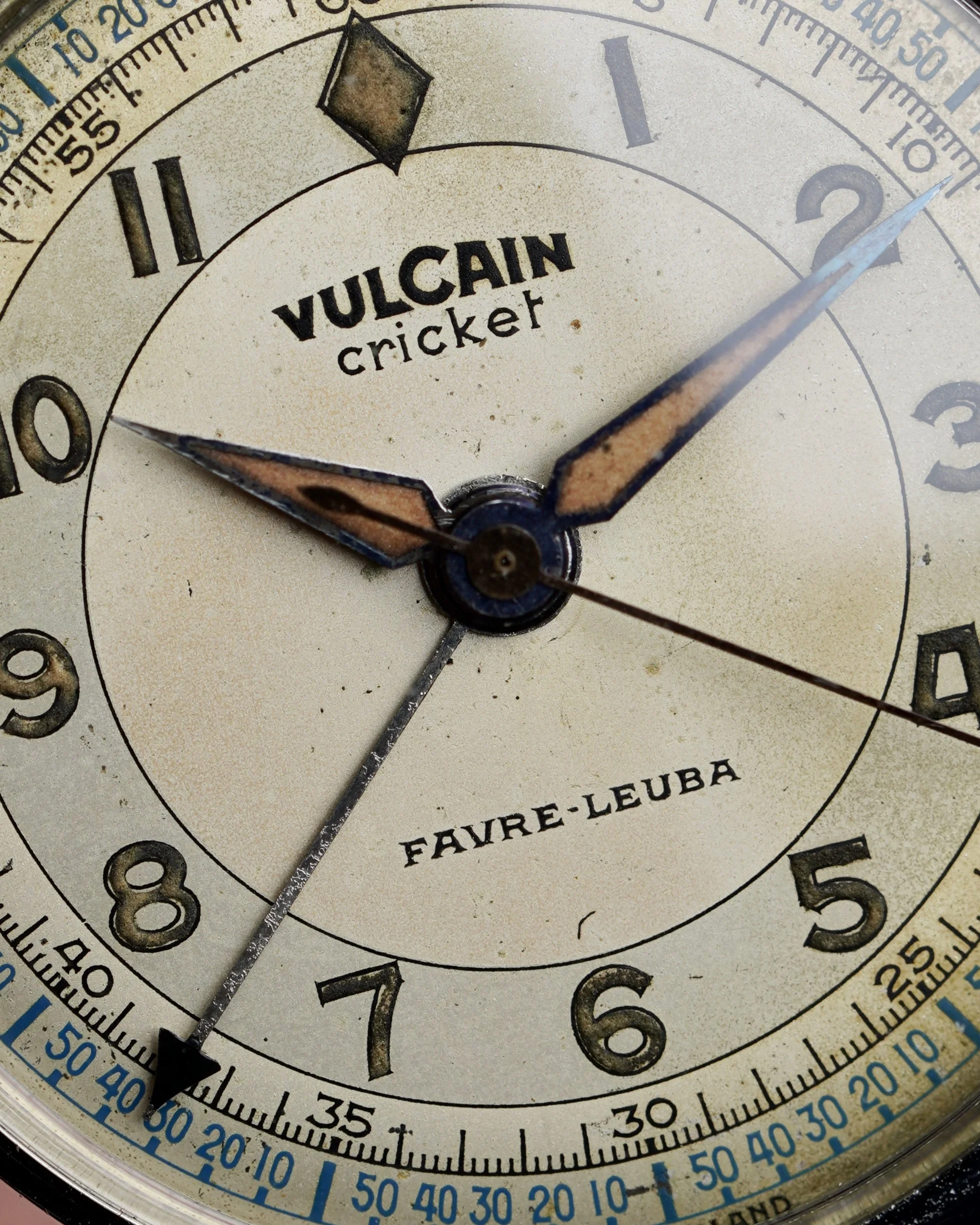
Even rarer are the Favre-Leuba double-signed dials. We are aware of three examples! Favre-Leuba was purportedly the distributor for many watch manufacturers in Calcutta, India prior to being a “manufacturer”. Given the tropical environment and heat, the dials often had a tough life in the non-water-resistant case.
Roman Numeral Dials
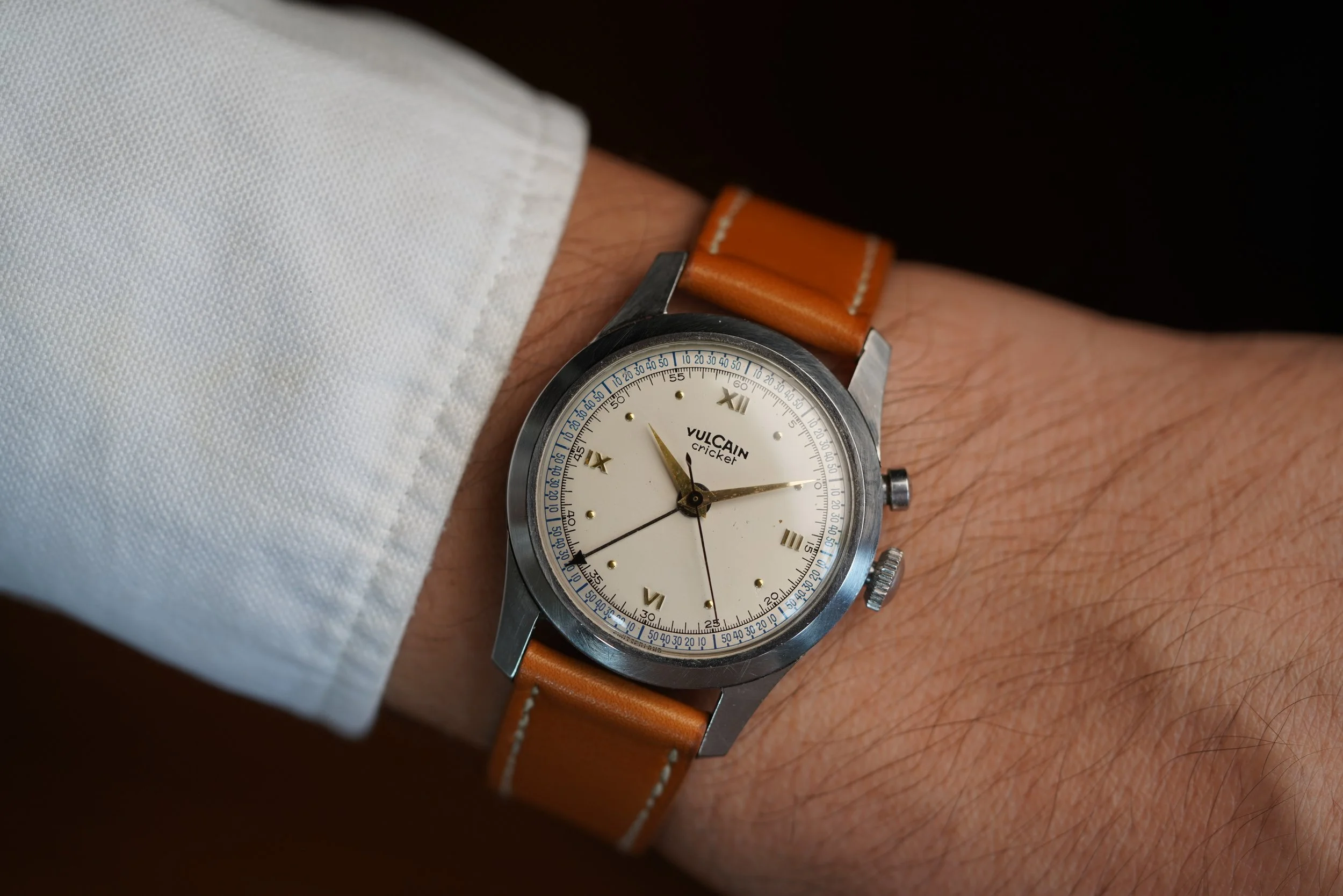
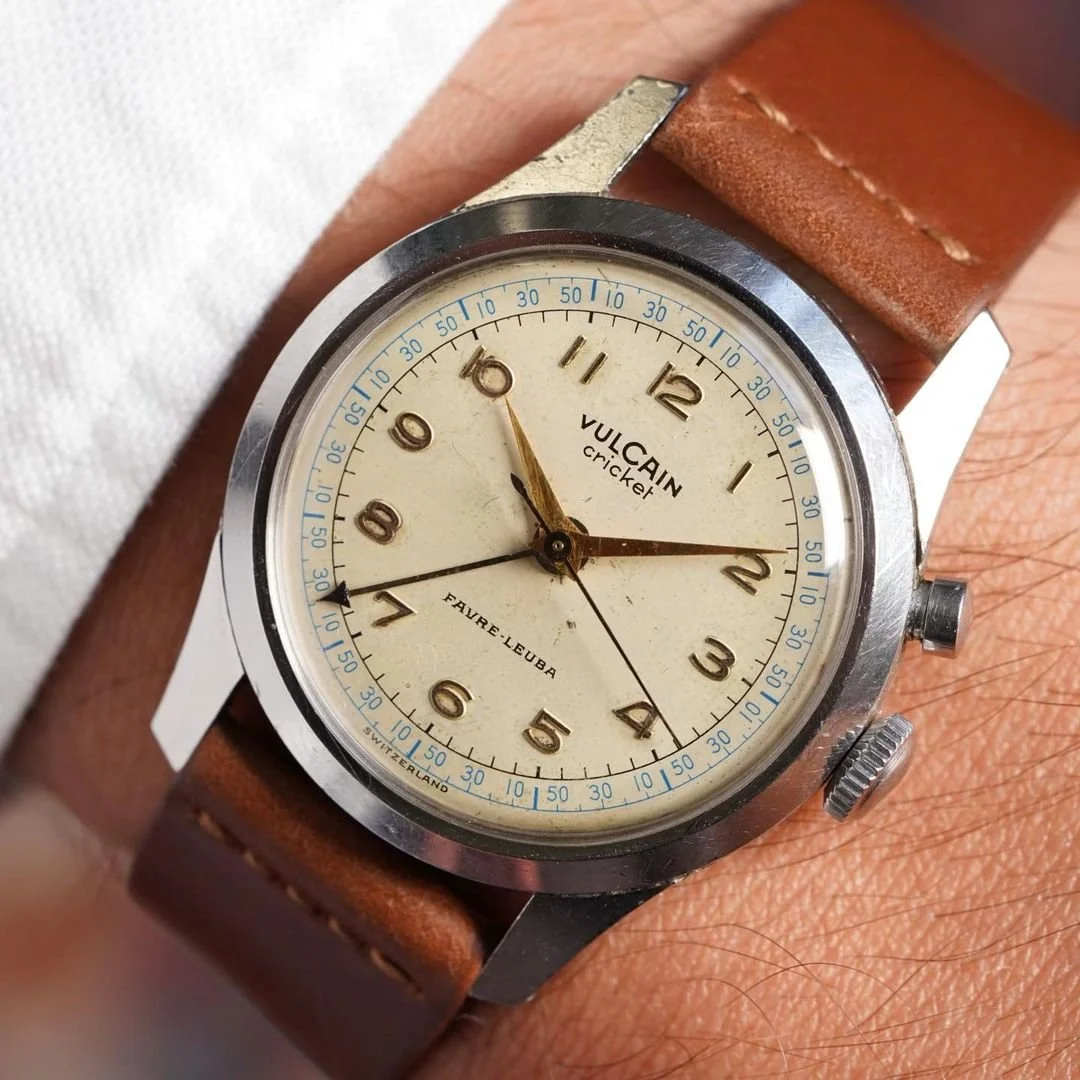
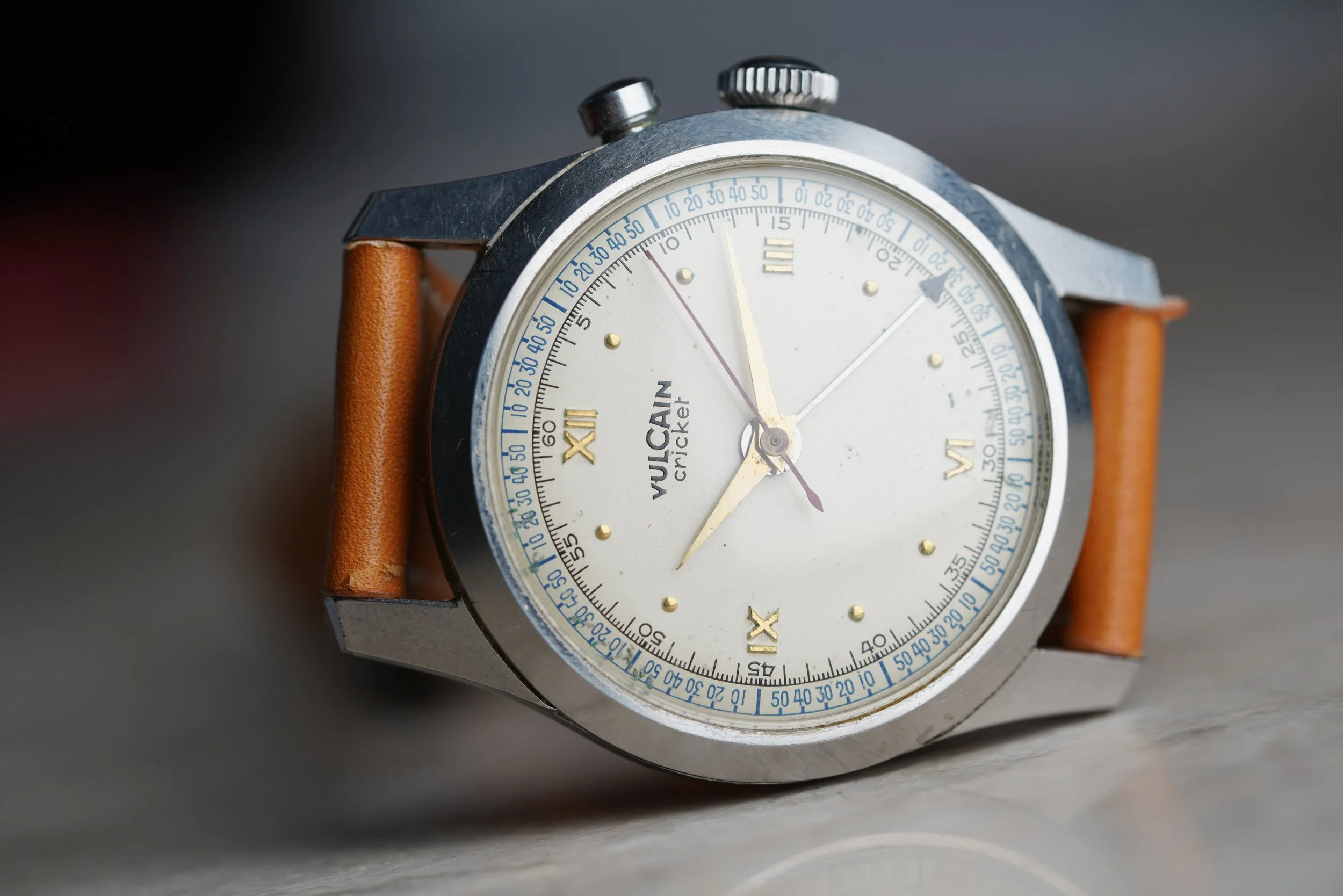
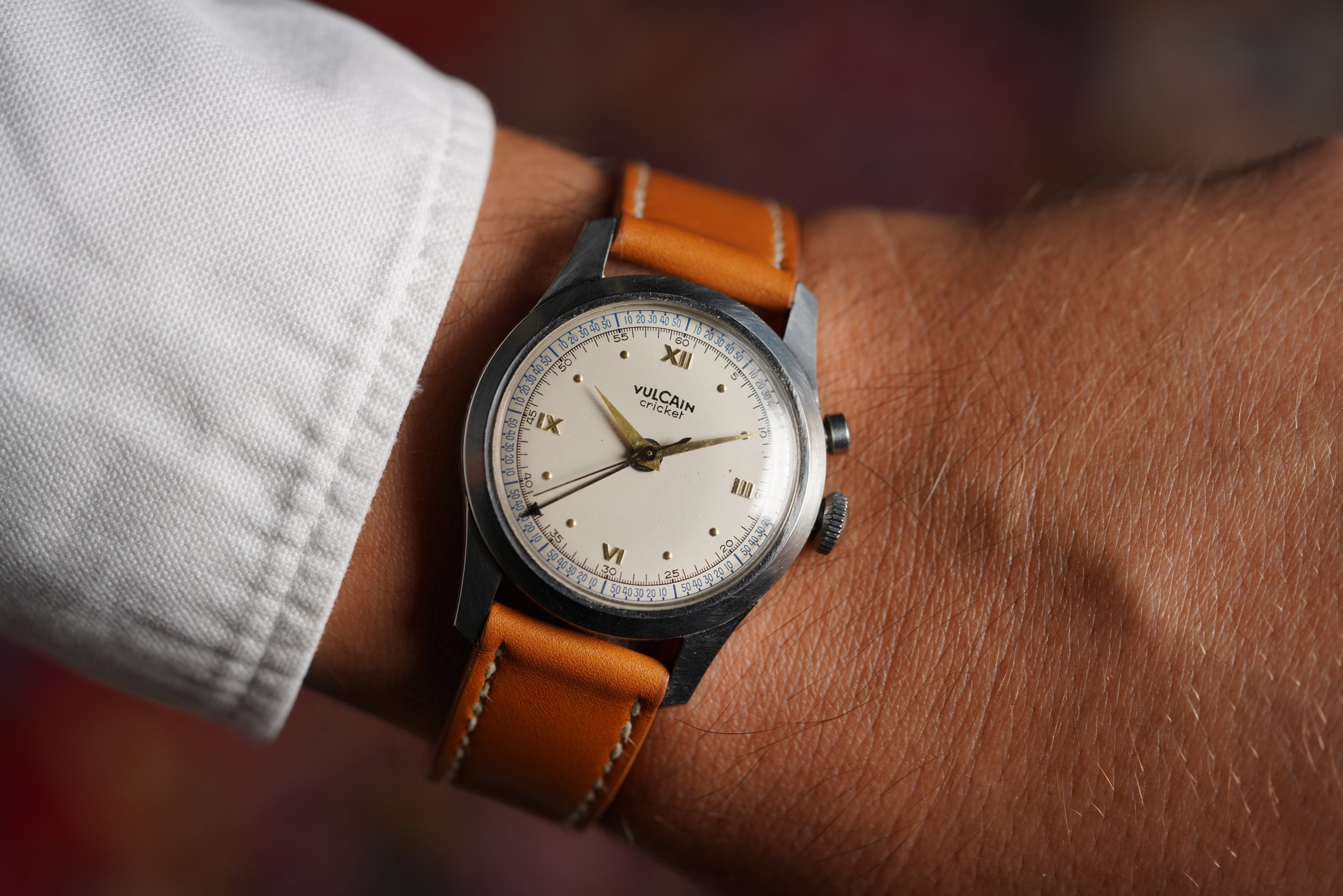
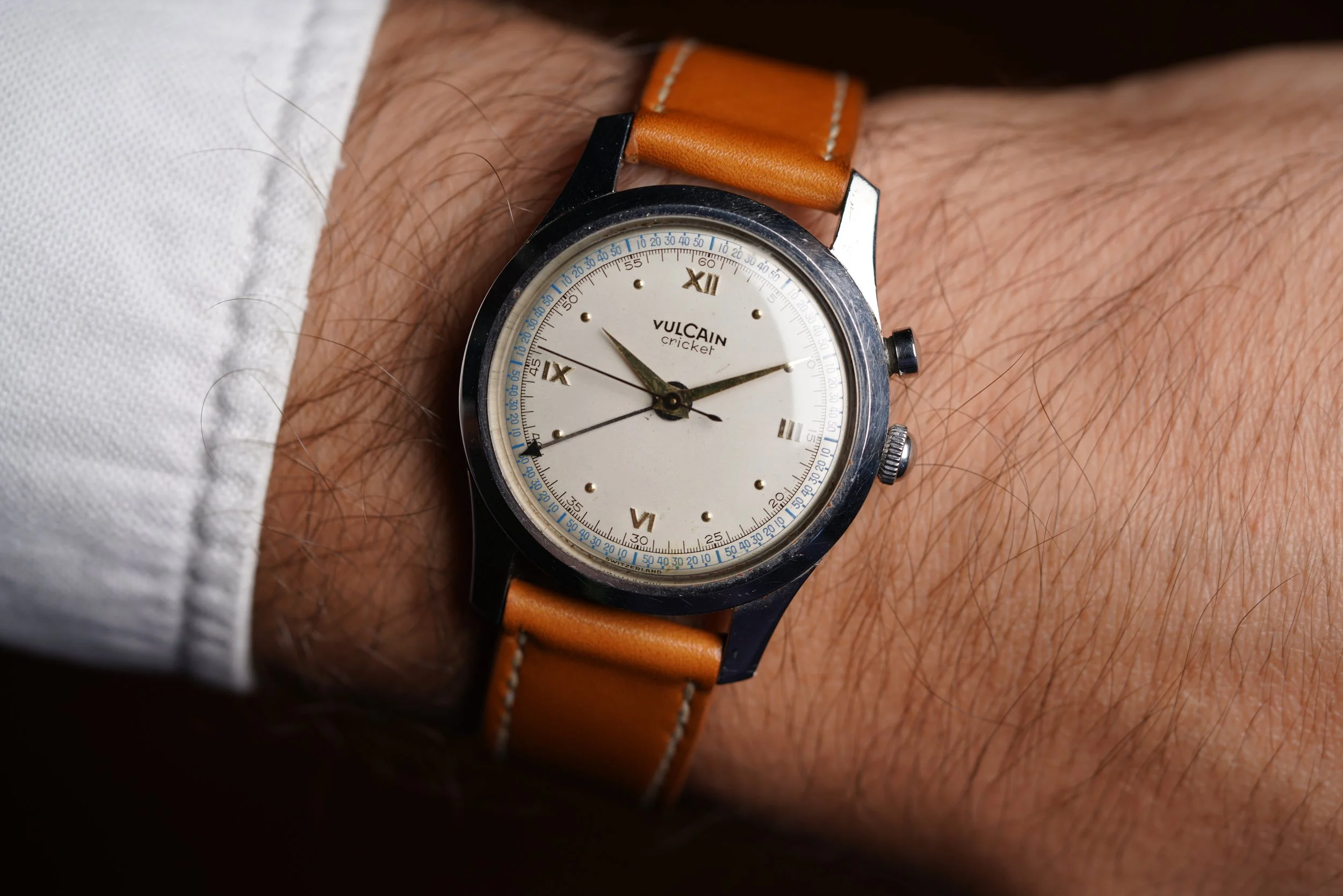
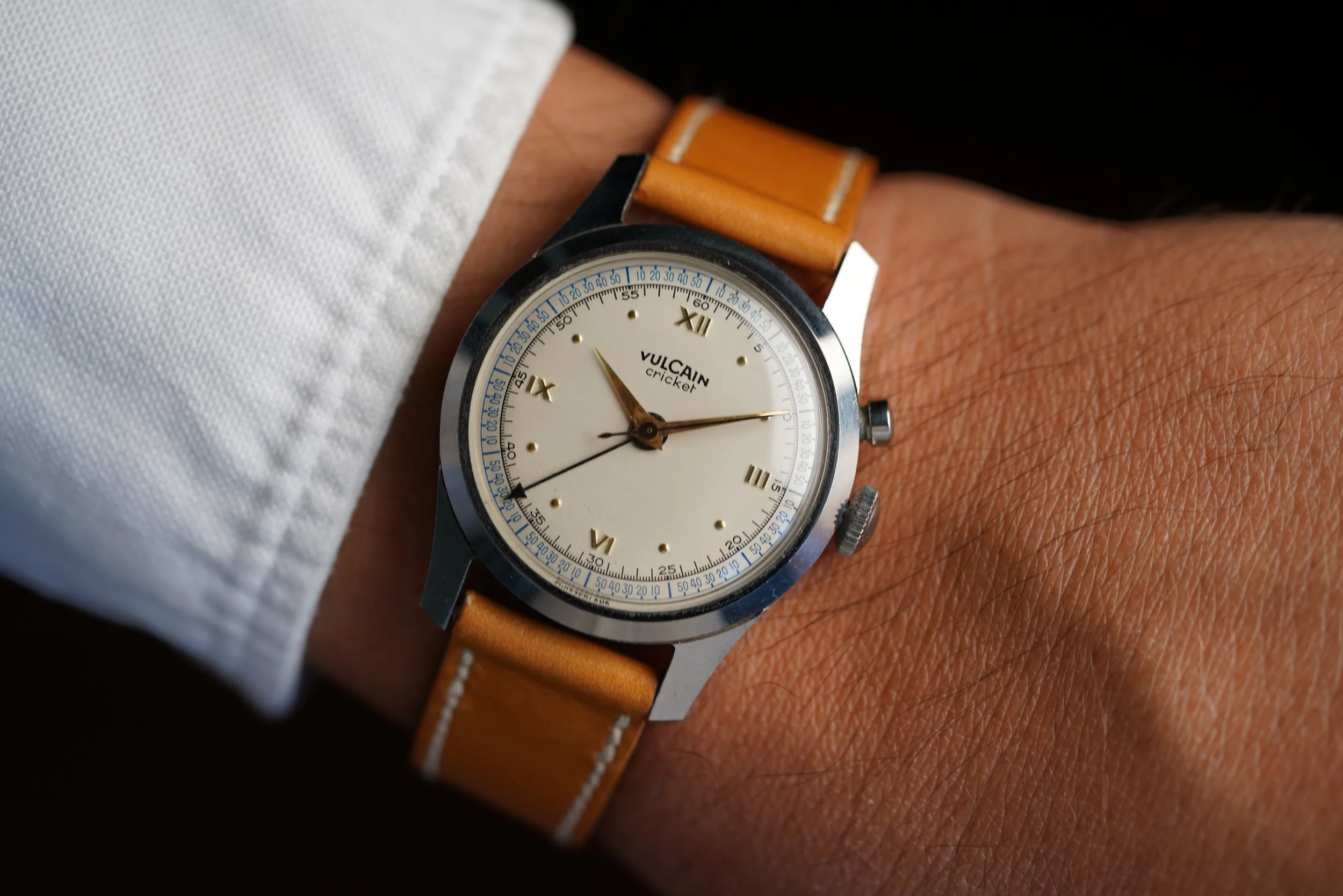
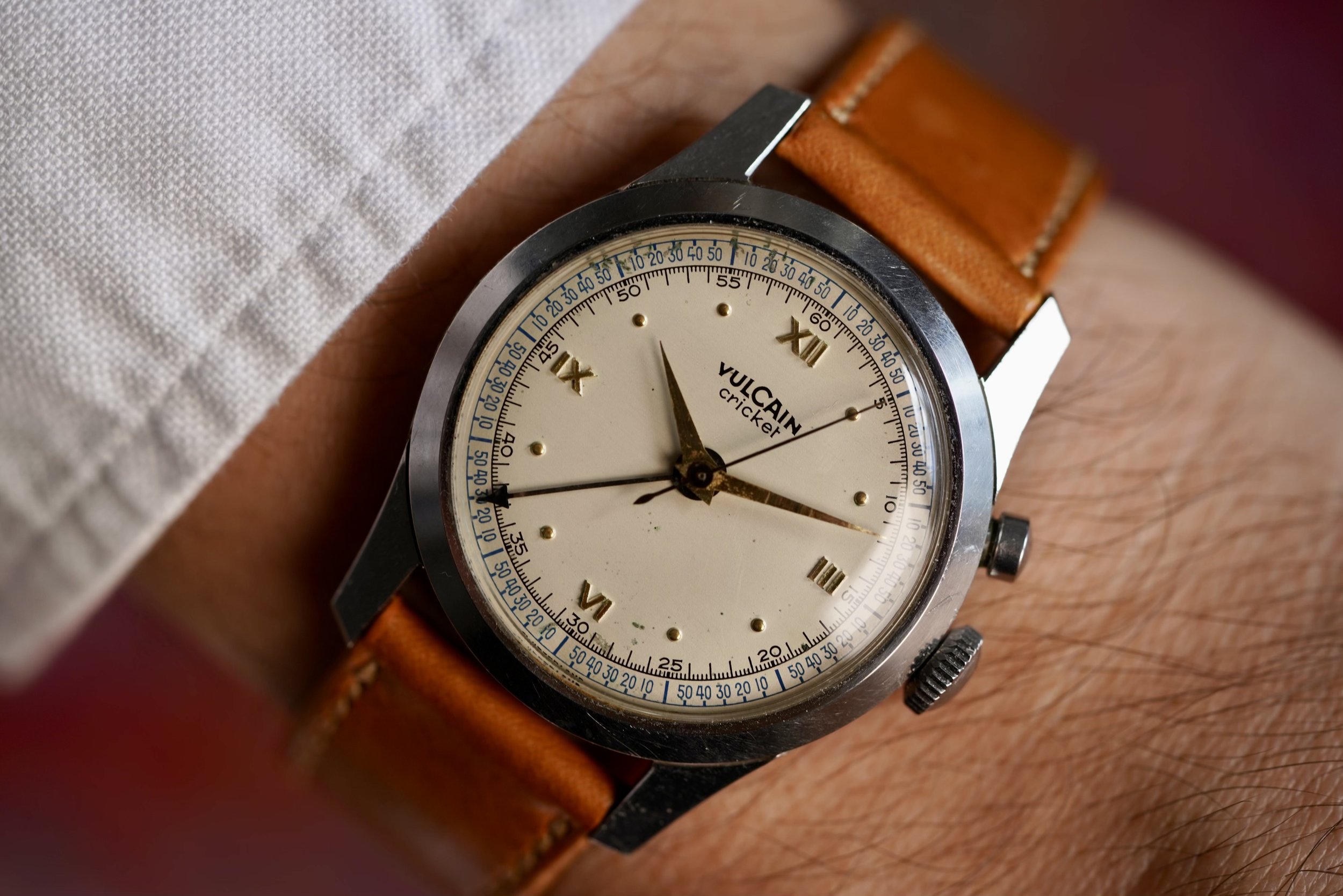
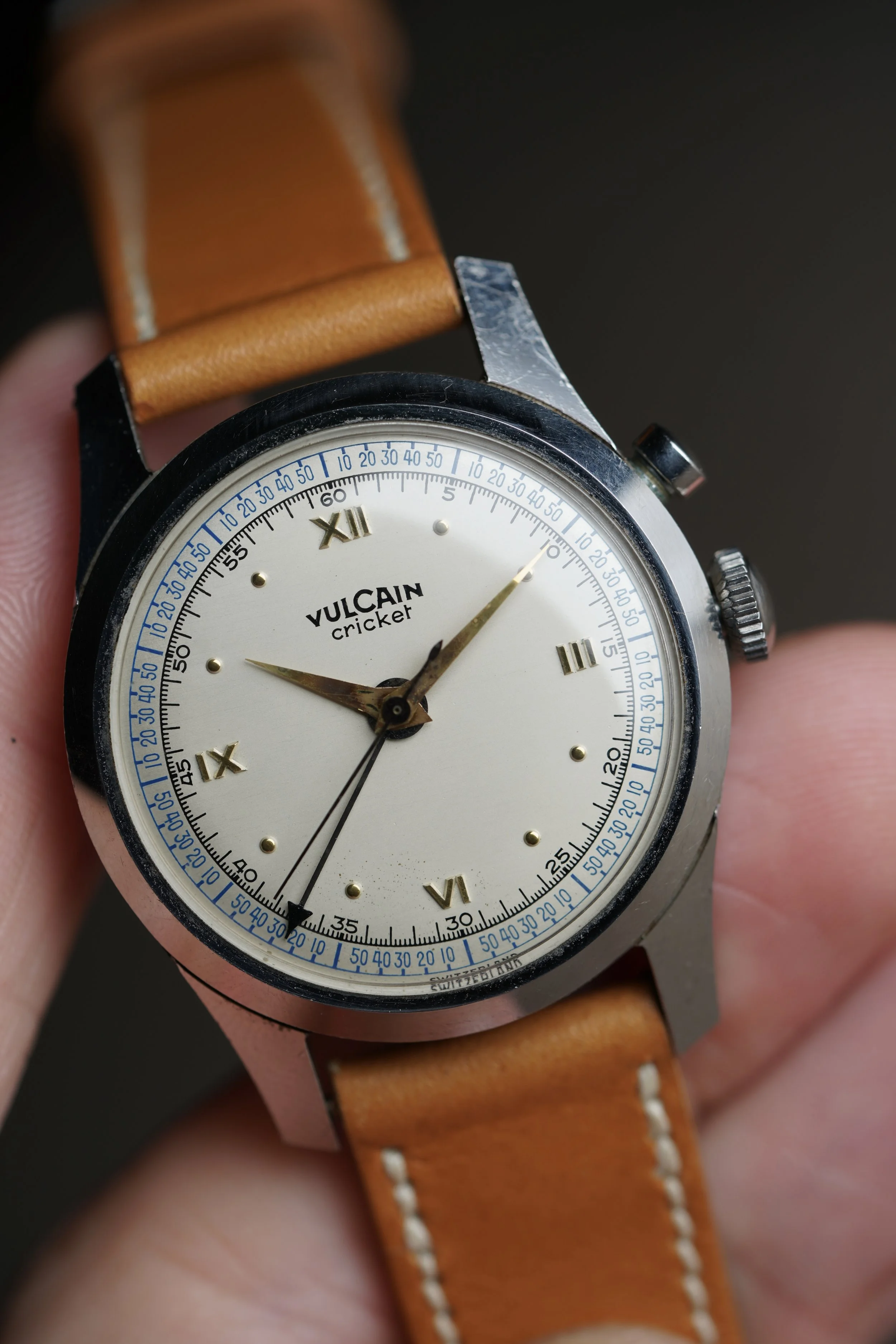
There are also non-luminous Roman numeral dial variants. These feature blue the same blue decimal track around the dial with gold Roman numerals at 3, 6, 9, and 12 o’clock with sphere markers. As mentioned prior, the handsets are thinner within these non-luminous Roman and Arabic dial variants.
Hodinkee
Arabic 3, 6, 9 & 12
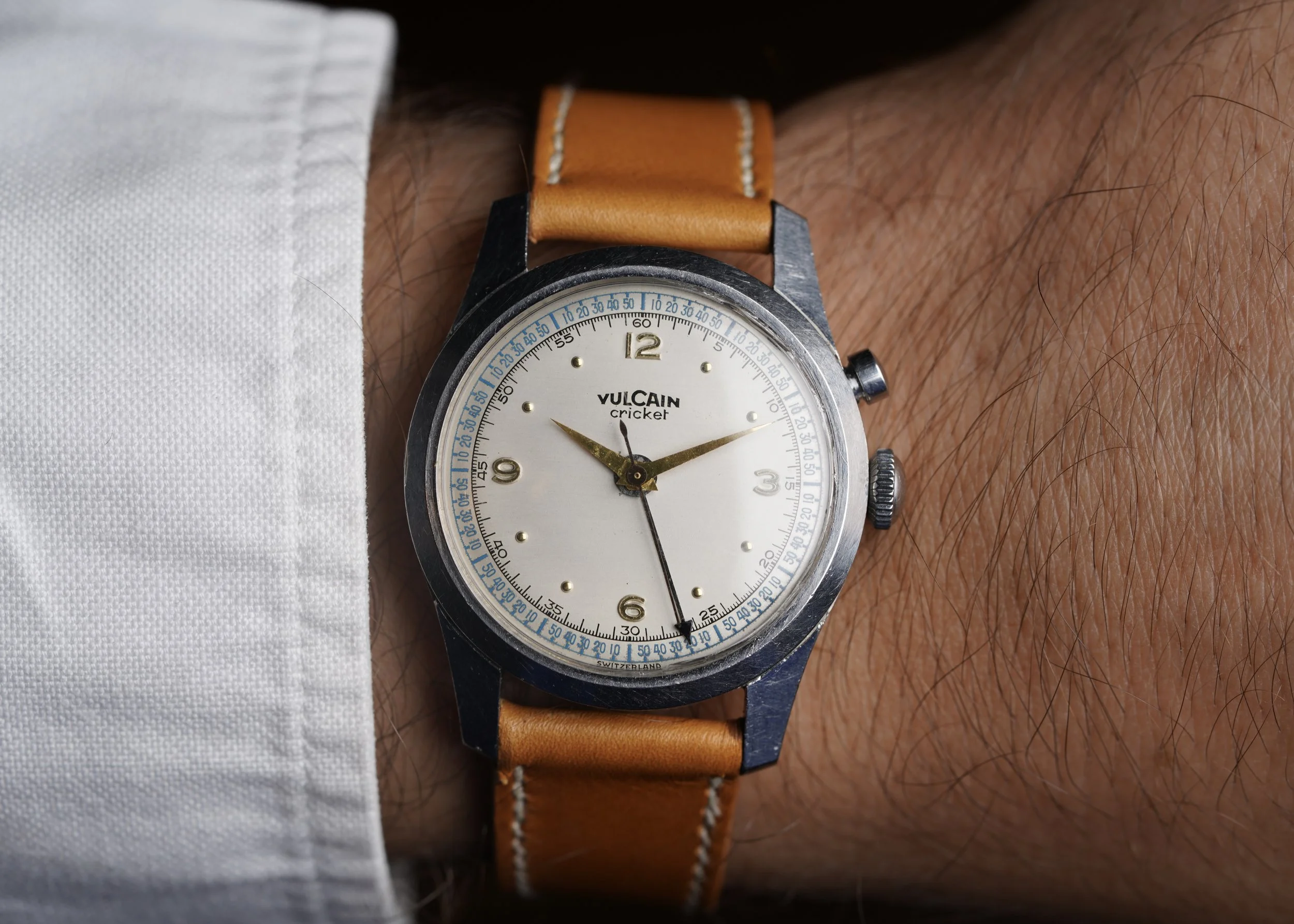
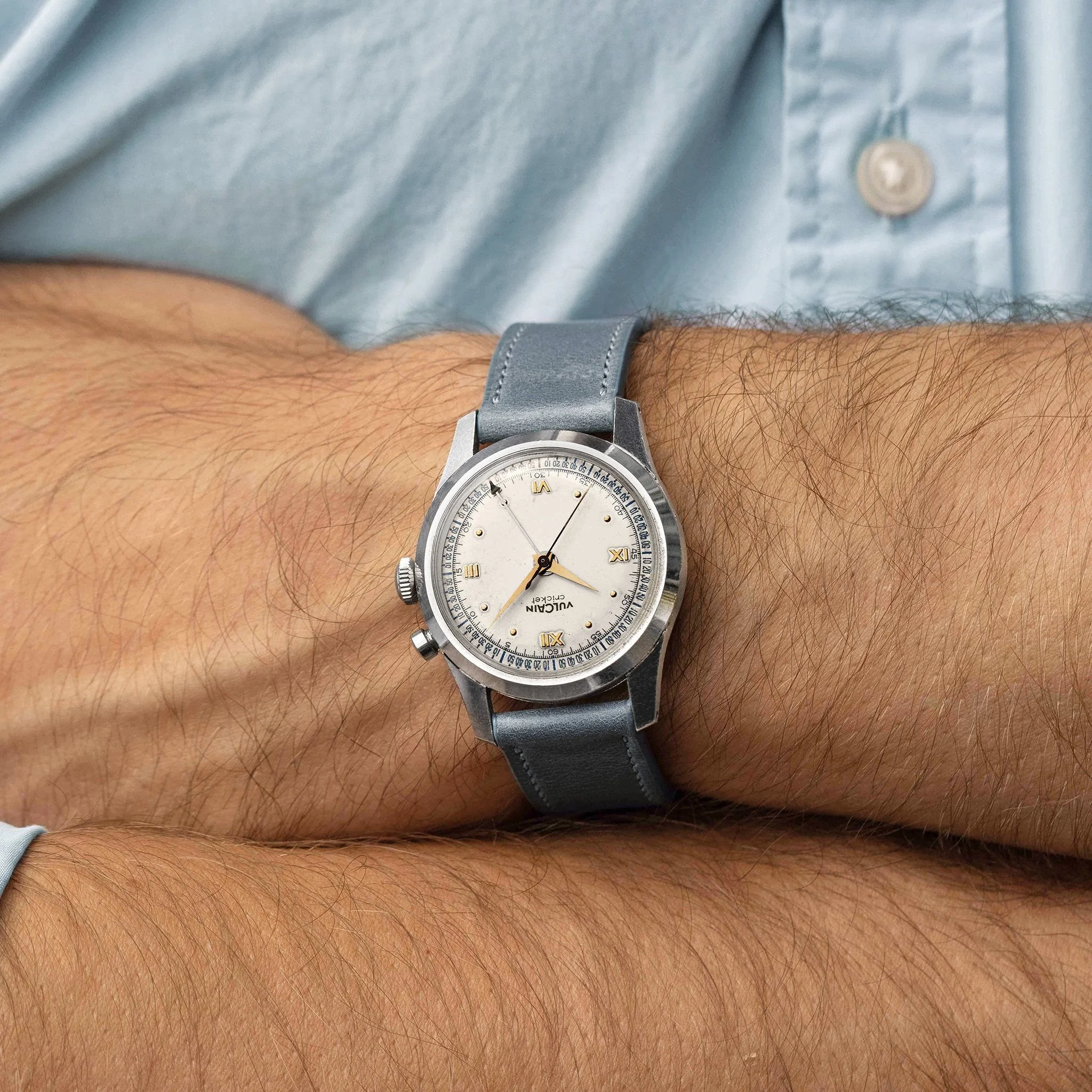
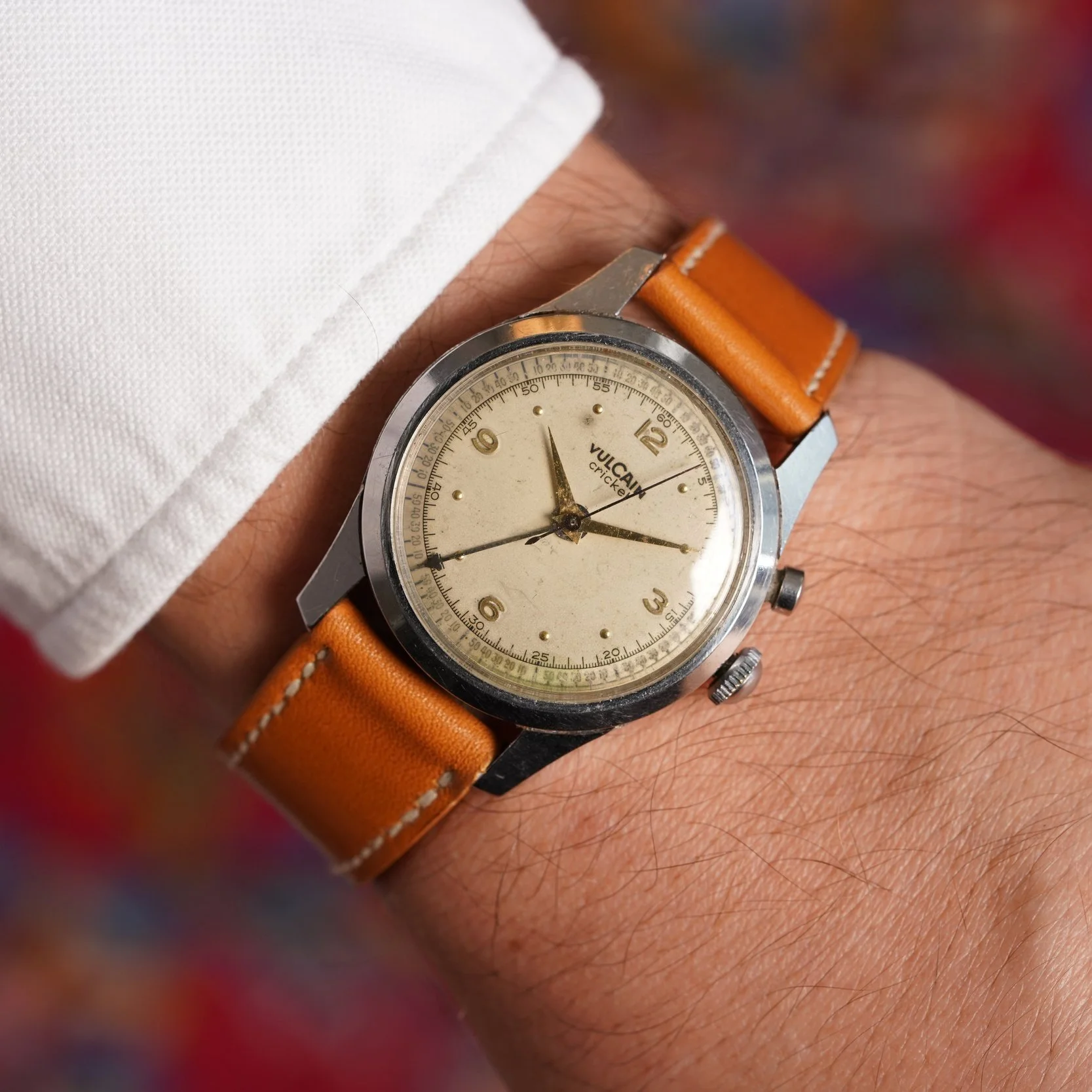
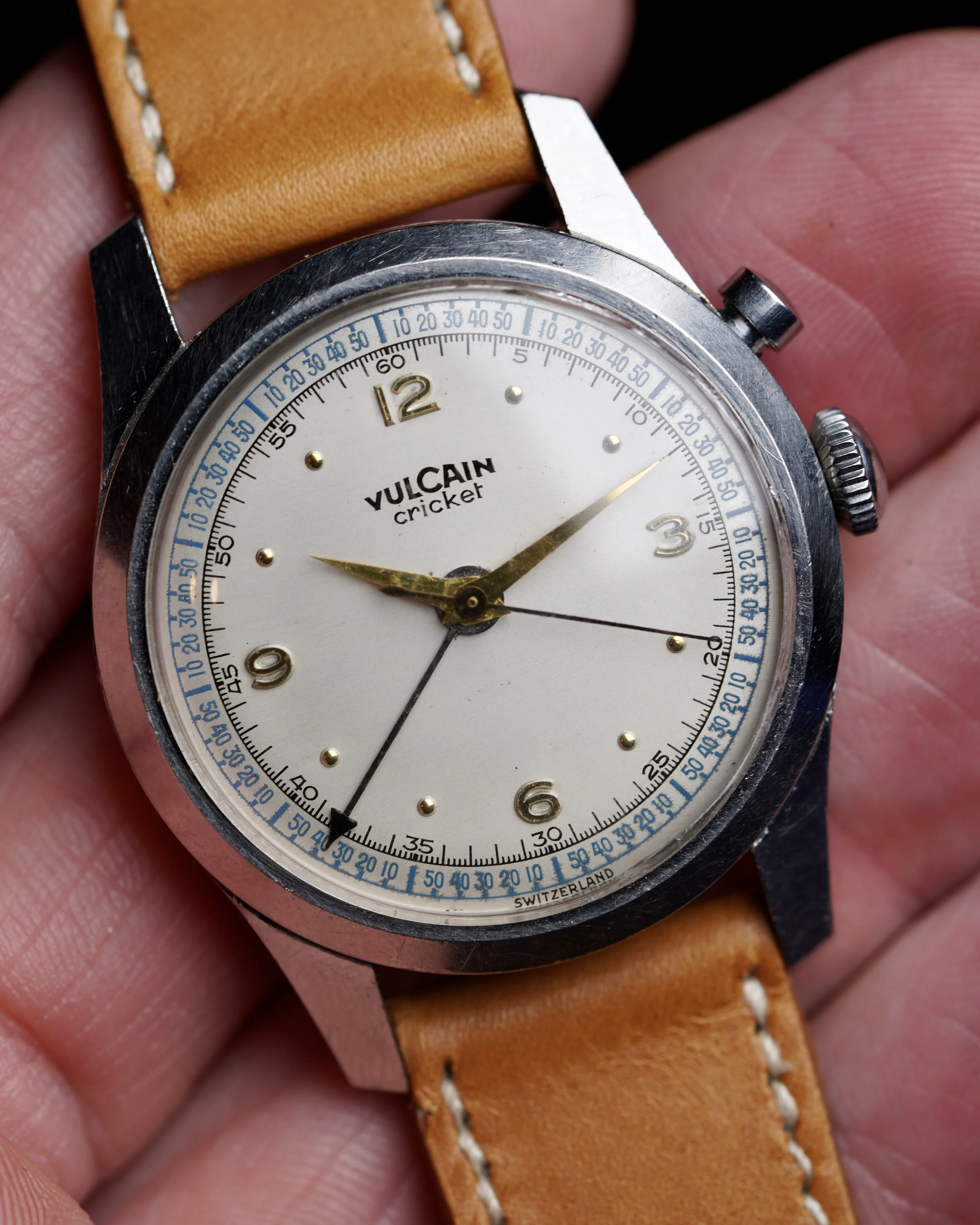
Additionally, there are dials with Arabic numerals at 3, 6, 9 and 12. These corresponds are stainless steel models with gold numerals and spheres. The Roman versions appear slightly more balanced, while my impression of these are that they have the most open space on the dials.
Even Luminous Numerals
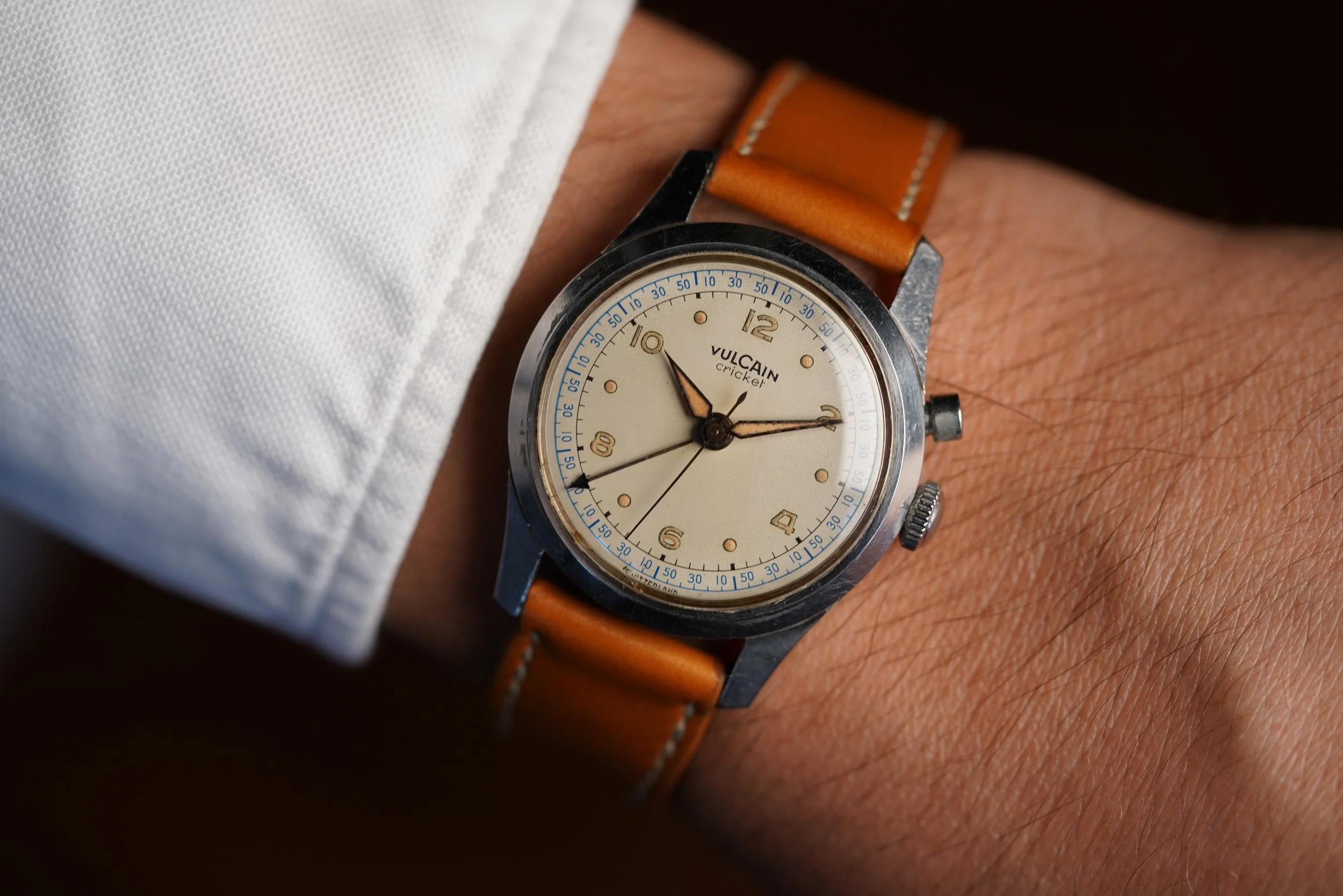
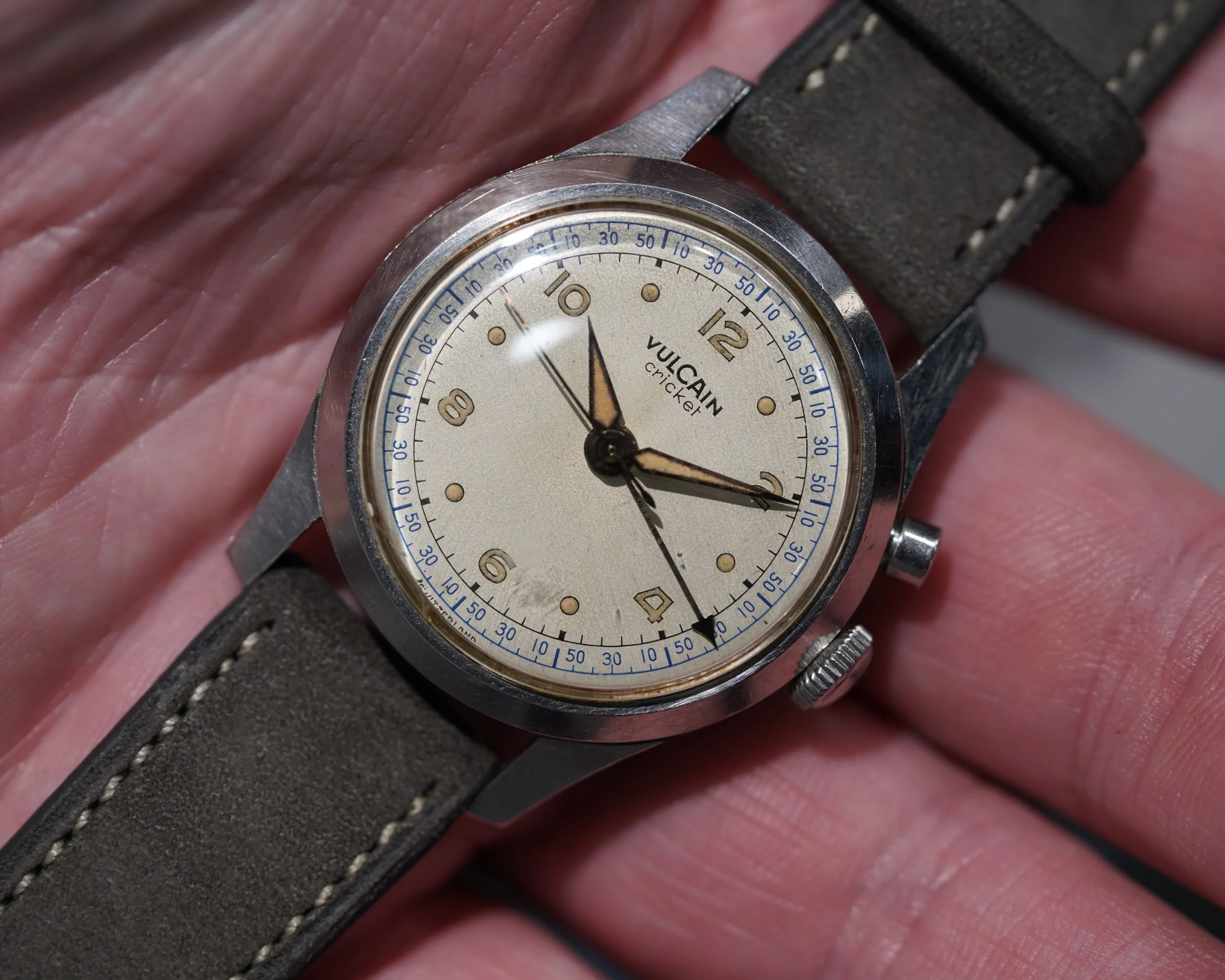
One of the rarest dial variants is the example above with even-luminous markers and circles. I recall less than five examples I have seen over the years. I am aware of one advertisement that features this variant. It is a hard one to hunt down. The “VULCAIN” font on these dials are slightly thinner font.
Gold Dial Variants
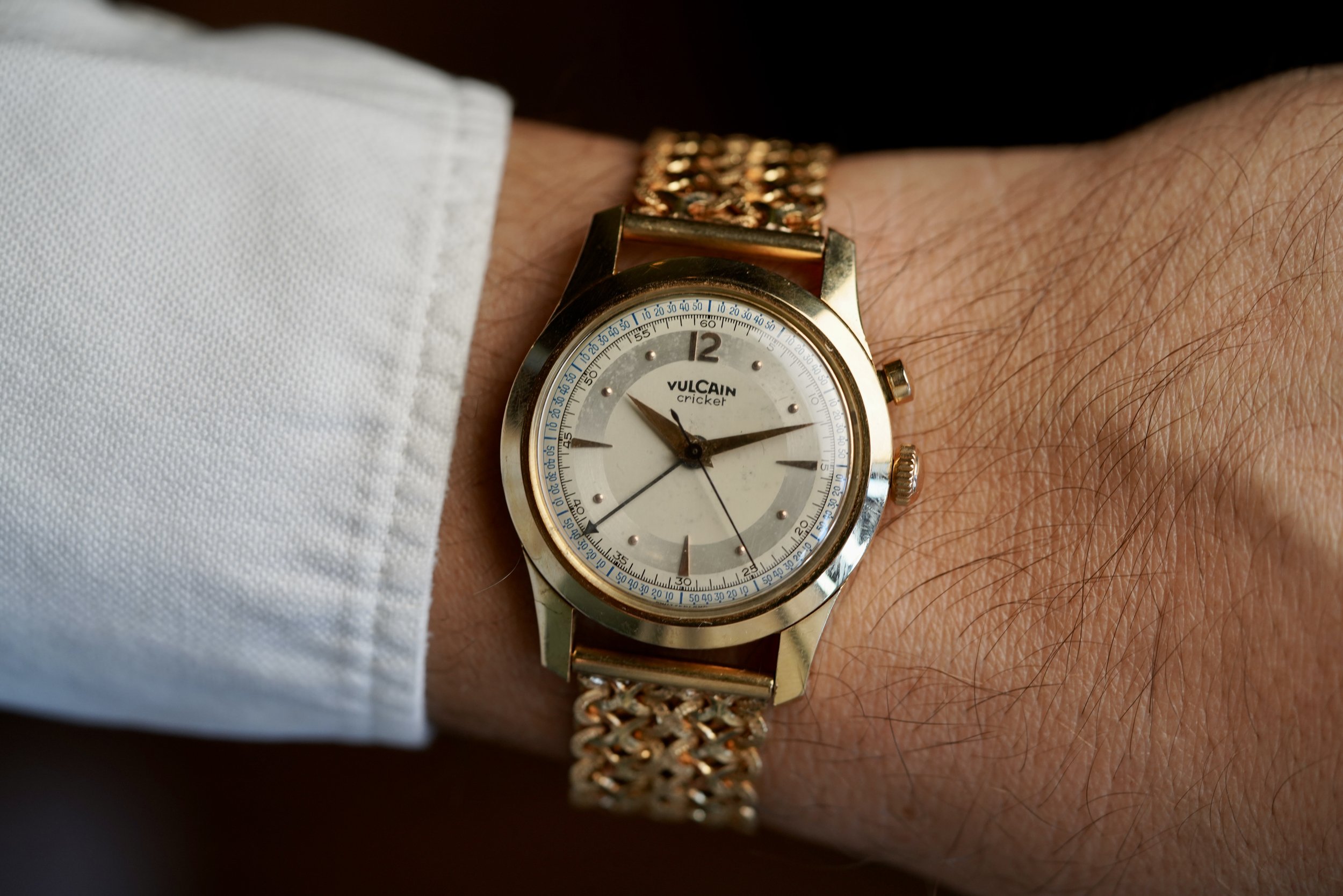
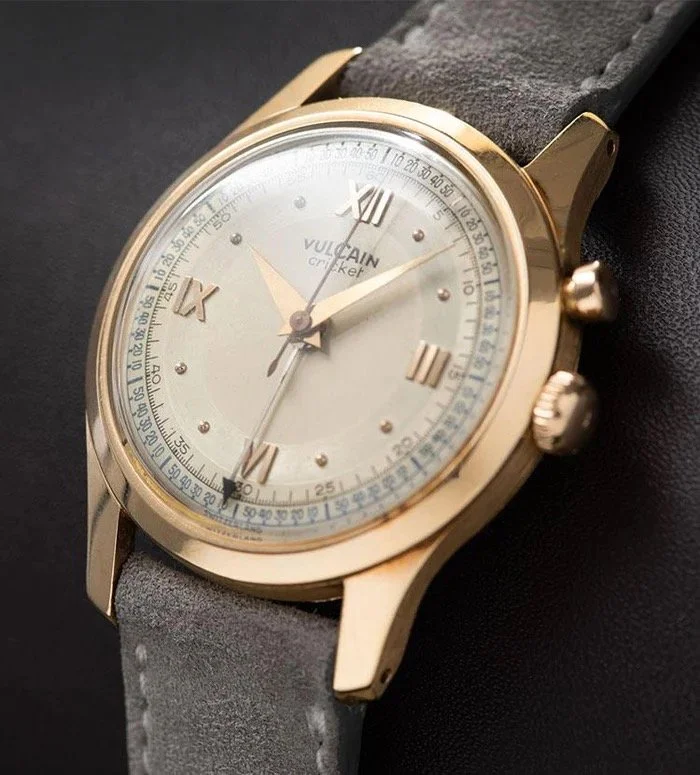
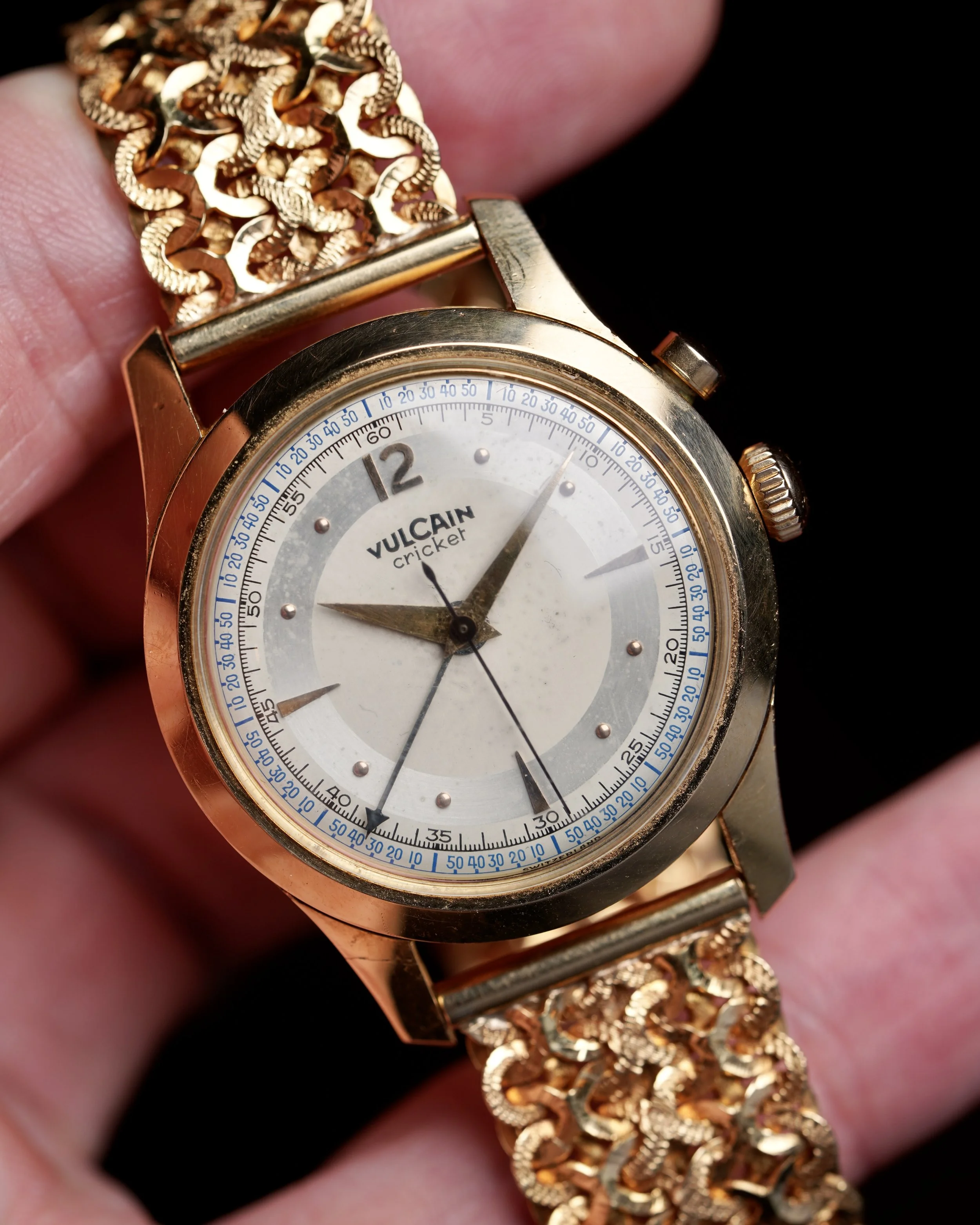
The gold OG Crickets were exclusively two-tone dials with a few variants. Advertisements from the 1940s cite these as being chronometer movements. The movements often had a chronometer number engraved on them and an extra jewel in the movement. Each will feature the applied sphere hour markers. Some feature applied-Arabic numerals at 3, 6, 9, and 12. These are seemingly the most common variants. There are also some with spear markers (reminiscent of the Patek Philippe 2508 and other 1940s-1950s dials) at 3, 6 and 9 and an applied-Arabic 12 numeral. Additionally, there are rare Roman numeral variants!
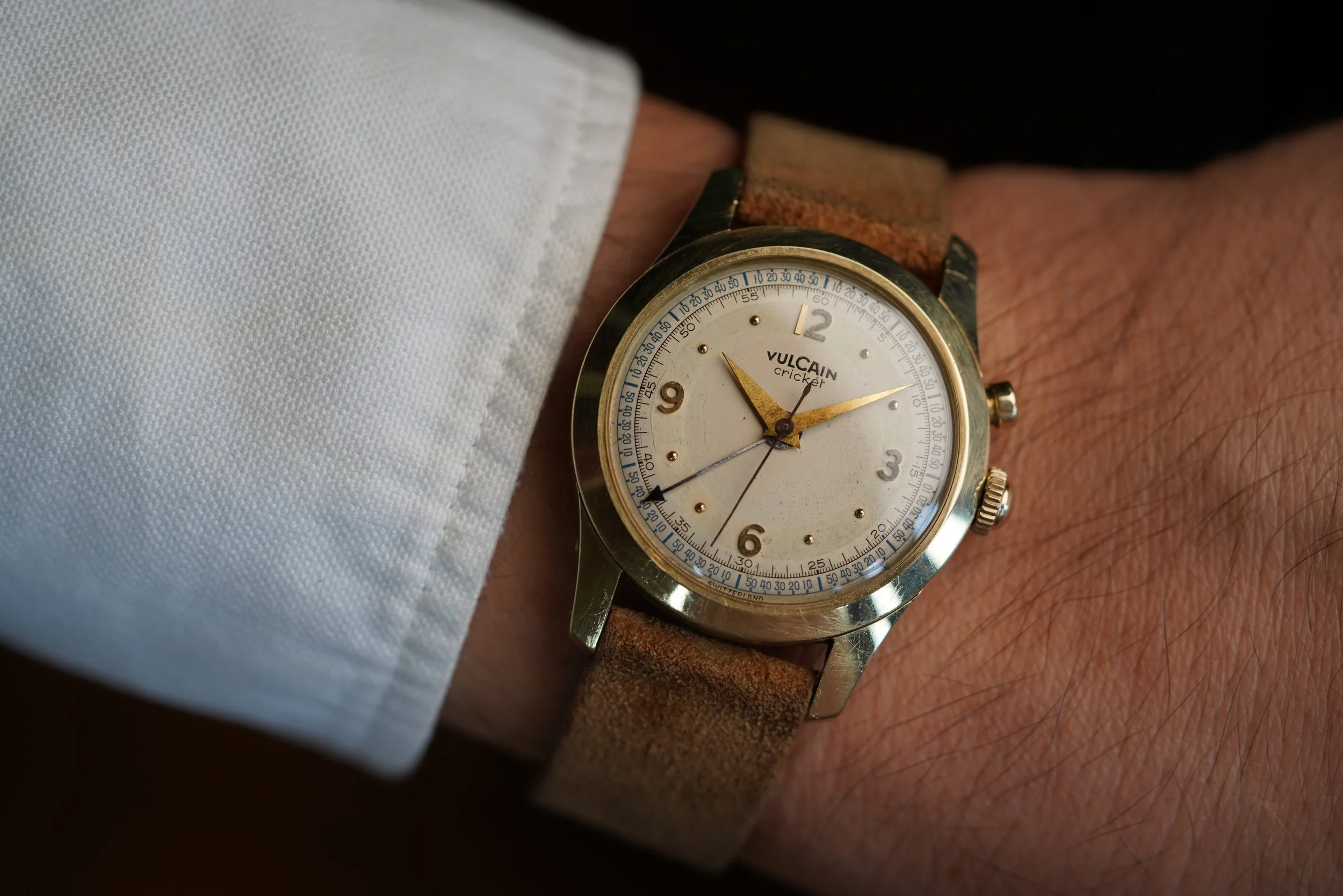
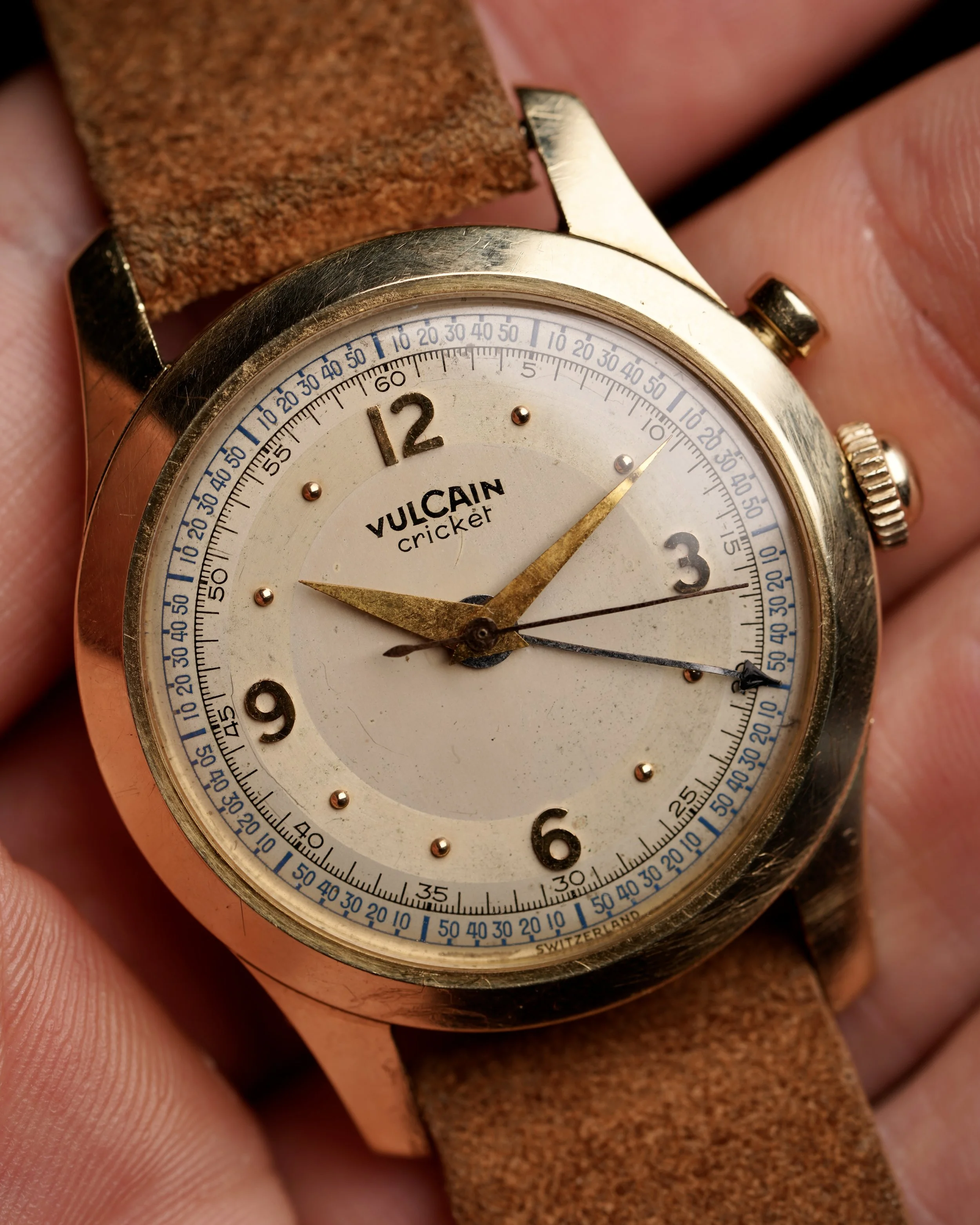
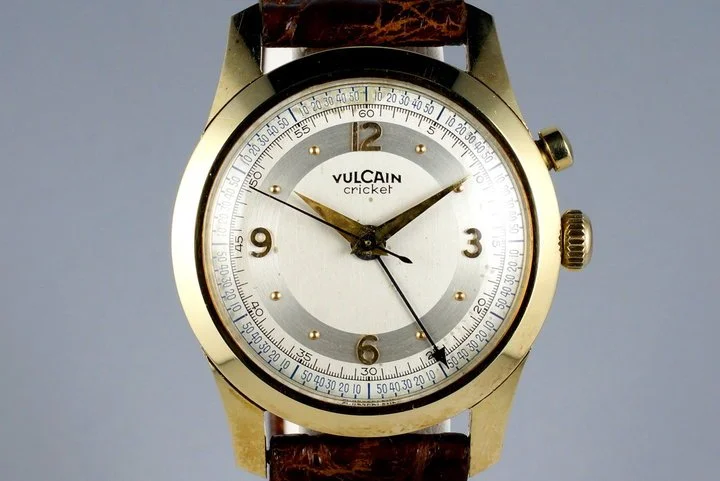
omegaforums
bulang&sons
The Vulcain Crickets have a cult following amongst serious vintage collectors due to the unconventional and historic nature of the watch, but also the awesome complication. However, early Crickets are also among one of the most frequent of any watch that we see come up with Frankenstein dials and cases - as these watches used interchangeable cases/dials/movements for a long period of time and can be purchased at affordable values. Over the years, we have sold countless examples, often to the crème de la crème of collectors Plain and simple, only the cool kids understand how fun a watch like a Cricket is!