The Best of The Best: The Audemars Piguet Reference 5516
By Charlie Dunne
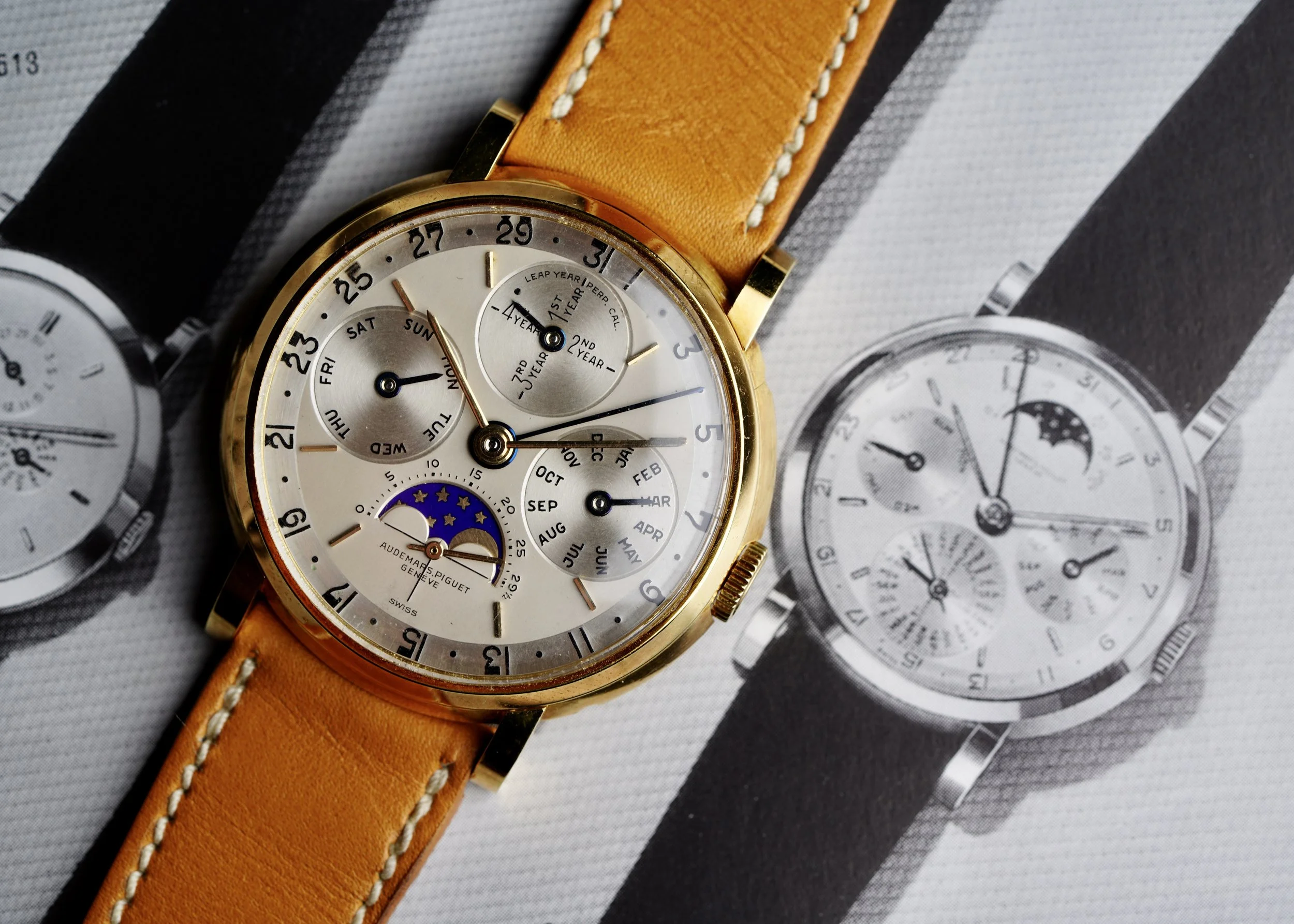
I see mind-blowing vintage watches each day, however, when Eric Wind asked me to submit an article for our new ‘The Best of the Best’ series, I instantaneously responded “I know which watch!”
In 2015, Eric sold the legendary Audemars Piguet reference 5516, which fetched $545,000 at Christie’s New York. It would be the topic of conversation between us for several years. “If there was one watch I wish could one day see, it would have to be that Audemars Piguet Perpetual Calendar reference 5516!”
Starting in 1955 and ending in 1957, Audemars Piguet produced only nine examples of the perpetual calendar reference 5516: the first three with moonphase located at 12:00 (bummer!) and the last six made with moonphase at 6:00 (hooray!). These were esoteric watches largely overshadowed for the following decades by Patek Philippe models - most notably the reference 1518. The reference 5516 remained in obscurity only highlighted in publications such as Wehrli and Brunner’s ‘Audemars Piguet Masterpieces of Classical Watchmaking’.
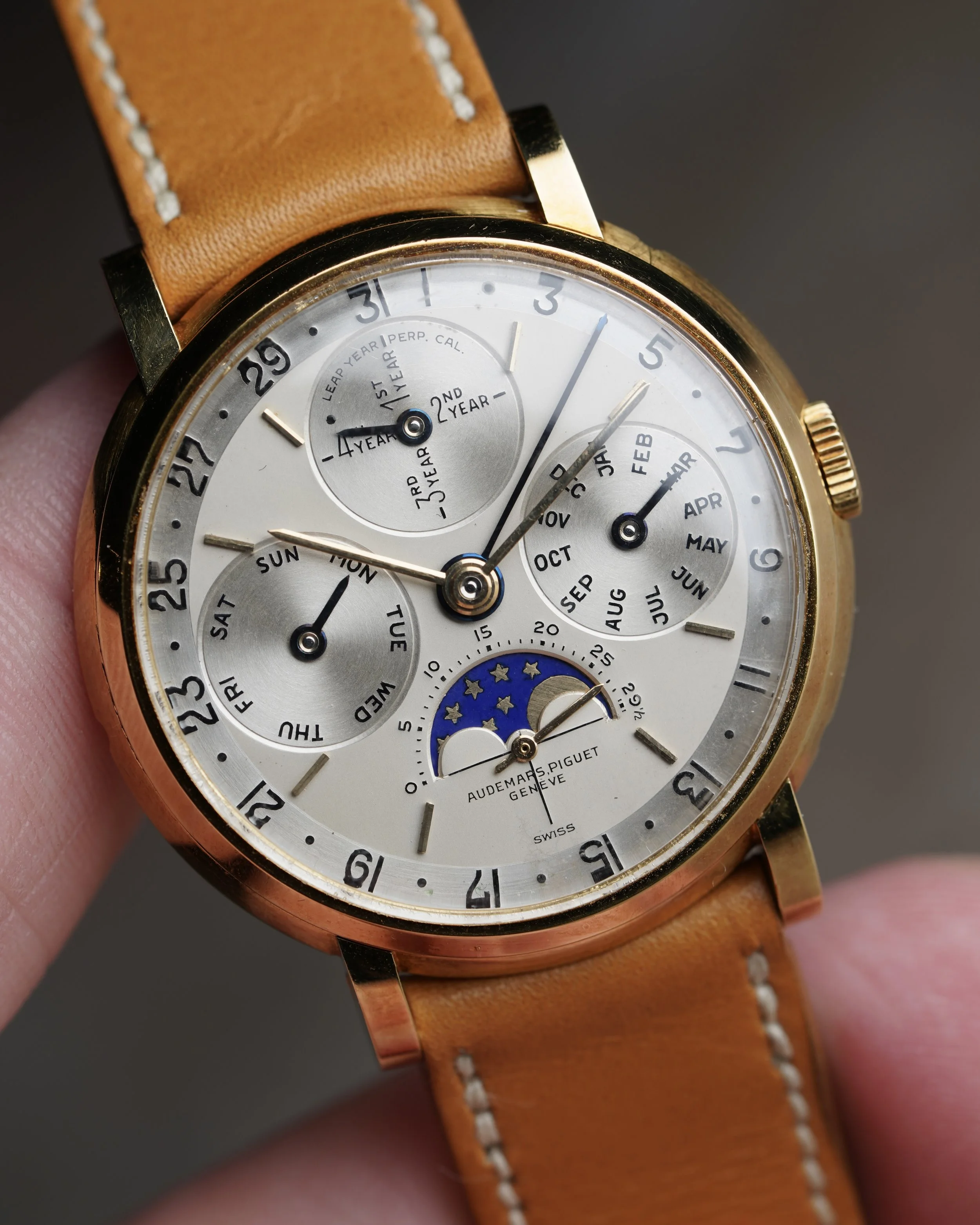
At that time of the sale in 2015, only six of the nine were known to have sold publicly. AP was late to the party on the Perpetual Calendar wristwatch by approximately 30 years (Patek Philippe had made very early wristwatches with the complication in the mid-1920s). Instead, Audemars Piguet beat Patek and everyone else by introducing the first perpetual calendar wristwatch with leap-year indication: the reference 5516.
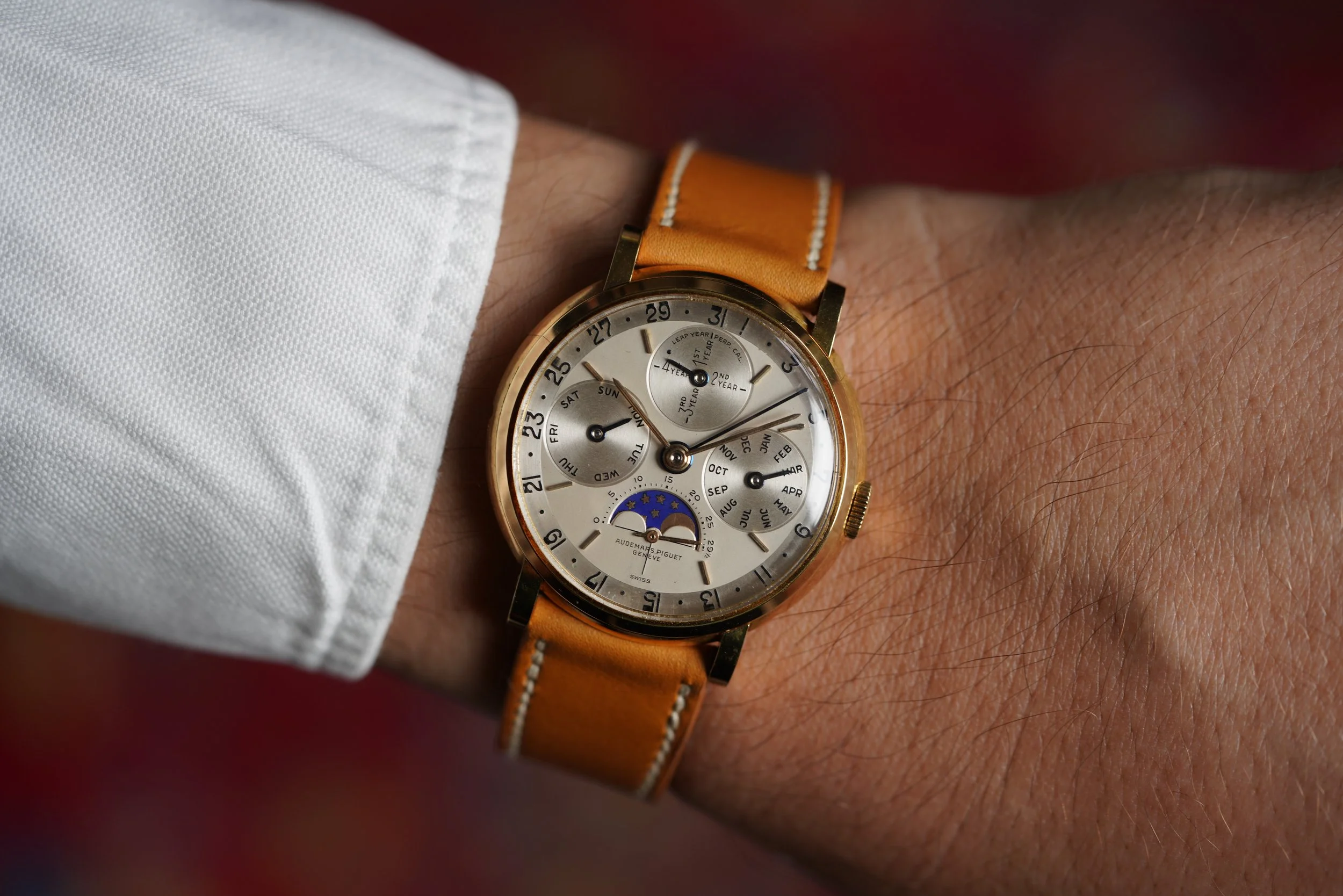
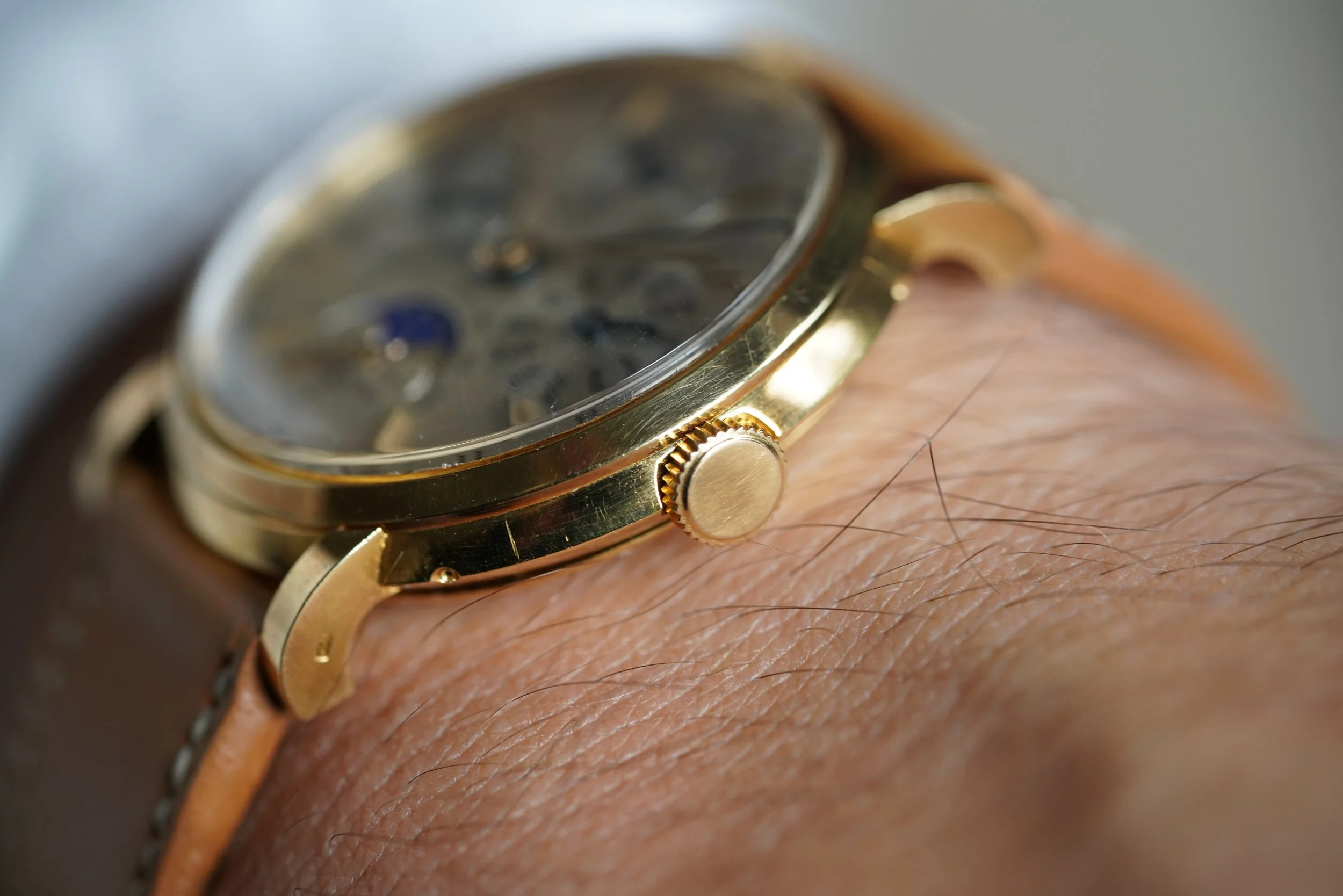
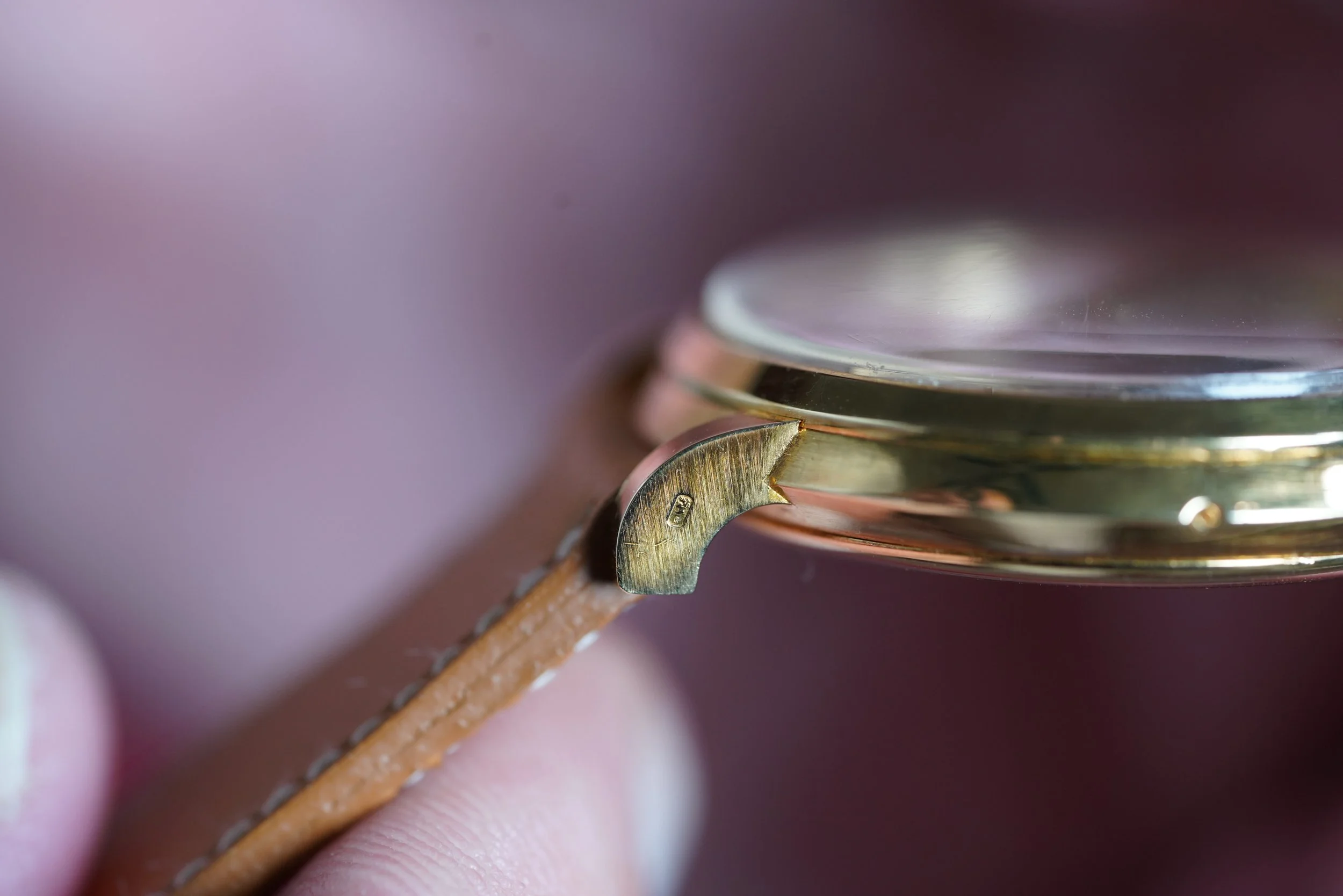
This particular example that I dreamed about was produced in 1957, toward the end of the production of these watches. It had to have been a fortune back in the day and naturally it sold years later in 1963. According to Eric, the watch was in fact found in Florida and came to Christie’s by way of the family of the original owner. It sat most of its life in its original Audemars Piguet box and remained unpolished in is beautiful Eggly & Cie. 18k yellow gold case. According to Eric, “Charlie Dunne is the world’s leading expert on Eggly cases! The Eggly family even consulted Charlie for assistance on learning about their family’s cases.”
This 5516 is, in a word, incredible. It seemed to have been a watch that I missed the opportunity to handle years back, and I constantly brought it up to Eric. “How good was it???” “It is the best example known!” In his cataloging about the watch for Christie’s in 2015, he stated it is “…arguably in the finest condition of the six reference 5516 examples known to the market out of nine made…,” which stirred up frustration and consternation from Marcus Margulies, who owned several of the other examples before selling them to the Audemars Piguet Museum.
From 1892 to the early 1970s, Audemars Piguet produced a total of only 550 complicated wristwatches, of which no two are identical: 35 minute repeaters, 188 calendar wristwatches, 307 chronograph wristwatches, and 20 double complication wristwatches featuring both calendar and chronograph. For all 550 wristwatches, there is no complicated Audemars Piguet that Eric Wind and I would want to more than this exact reference 5516 - not even the only split-seconds chronograph!
Lot Essay from 2015
Accompanied by a red Audemars Piguet & Co. presentation box.
According to the archives of Audemars Piguet the present watch with movement serial 73’013 and caliber 13VZSSQP was part of the reference 5516 and was made in 1957 and sold in 1963.
In the world of vintage watches superlatives are frequently overused, which can leave one wanting for words to exist that are more powerful than “most important” and “best” when it comes to watches such as the present Audemars Piguet reference 5516 perpetual calendar. This watch is arguably the most important reference ever made by Audemars Piguet, had one of the most important innovations for a perpetual calendar wristwatch, is one of the finest representations of traditional Vallée de Joux wristwatchmaking, is arguably in the finest condition of the six reference 5516 examples known to the market out of nine made, and is one of the most beautiful and well-balanced wristwatches ever made.
The present watch comes to Christie’s from a private and respected American family. According to the consignor, the watch was likely worn on only a few occasions and spent most of the last 50+ years in its red Audemars Piguet & Co. presentation box.
Perpetual calendar watches were made popular by military officials during World War One. These were, however, unique piece pocket watches. It took a decade for the first perpetual calendar wristwatch to be developed, a unique creation by Patek Philippe, and then sixteen more years for the first serially produced perpetual calendar wristwatch to see the light of day, the Patek Philippe reference 1518. Although breakthroughs in horological development, these early perpetual calendar wristwatches lacked a fundamental indication, which was present in their earlier pocket watch counterparts: the leap year cycle. Setting the correct date involved a lengthy procedure of reaching February 28th with the correctors, then having to manually advance the hands to see if they would move to February 29th, thus indicating the watch is in the leap year, or not, in which case again the correctors would be used to go through one more year and again repeat the procedure on the next February 28th.
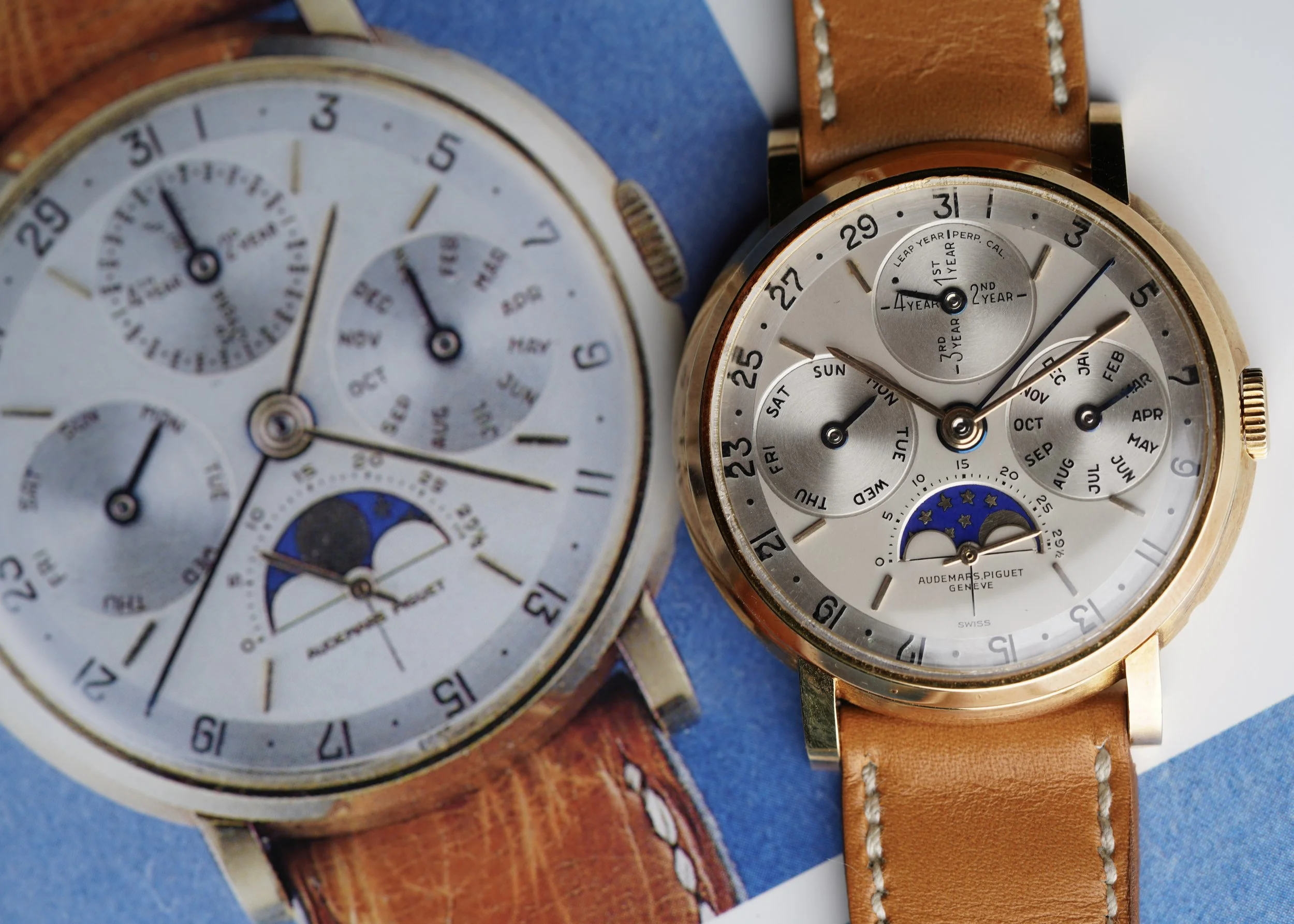
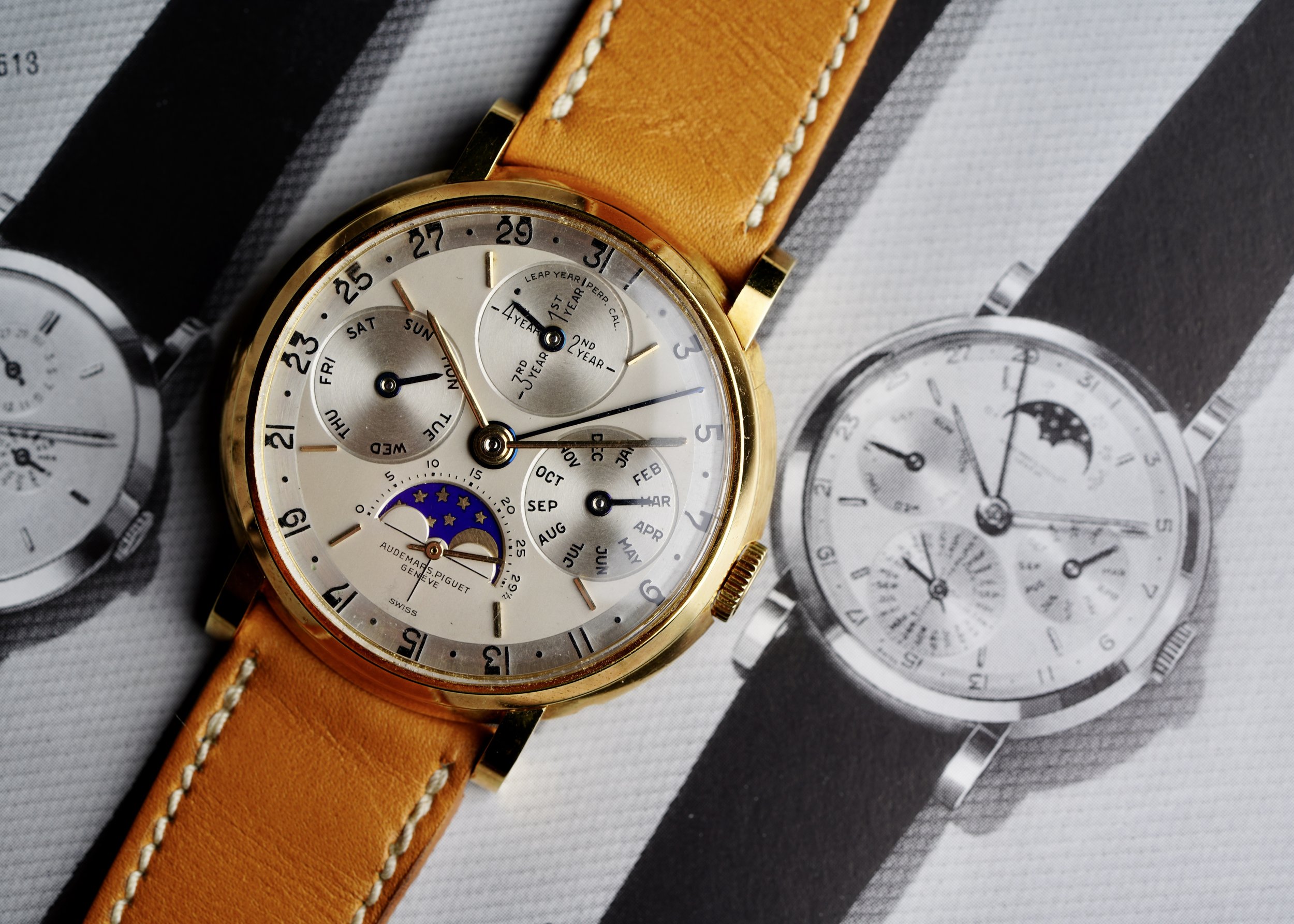
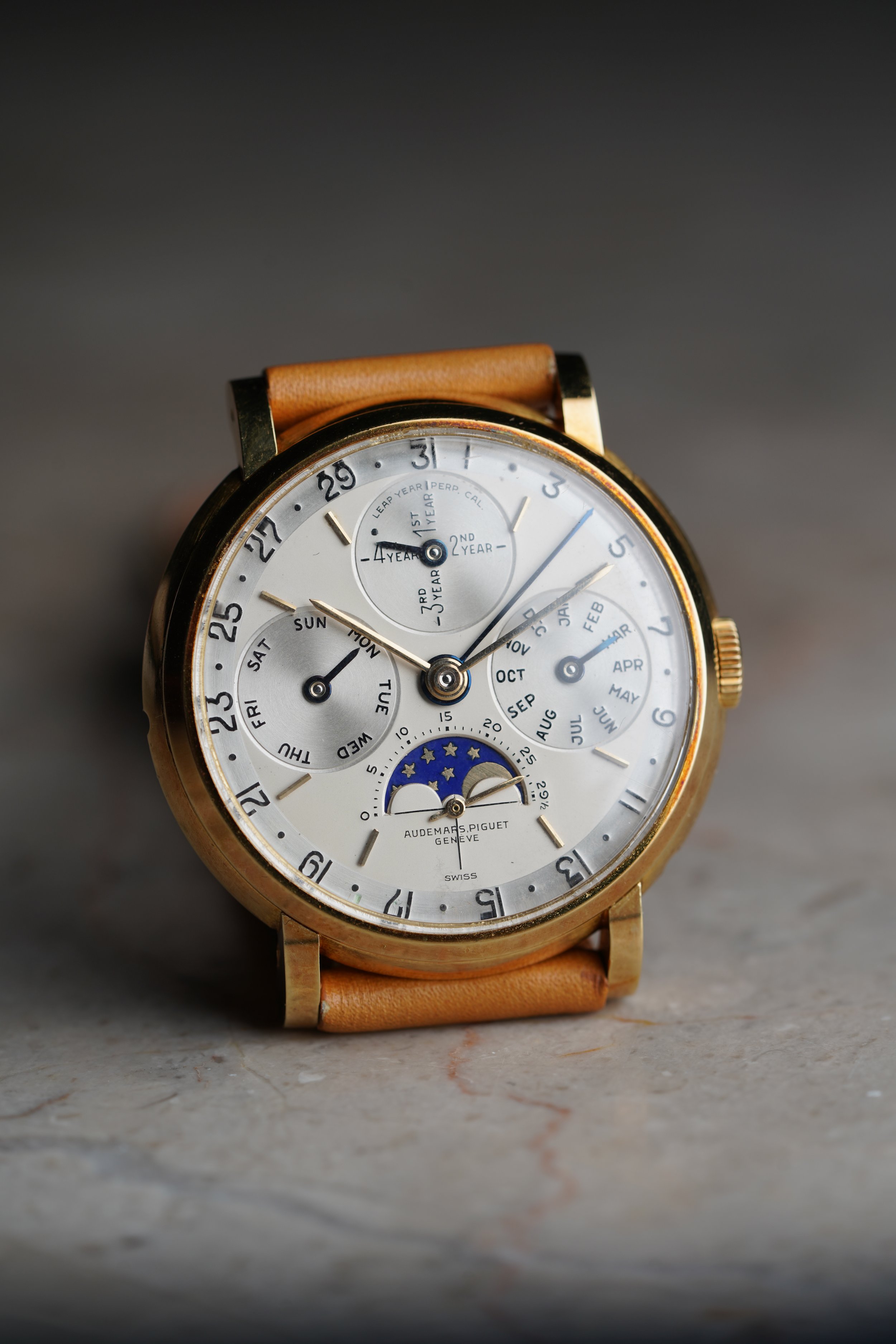
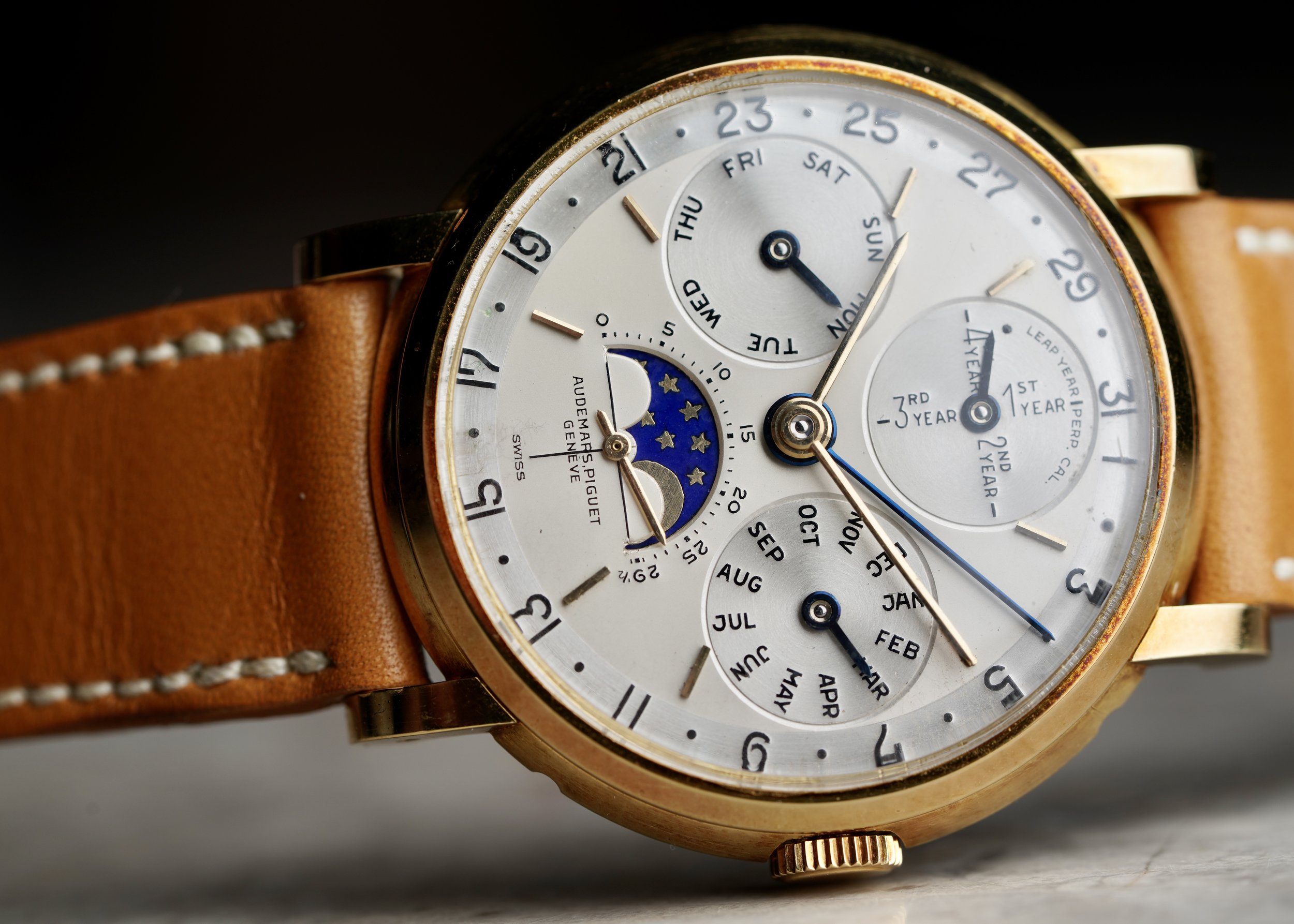
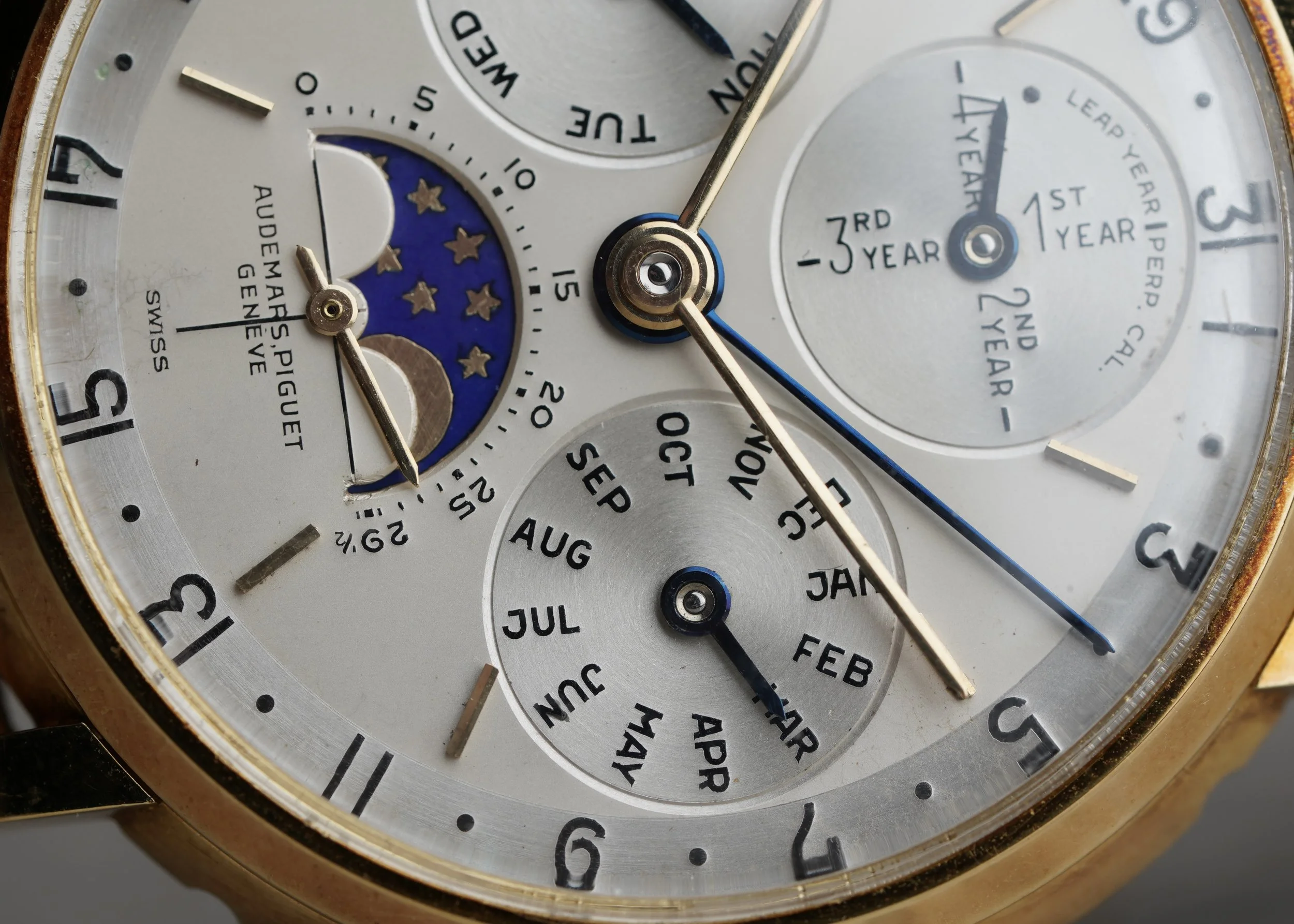
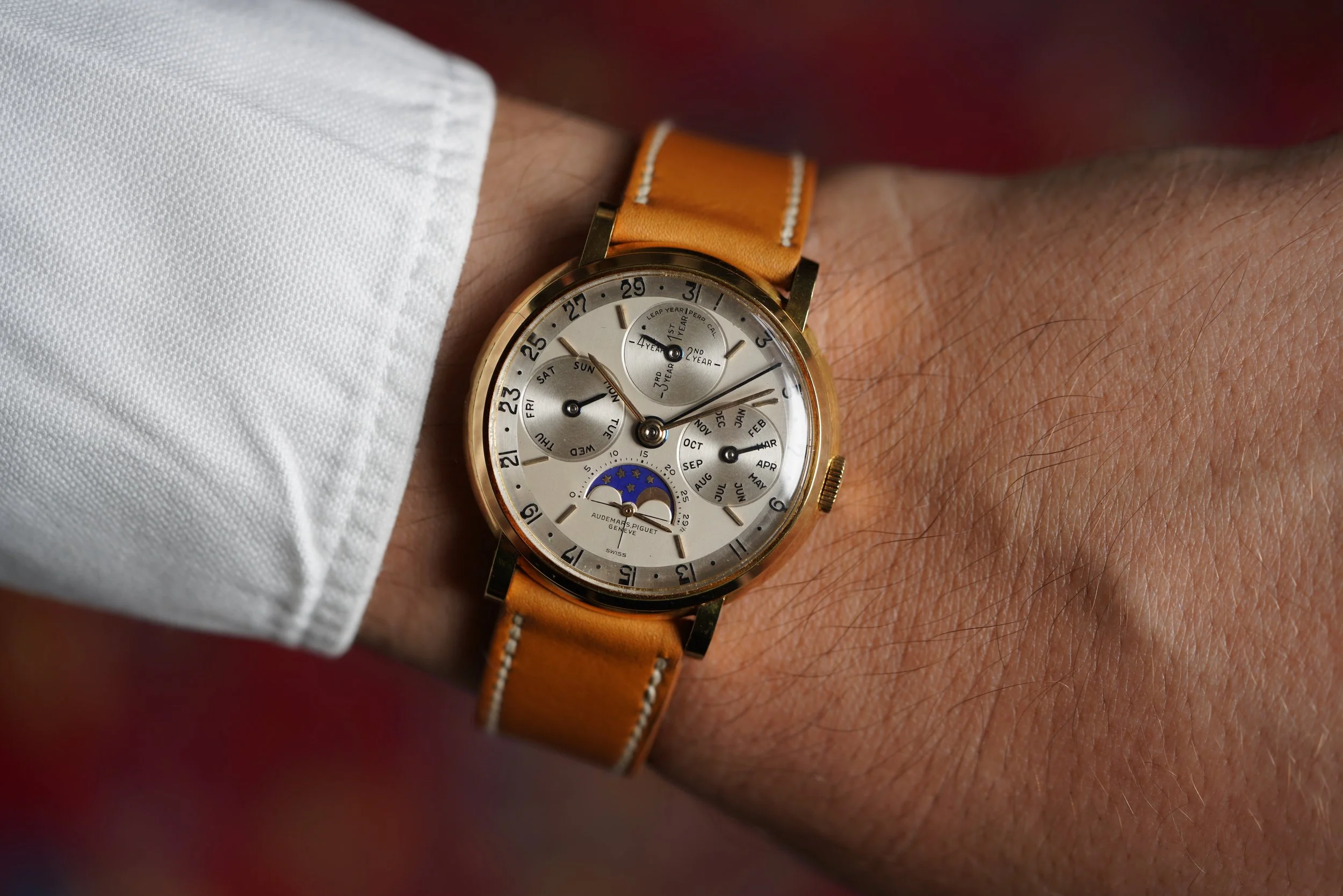
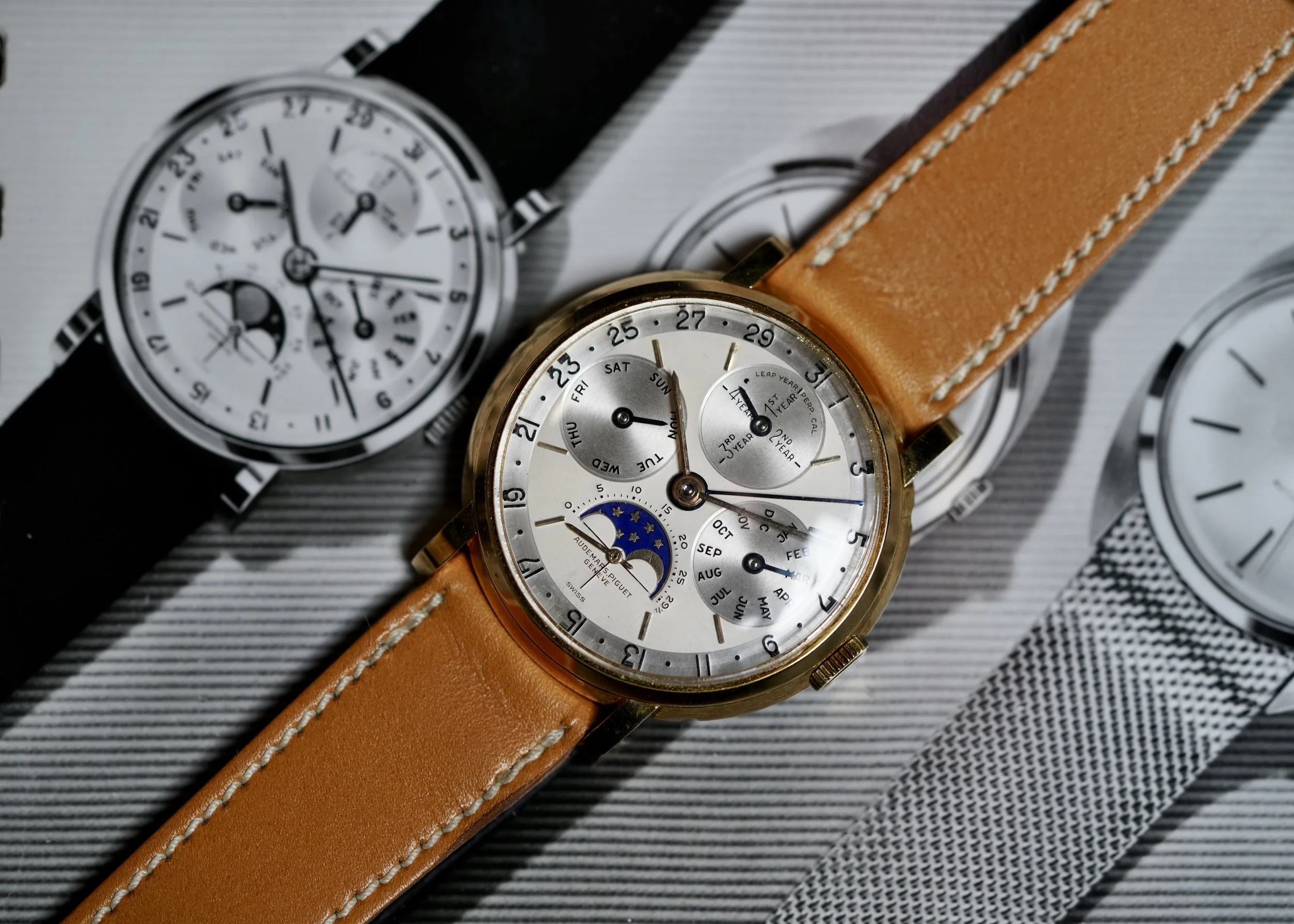
In fact, the first serially produced perpetual calendar wristwatch with leap year indication was developed by Audemars Piguet in the late 1950s: the legendary reference 5516, here represented in one of the most pristine example of this model. Reference 5516 was realized in an extremely limited series of 9 examples starting from 1955, all being sold between 1963 and 1969. The first three examples displayed the moon phases at 12 o’clock, and the leap year cycle, with the full indication of the 48 months at 6 o’clock. The last six specimens, realized from 1957 such as the present watch held the opposite design: moon phases at 6 and leap year indication at 12. Furthermore, most of these last pieces feature a much cleaner leap year subsidiary register, without the detailed indication of the month, resulting in much more refined aesthetic. Undeniably, this timepiece is a supremely attractive, balanced and legible watch: the three subsidiary dials and leap year indication are perfectly aligned with the four cardinal points of the dial, and the other date track is tangent to the subdials at 9, 12 and 3. The entirety of the scales and designations are engraved and hard enameled, thus practically eternal. Furthermore, there is absolutely no sign of cosmetic intervention on the dial, which arrived to us perfectly intact in all of its details, including commas and accents, which are easily lost even with gentle washing.
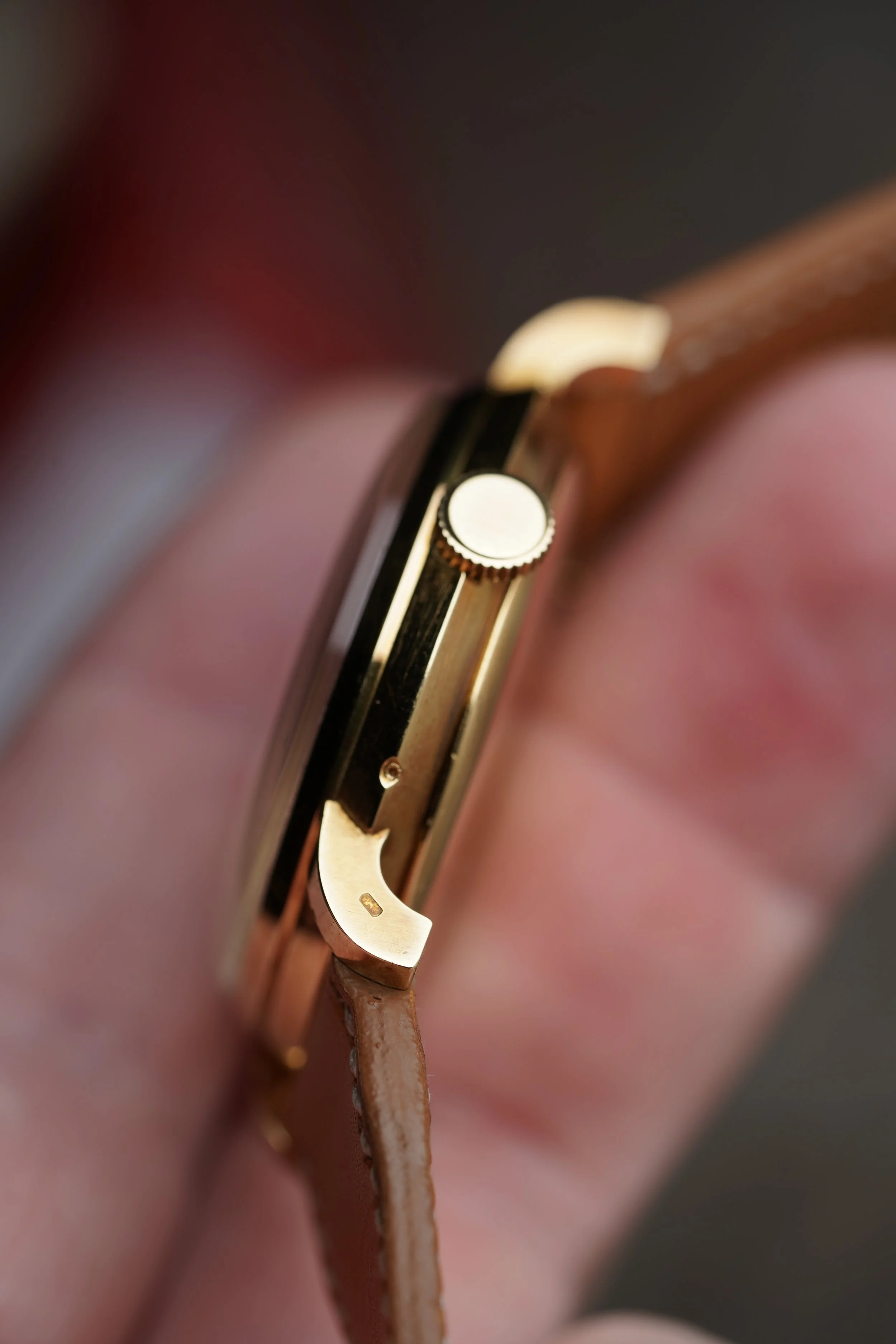
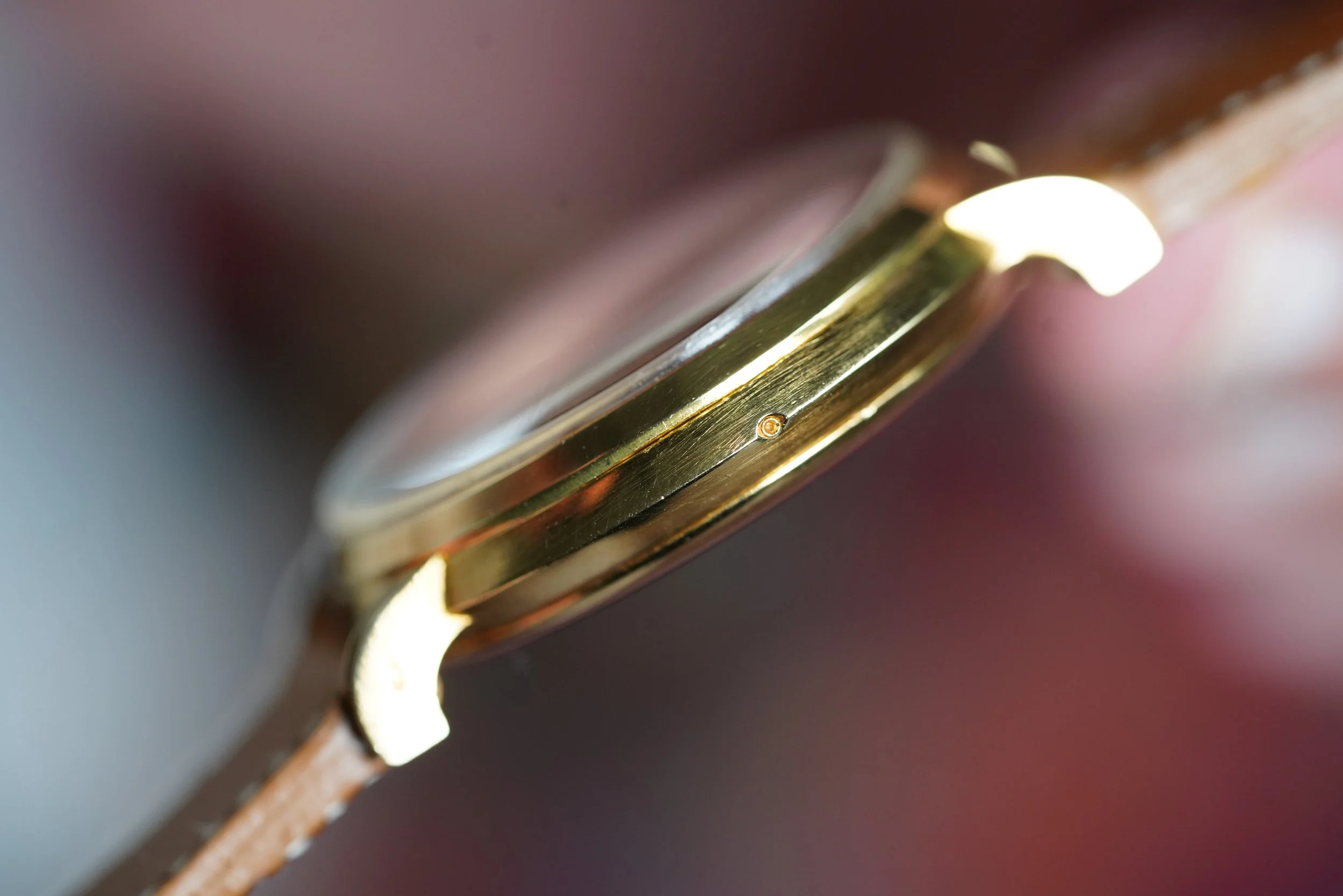
The case is no less impressive than the dial: unpolished, it fully retains the satin finish to the sides of the lugs, extremely sharp edges, and absolutely untouched hallmarks. The diameter of 36.5mm is generous for the times, and it grants a remarkable wrist presence to the watch, also in virtue of the angular bands and stepped bezel, precursors to a trend typical of the 1960s and 1970s, characterized by angular cases with sharp edges.
Reference 5516 is furthermore distinguished by the fact it is one of the last timepieces ever to be realized with the historical “établissage” system. Typical of 19th century watchmaking and gradually abandoned during the 20th century, this methodology consists in delegating the production of the watch components to a myriad of tiny and highly specialized companies, each with a specific niche: screws, dials, springs, case components, jewels and so on. This made sense in the early days of watchmaking with limited technology available and high precision standards of the components involved led to the rise of specialized companies, as it would be impossible for one manufacturer to achieve state of the art results in each and every component. Thus, the brand acted as an orchestra director, providing detailed specifications to the various suppliers and then assembling the pieces in house.
The nine examples of reference 5516 are indeed realized with this system. The movement blanks were realized by Valjoux; the underdial work (cadrature) was made by independent artisan Alfred Aubert; the screws, pallets, jewels, gears etc. by a multitude of specialized businesses located in Vallée de Joux, and the case maker for this masterpiece is, as denoted by the stamp to the case back, Eggly & Cie from Geneva Canton (case maker number 23, inscribed in a key).
The first series of the reference 5516 featured an aperture for the the moon phases at 12 o’clock and was produced in 1955 in three examples with movement serial numbers 66’135, 66’136 and 66’137. Christie’s sold the watch with movement serial number 66’137 in November 2008 for the equivalent of $314,461. That watch along with the other first series reference 5516 is in what is recognized as the most important private collection of vintage Audemars Piguet wristwatches.
The present watch is part of the second series of the reference 5516, which featured an aperture for the moon phases at 6 o’clock and was produced in six examples in 1957 with movement serial numbers 73’011, 73’012, 73’013, 73’014, 73’015 and 73’016. Each watch has a hand-engraved dial filled with enamel and each is unique.
73’011: This watch resides in the collection of Audemars Piguet. It features a similar dial layout to 73’013, with some minor differences.
73’012: This watch is in a private collection of vintage Audemars Piguet wristwatches along with the two known first series reference 5516 examples. It is notable for its display of months in the leap year indicator register.
73’013: The present watch. A close analysis of a photograph from the Archives of Audemars Piguet shows that it is the present watch, notably due to the slightly lower location of “SUN” in the day of the week register and the smaller “0” to the left of the second register.
73’014 and 73’015: The location of both of these watches is unknown to the market. Based on ongoing research, it is believed that one is signed Cartier and the other has French abbreviations for days of the week.
73’016: This watch resides in the collection of Audemars Piguet. It notably has a Tiffany & Co. retailer signature on the dial.
Considering its astounding rarity, historical importance, aesthetic appeal, groundbreaking movement, incredible condition and heritage production methodology, the present timepiece fully deserves a place among the most important and remarkable wristwatches ever manufactured and offered in public.
For more information on the reference 5516, please see the book Audemars Piguet Calendar Wristwatches 1924-1993, p. 48, and the article “Making the Leap: The Audemars Piguet Perpetual Calendar Wristwatch, 1950-1969” by the Audemars Piguet Heritage Department.”
Since the 2015 sale of this Audemars Piguet reference 5516 and Eric Wind wrote the above footnote, case number 73’014 came to market at Phillips in New York in 2017. It had a case that appeared to be lightly polished. Oddly, it had the dial marked for 73’014 and came with a spare dial that was 73’014 and originally in the case, but supposedly in rough condition. Perhaps the dial marked 73’015 was taken out of that watch to exchange in a Cartier dial. Regardless, the dial swapping was quite unusual and that watch can be seen here.
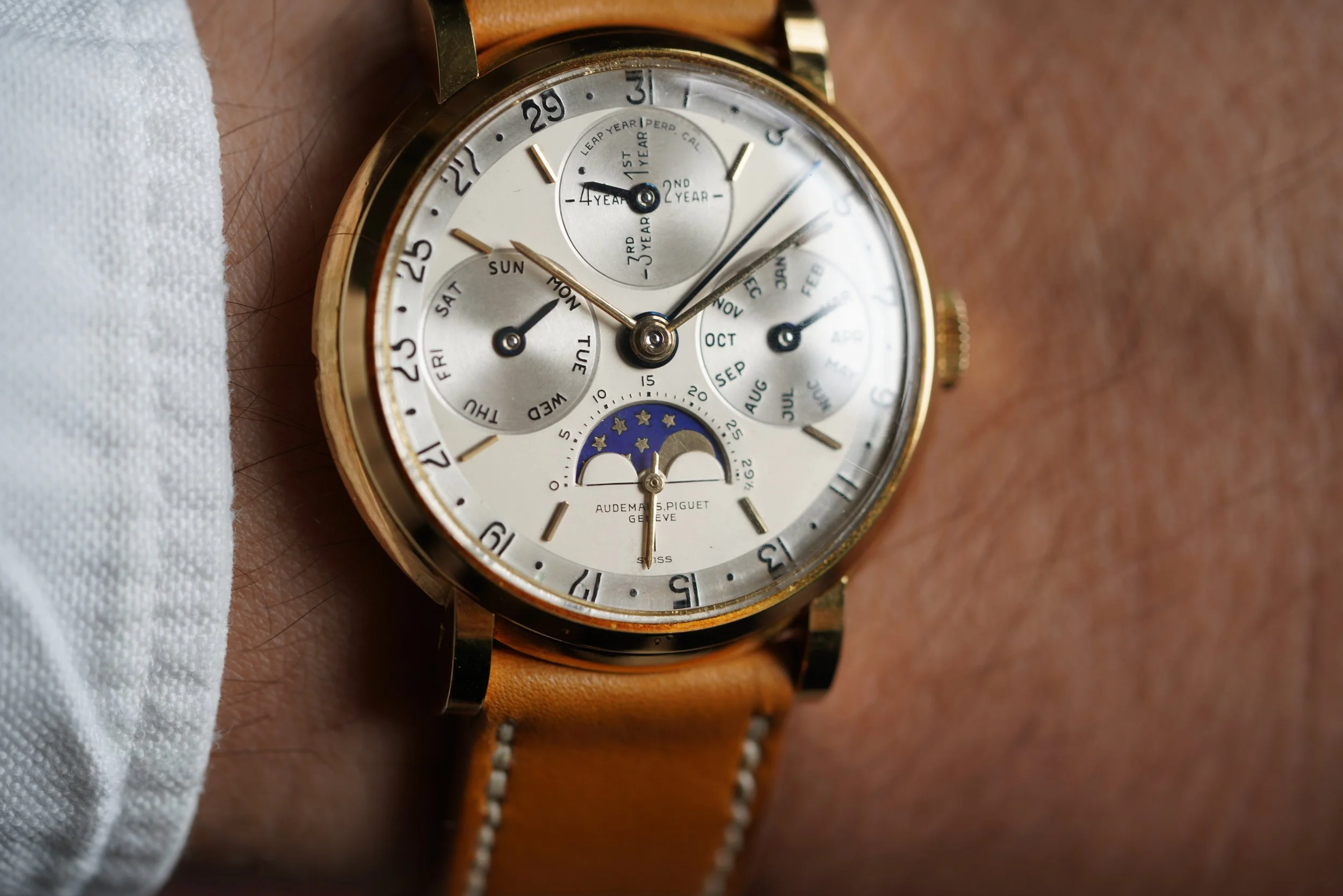
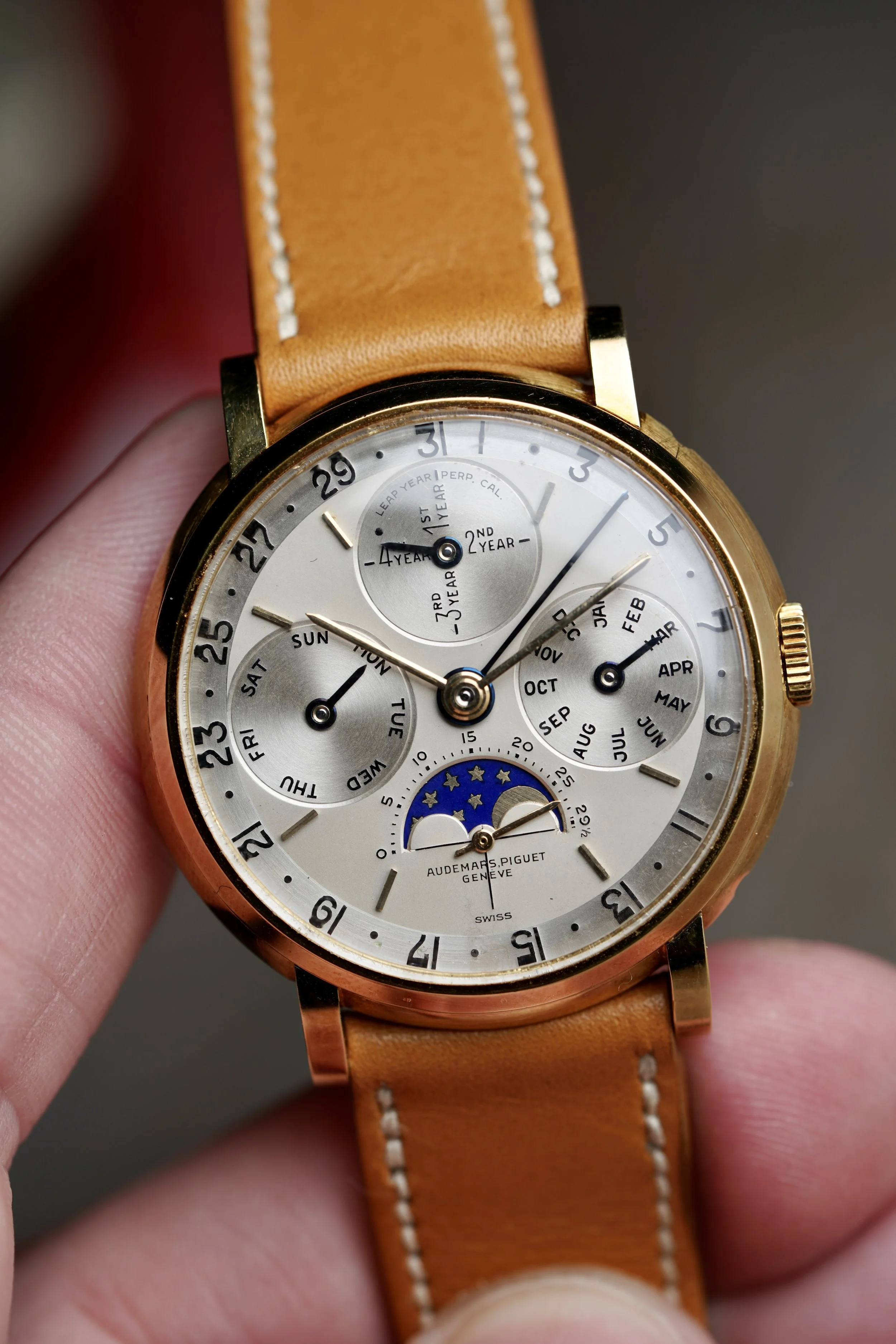
Years later, I saw the Tiffany & Co. example located Inside The Musée Atelier Audemars Piguet. This is among two other reference 5516 models that were on display in the AP Museum collection. However, the dial of the Tiffany example was a bit rough and the condition of the case left my interest a bit deflated. We understand that AP owns six of the nine produced, with two remaining in private hands and one still missing.
Years after, our friend Danny Benyamin found an incredible Audemars Piguet catalog from the late 1950s that featured the reference 5516. Eric gave him a Rolex in gratitude (hooray!). This AP catalog is extremely rare and one of the only primary source materials from this era of AP. We scanned the page featuring the reference 5516 for those that appreciate these relics!
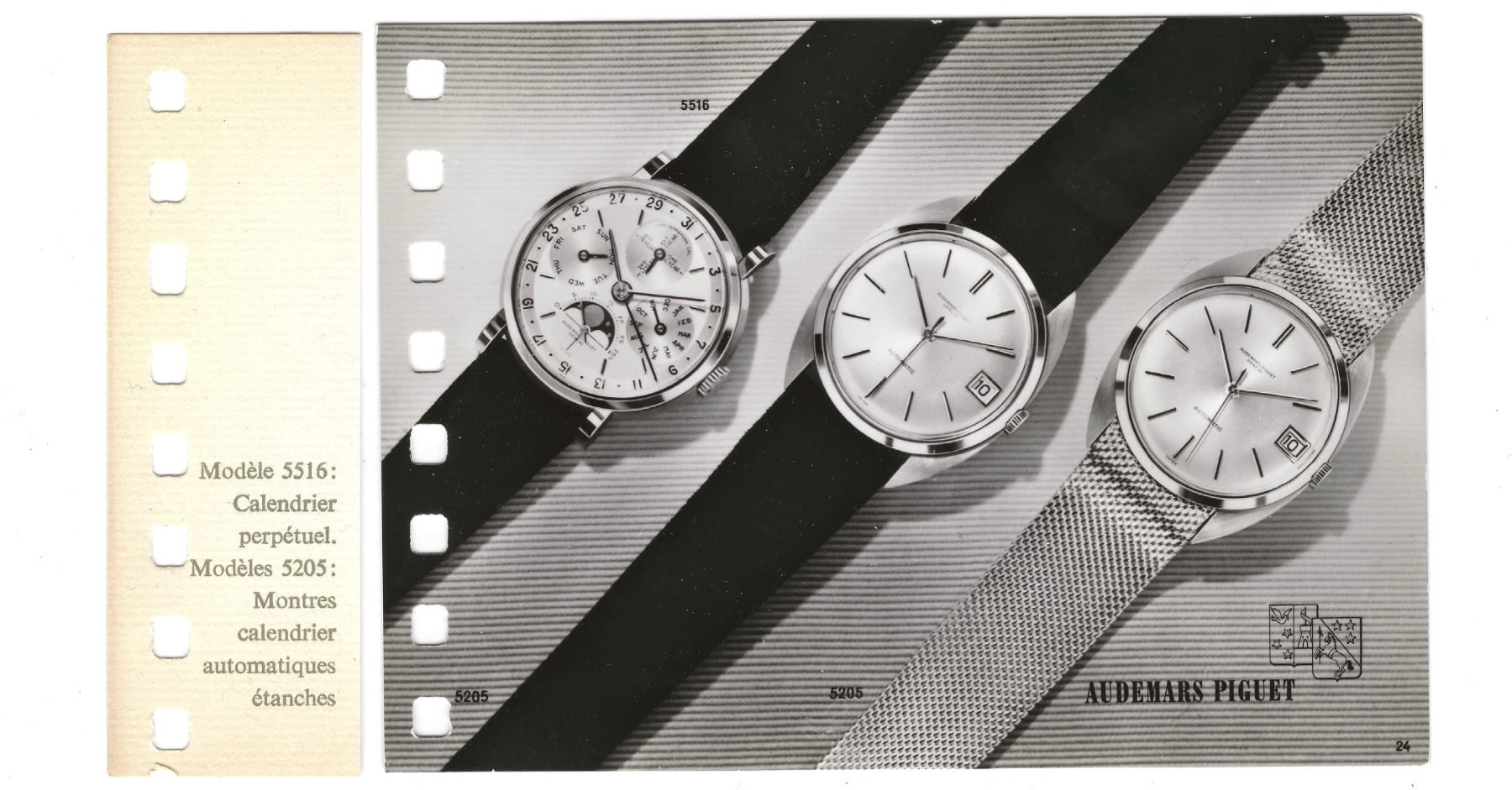
A 1950s Audemars Piguet catalog seeming to show this exact watch with its slightly unique dial characteristics.
In February 2024, Eric informed me that he was working on the getting the watch again. It was one of the most exciting moments in my career to finally have the opportunity to admire this watch in person and take photographs of it. While the time with it was short as Eric had already sold it to an important collector. He later brought it to our inaugural Wind Vintage Retreat so he could share it with other collectors.
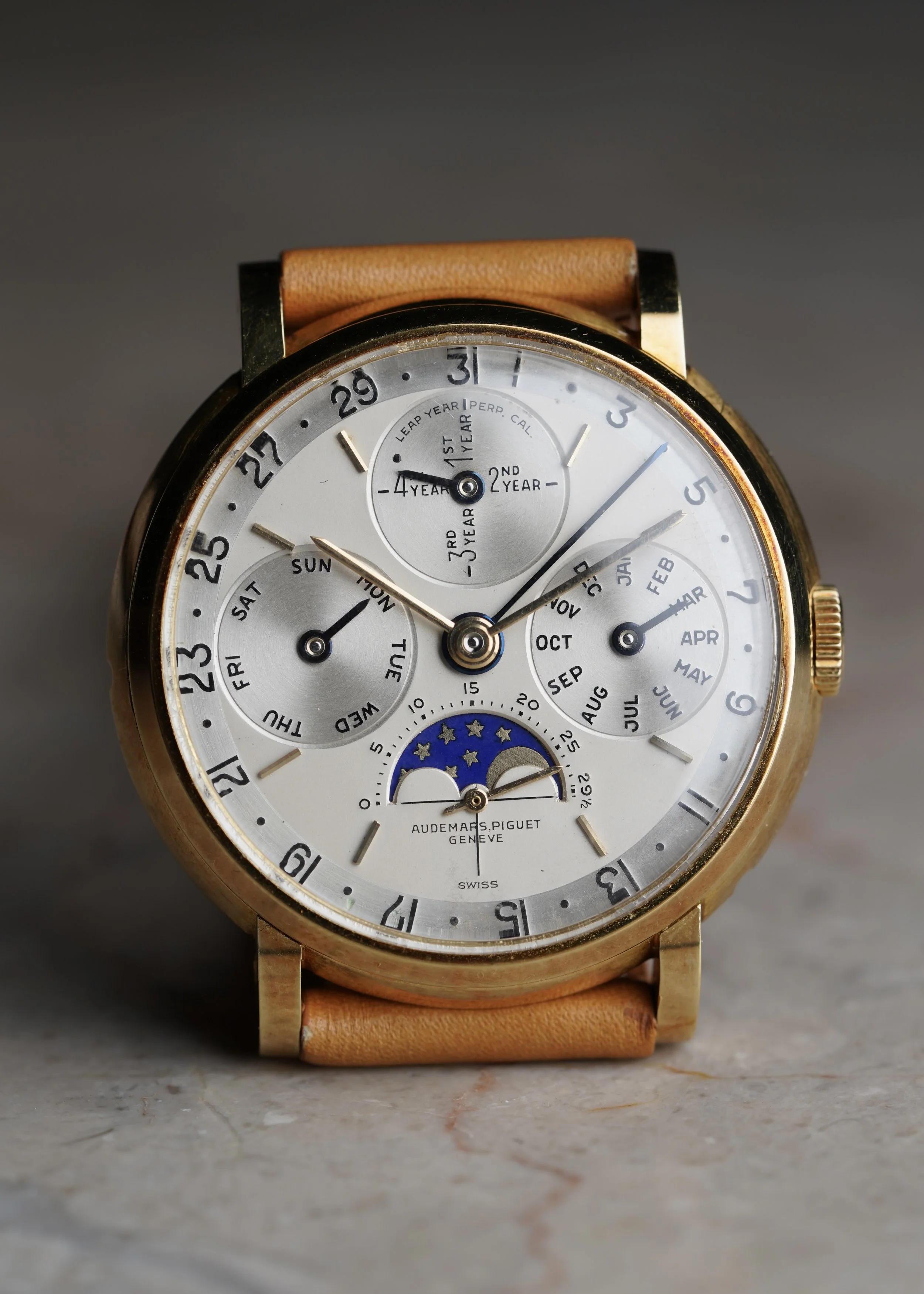
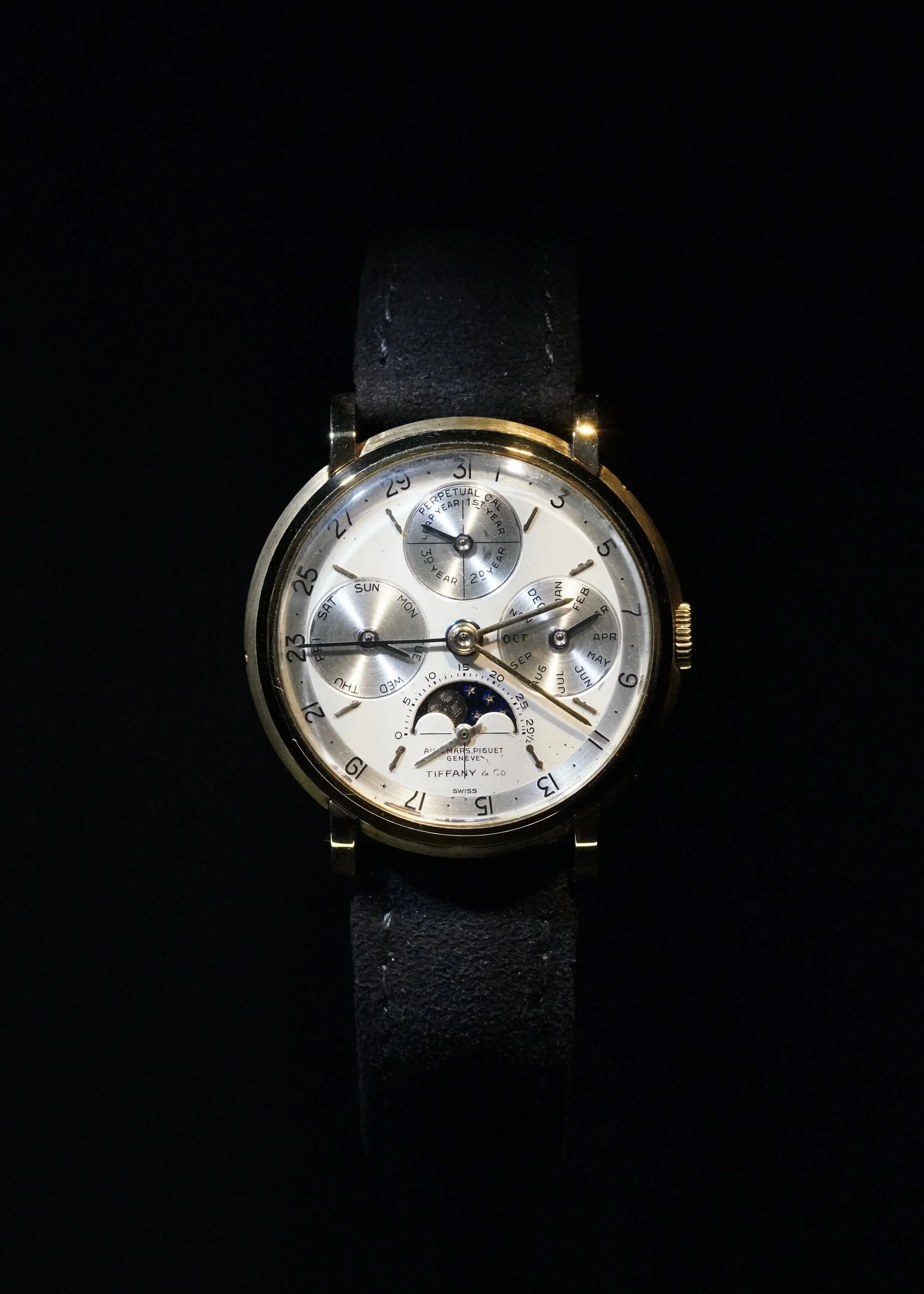
Tiffany reference 5516 in AP museum.