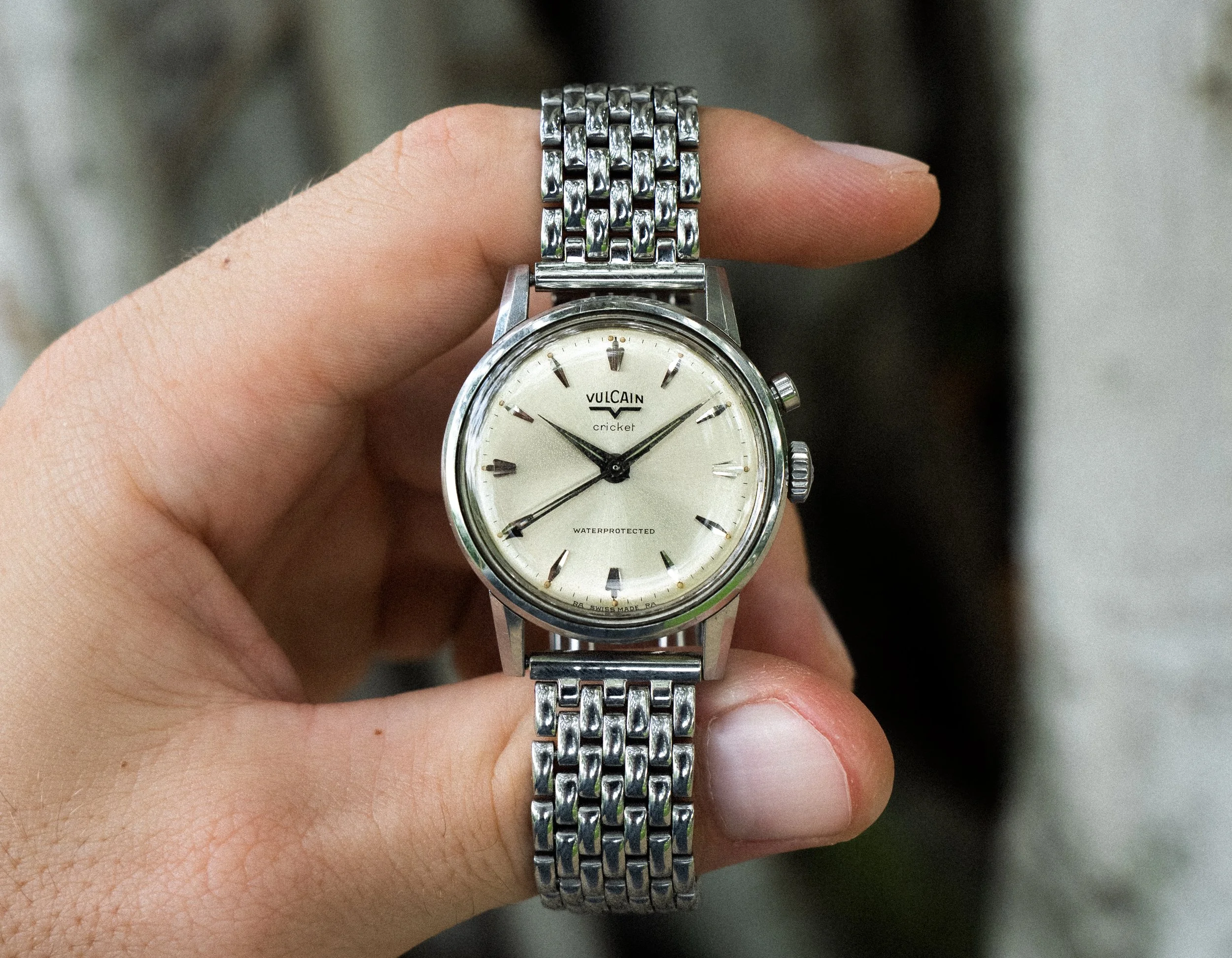
The Vulcain Cricket: My First Vintage Watch
By Mitch Clinard
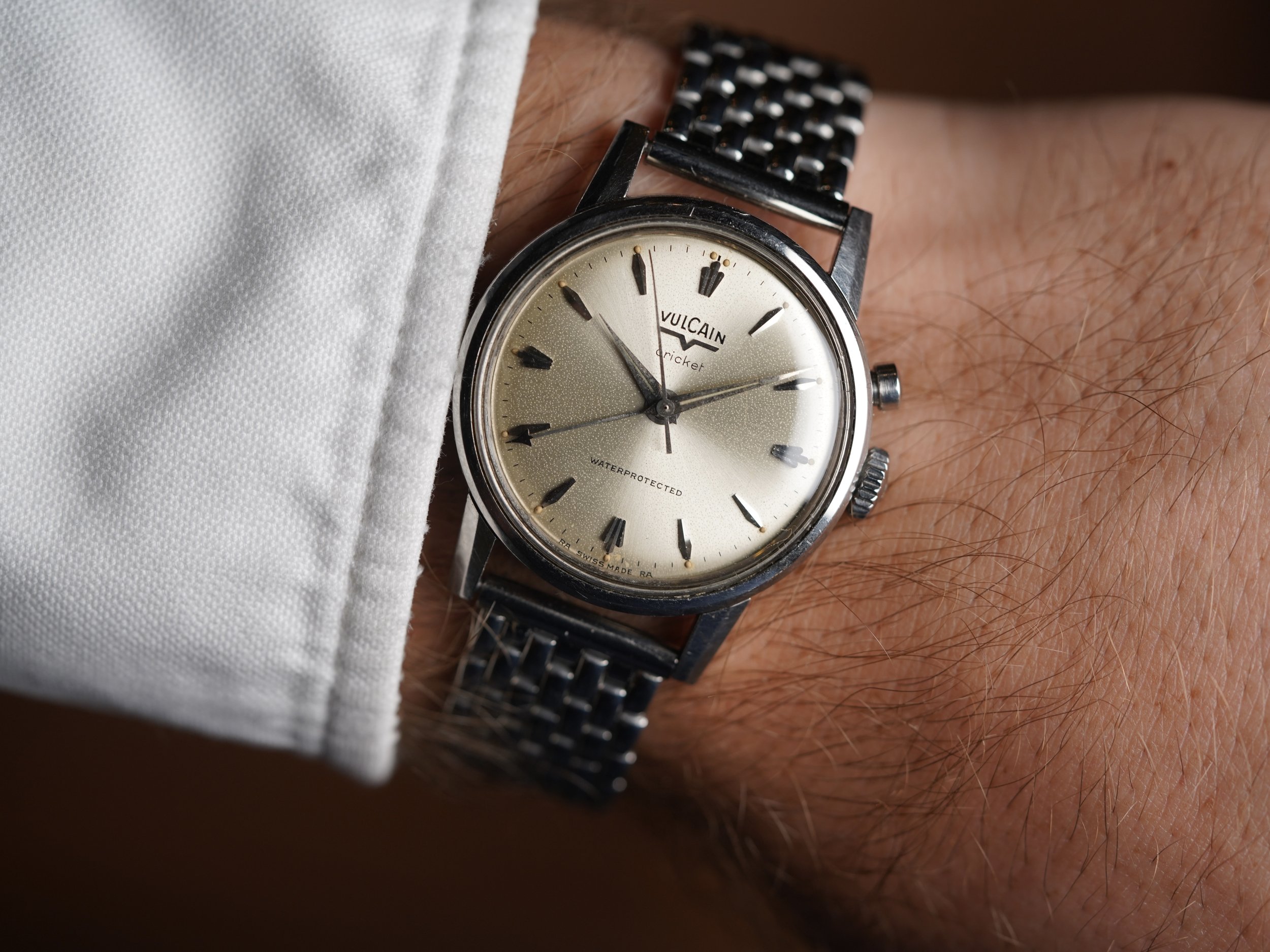
When I walked into Wind Vintage HQ just days before my 22nd birthday, I had no clue that my appreciation for vintage watches was going to change forever. That day, Eric Wind and Charlie Dunne gifted me my first vintage watch: a Vulcain Cricket.
At first glance, the proportions, the patina, and the simplicity of the dial gave the timepiece unmistakable character. As I began to learn more about the watch itself, I realized that what drew me initially was only a small part of what made it special.
The Vulcain Cricket is, at its heart, a watch built around an idea that was remarkably ambitious for its time: putting a mechanical alarm into a wristwatch and making it loud enough to be genuinely useful.
The Cricket was introduced in 1947 by the Swiss watchmaker Vulcain, following years of development toward creating a practical mechanical alarm wristwatch. Its defining feature was its movement, which incorporated two separate mainsprings; one to power the timekeeping functions and another dedicated to the alarm. This allowed the alarm to operate independently without compromising the watch’s ability to keep time.
The movement also featured a distinctive construction that helped amplify the alarm. Rather than simply producing a faint vibration inside the case, the Cricket was engineered to resonate through the watch itself, giving the alarm its characteristic sound and earning the watch its name. For a watch that can appear initially modest, the engineering behind it is anything but that.
The Cricket’s significance grew throughout the 1950s, when Vulcain began presenting the watch to U.S. presidents. Harry S. Truman was among the first to receive one, beginning a tradition that would continue with subsequent presidents including Dwight D. Eisenhower, Lyndon B. Johnson, Richard Nixon, and others. This association eventually gave the Cricket its enduring nickname: the “President’s Watch.”
What I find most fascinating about the Cricket isn’t simply its connection to presidents or its place in watchmaking history. It is the fact that its importance is so easy to miss.
These are generally on the smaller side for vintage watches. It is not a complicated dial, and no obvious indication of the mechanical ingenuity inside. Yet beneath that simplistic exterior is a piece of mid-century horological history that helped establish the mechanical alarm wristwatch as a serious and practical complication.
Before owning the Cricket, I think I was naturally drawn to vintage watches in much the same way most people are drawn to beautiful objects. I appreciated the design, the details, the imperfections that come with age. The Cricket taught me that the appreciation of a watch can extend far beyond what you see when you look down at your wrist.
A vintage watch can represent a moment in technological history. It can embody a particular approach to design or engineering. It can be evidence of how people once lived and what they once needed from the objects they carried with them every day.
In the case of the Cricket, its story is rooted in something remarkably human: the desire to make a mechanical object do more.
The watch was designed to wake its wearer, remind them of something important, and punctuate their day with a sound produced entirely through the energy stored in a tiny mechanical movement. Today, the idea of an alarm watch may seem almost quaint. We carry devices that can set dozens of alarms, reminders, and notifications without a second thought. The Cricket comes from a time when accomplishing the same simple task required an extraordinary amount of mechanical ingenuity.
That contrast is part of what makes vintage watches so fascinating to me.
The watch on my wrist is no longer just a watch, but is a reflection of the culture and technology that surrounded it.
Perhaps that is what I appreciate most about Vulcain Cricket. It taught me that the beauty of a vintage watch isn’t always found in its first impression. Sometimes, the most compelling part of a watch is the story you uncover after you’ve already fallen in love with the way it looks.
The Cricket captivated me when I first saw it, but most importantly its history is what made me truly appreciate it.
Somewhere between those two things, I began to understand why vintage watches have become so much more than objects to me. They are small, wearable pieces of history; each one carrying with it a story that often becomes more fascinating the deeper you look.
My Vulcain Cricket was the first vintage watch I ever owned, but more importantly, it was the first watch that taught me how to truly appreciate one.